The Zero Trust Maturity Model: A Vendor-Neutral Guide to Assessing and Advancing Zero Trust
Zero Trust is a strategy, not a product — and like any strategy, it needs a way to measure where you are and chart where you are going.
- Content owner
- Insyto Content Team
- Editorial reviewer
- Ritesh Mhatre
- Technical reviewer
- Navish Ansari
- Next review
- To be scheduled
- Last reviewed
- Review pending
- Technical level
- Intermediate · CISOs, security architects, IT directors
Zero Trust is a strategy, not a product — and like any strategy, it needs a way to measure where you are and chart where you are going. The Zero Trust Maturity Model provides exactly that: a structured framework for assessing an organization’s Zero Trust posture across the domains that matter and for planning a realistic path to improve it. Rather than treating Zero Trust as a binary state you either have or do not, the maturity model recognizes it as a journey with distinct stages, so every organization can locate itself honestly and advance deliberately.
This is a vendor-neutral guide. The most widely referenced model is the U.S. Cybersecurity and Infrastructure Security Agency (CISA) Zero Trust Maturity Model, with its five pillars, three cross-cutting capabilities, and four maturity stages; it complements the foundational NIST SP 800-207 architecture, the U.S. Department of Defense Zero Trust strategy, and analyst frameworks such as Forrester’s Zero Trust eXtended (ZTX). We use these standards as the backbone and reference real technologies only as examples, because the maturity model applies regardless of which platforms an organization runs.
Who should read this
- CISOs and security architects setting a Zero Trust strategy
- Zero Trust program leaders measuring and reporting progress
- IT and security leaders building a multi-year roadmap
- Risk and compliance leaders aligning to Zero Trust mandates
Key points for executives
A useful maturity assessment normally rests on four ideas:
- Zero Trust is measured across multiple pillars, not as a single control — an organization can be mature in one and immature in another.
- Maturity is staged — Traditional, Initial, Advanced, and Optimal — so progress is incremental and measurable.
- Cross-cutting capabilities (visibility, automation, and governance) mature alongside every pillar.
- The model is a planning tool: assess honestly, prioritize by risk, and advance one stage at a time.
The maturity model turns Zero Trust from an aspiration into a measurable program. For a control-level identity checklist that feeds it, see the Identity Security Assessment Checklist.
Executive takeaways
- The maturity model assesses Zero Trust across five pillars and three cross-cutting capabilities.
- Four stages — Traditional, Initial, Advanced, Optimal — describe increasing automation and rigor.
- Organizations are typically uneven, more mature in some pillars than others.
- Use the model to baseline, prioritize by risk, and build a multi-year roadmap.
- It is standards-based and vendor-neutral, applicable to any technology stack.
What is the Zero Trust Maturity Model?
The model decomposes Zero Trust into five pillars — the domains where controls are applied — supported by three cross-cutting capabilities that span all of them. Each pillar and capability is then assessed against maturity stages, giving a multidimensional picture of posture rather than a single score.
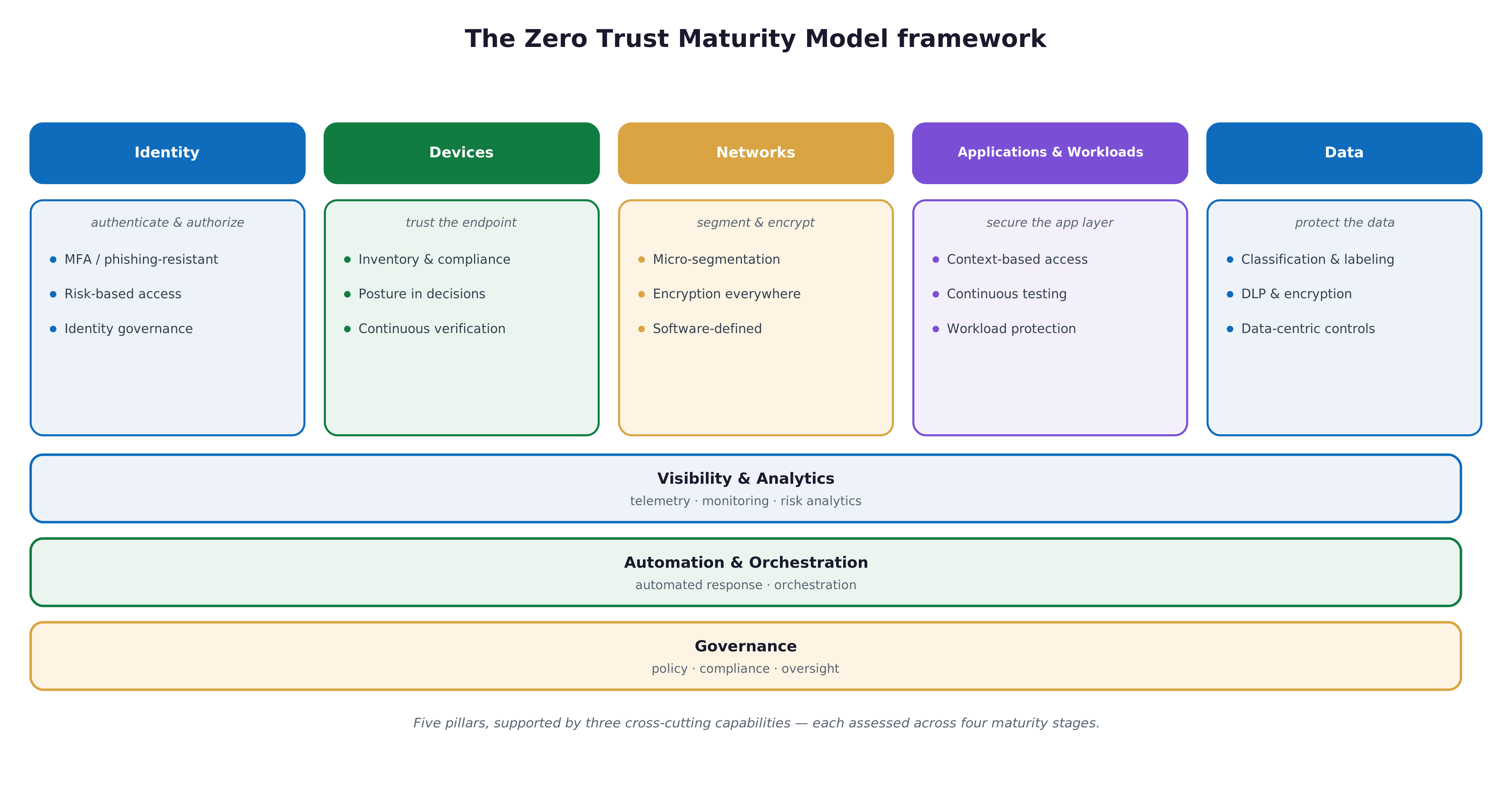
Figure 1. The Zero Trust Maturity Model framework — five pillars supported by three cross-cutting capabilities.
Diagram description: The Zero Trust Maturity Model has five pillars — Identity (authenticate and authorize: MFA/phishing-resistant, risk-based access, identity governance), Devices (trust the endpoint: inventory and compliance, posture in decisions, continuous verification), Networks (segment and encrypt: micro-segmentation, encryption everywhere, software-defined), Applications and Workloads (secure the app layer: context-based access, continuous testing, workload protection), and Data (protect the data: classification and labeling, DLP and encryption, data-centric controls) — supported by three cross-cutting capabilities: Visibility and Analytics, Automation and Orchestration, and Governance. Each is assessed across four maturity stages.
Table 1. The five Zero Trust pillars.
| Pillar | What it secures |
|---|---|
| Identity | Authentication and authorization of users and entities |
| Devices | Trust and posture of endpoints and hardware |
| Networks | Segmentation, encryption, and traffic controls |
| Applications & Workloads | Secure access to and protection of applications |
| Data | Classification, protection, and governance of data |
What are the four maturity stages?
Maturity progresses through four stages that describe a steady shift from manual, static, perimeter-based controls to dynamic, automated, continuously verified ones.
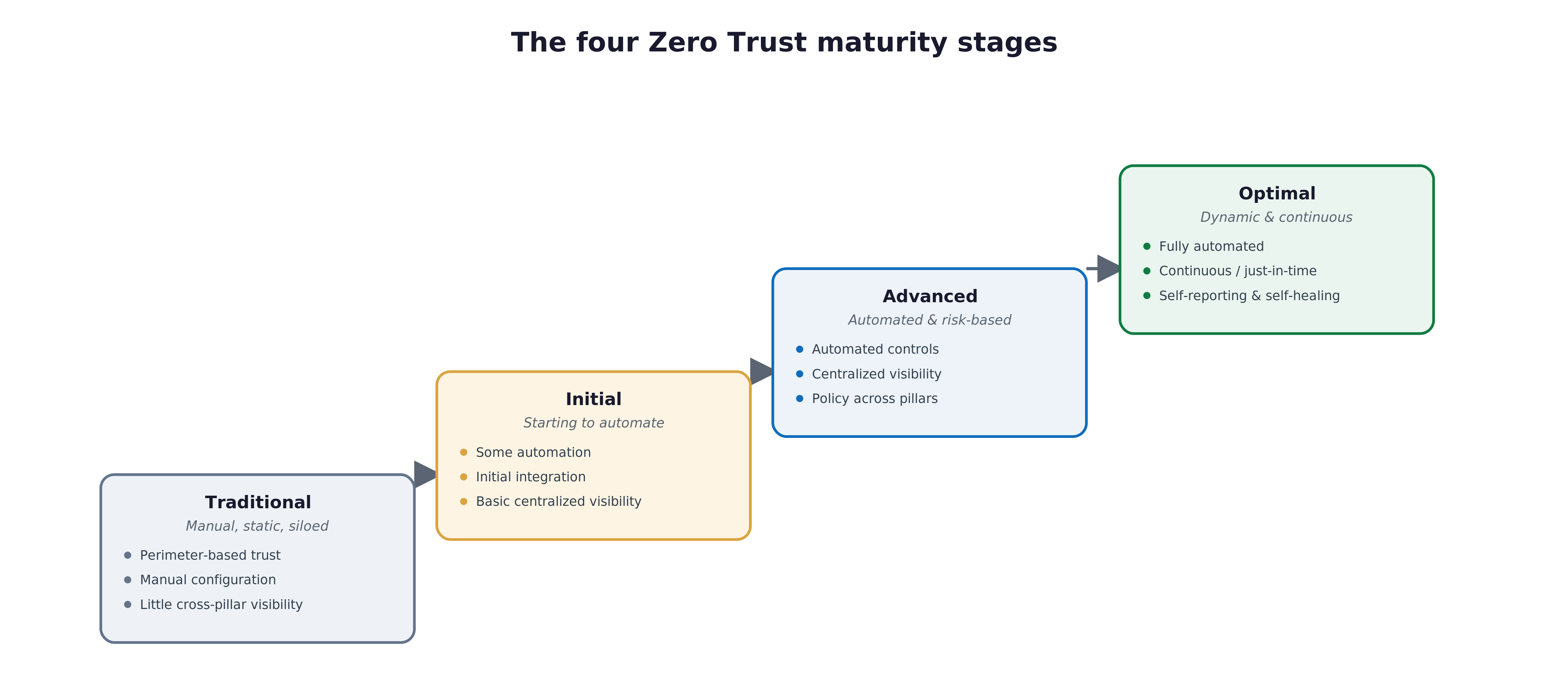
Figure 2. The four Zero Trust maturity stages — Traditional, Initial, Advanced, and Optimal.
Diagram description: The four maturity stages rise in capability: Traditional (manual, static, siloed — perimeter-based trust, manual configuration, little cross-pillar visibility); Initial (starting to automate — some automation, initial integration, basic centralized visibility); Advanced (automated and risk-based — automated controls, centralized visibility, policy across pillars); and Optimal (dynamic and continuous — fully automated, continuous and just-in-time, self-reporting and self-healing).
Table 2. The four maturity stages.
| Stage | Characteristics |
|---|---|
| Traditional | Manual configuration, static policies, siloed tools, perimeter trust |
| Initial | Some automation, initial cross-pillar integration, basic central visibility |
| Advanced | Automated controls, centralized visibility, risk-based policy across pillars |
| Optimal | Fully automated, dynamic and continuous, just-in-time, self-healing |
How do the pillars evolve across stages?
The real value of the model is seeing how each pillar changes as it matures. The matrix below maps the five pillars against the four stages, giving a concrete picture of what “more mature” looks like in each domain — and a shared vocabulary for assessment.
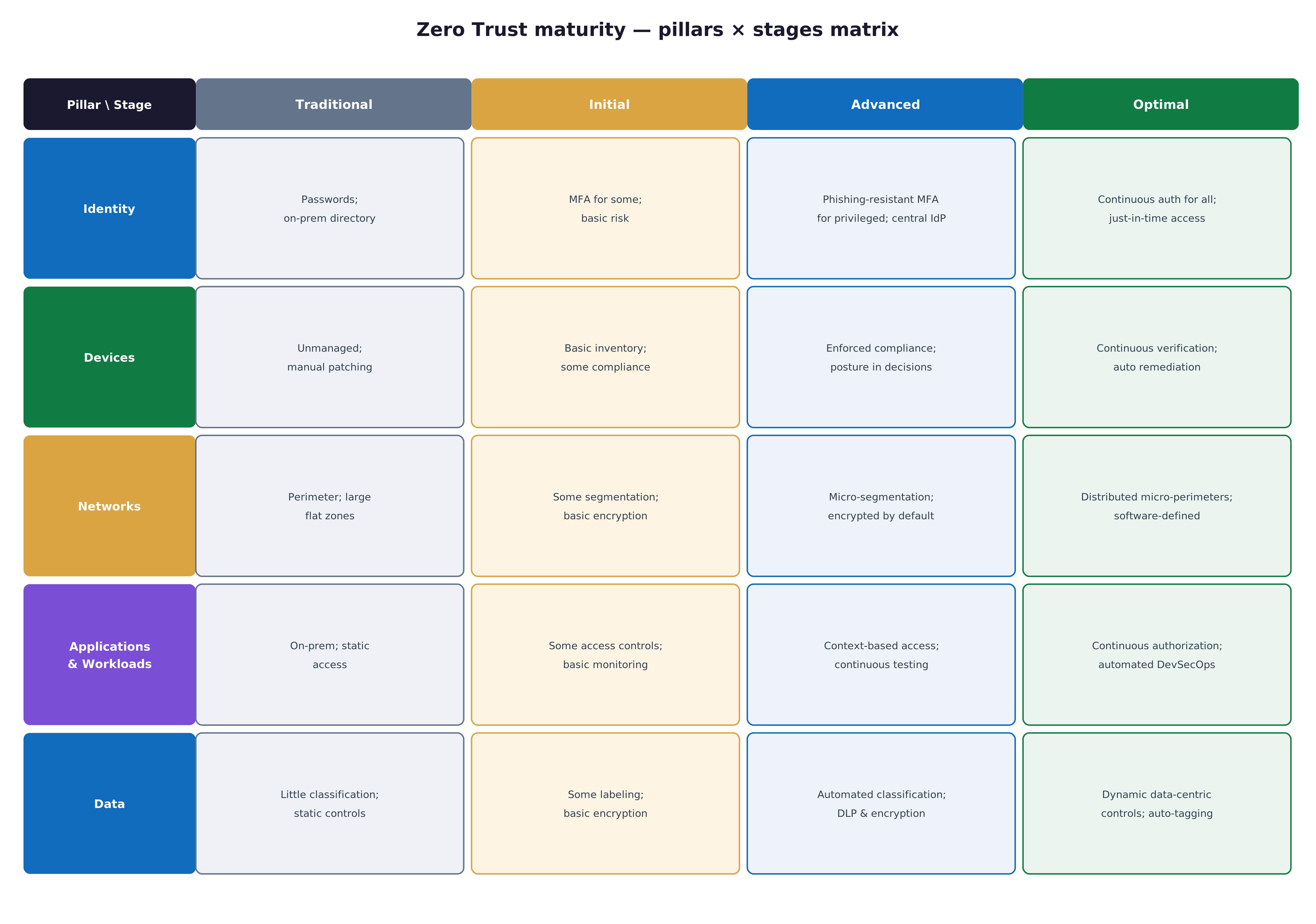
Figure 3. The Zero Trust maturity matrix — each pillar assessed across the four stages.
Diagram description: A matrix of the five pillars against the four maturity stages. Identity: Traditional (passwords, on-prem directory), Initial (MFA for some, basic risk), Advanced (phishing-resistant MFA for privileged, central IdP), Optimal (continuous auth for all, just-in-time access). Devices: Traditional (unmanaged, manual patching), Initial (basic inventory, some compliance), Advanced (enforced compliance, posture in decisions), Optimal (continuous verification, auto remediation). Networks: Traditional (perimeter, large flat zones), Initial (some segmentation, basic encryption), Advanced (micro-segmentation, encrypted by default), Optimal (distributed micro-perimeters, software-defined). Applications and Workloads: Traditional (on-prem, static access), Initial (some access controls, basic monitoring), Advanced (context-based access, continuous testing), Optimal (continuous authorization, automated DevSecOps). Data: Traditional (little classification, static controls), Initial (some labeling, basic encryption), Advanced (automated classification, DLP and encryption), Optimal (dynamic data-centric controls, auto-tagging).
Reading the matrix by row shows a pillar’s roadmap; reading it by column shows what a given stage looks like across the whole estate. Most organizations sit at different stages in different pillars — which is expected, and is exactly what the model is designed to reveal.
What are the cross-cutting capabilities?
Three capabilities are not pillars in their own right but underpin all of them, and they mature in step with the pillars. Without them, per-pillar controls cannot reach the Advanced or Optimal stages.
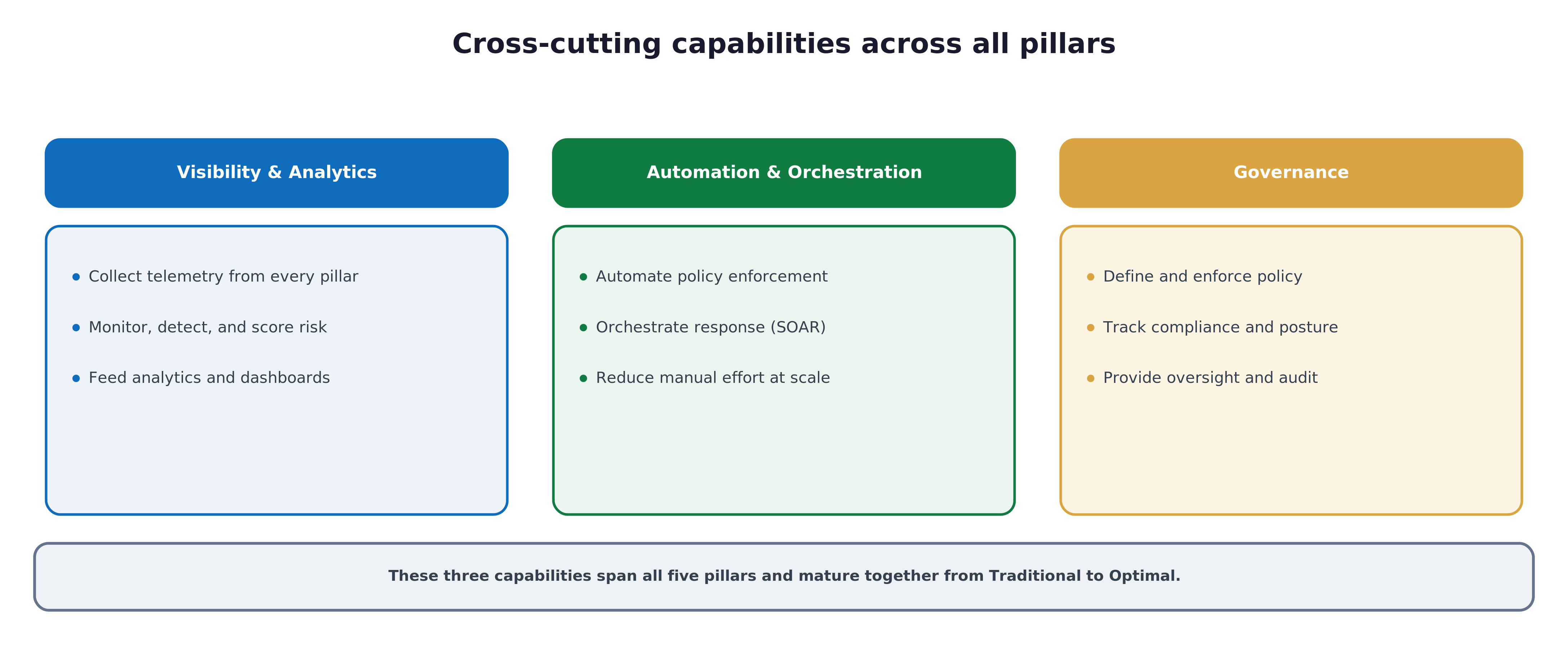
Figure 4. The three cross-cutting capabilities — visibility, automation, and governance — span every pillar.
Diagram description: Three cross-cutting capabilities span all five pillars. Visibility and Analytics collects telemetry from every pillar, monitors and scores risk, and feeds analytics and dashboards. Automation and Orchestration automates policy enforcement, orchestrates response (SOAR), and reduces manual effort at scale. Governance defines and enforces policy, tracks compliance and posture, and provides oversight and audit. All three mature together from Traditional to Optimal.
Table 3. The cross-cutting capabilities.
| Capability | Role |
|---|---|
| Visibility & Analytics | Telemetry, monitoring, risk analytics across all pillars |
| Automation & Orchestration | Automated enforcement and response; SOAR |
| Governance | Policy definition, compliance tracking, and oversight |
How do you assess and advance maturity?
The model is a program tool. Use it to baseline honestly, prioritize by risk and effort, and advance deliberately — pillar by pillar, one stage at a time — then re-measure.

Figure 5. Assessing and advancing maturity — a continuous cycle of assess, gap, prioritize, advance, and reassess.
Diagram description: Advancing maturity is a continuous cycle: Assess (score each pillar), Gap (find the shortfalls), Prioritize (by risk and effort), Advance (move up a stage), and Reassess (measure progress).
Table 4. An assessment approach.
| Step | Focus |
|---|---|
| 1 · Assess | Score each pillar and capability against the stages |
| 2 · Gap | Identify where you fall short of your target stage |
| 3 · Prioritize | Sequence improvements by risk reduction and effort |
| 4 · Advance | Implement changes to move a pillar up a stage |
| 5 · Reassess | Re-score, report progress, and set the next target |
Best practice. Do not aim for “Optimal everywhere” on day one. Set a realistic target stage per pillar based on your risk profile — many enterprises target Advanced for identity and data first — and advance the highest-risk, lowest-friction gaps before the rest. Report maturity by pillar to executives so investment tracks to measurable progress.
How does the maturity model relate to other frameworks?
The maturity model does not replace foundational Zero Trust guidance; it operationalizes it. Understanding how the major references fit together helps teams use each for its strength.
Table 5. Zero Trust frameworks at a glance.
| Framework | Contribution |
|---|---|
| NIST SP 800-207 | The foundational Zero Trust architecture and tenets |
| CISA Zero Trust Maturity Model | Pillars, capabilities, and staged maturity for assessment |
| U.S. DoD Zero Trust strategy | Detailed pillars, capabilities, and target activities |
| Forrester ZTX | An analyst framework spanning people, data, and workloads |
Vendor Zero Trust guidance — such as Microsoft’s Zero Trust deployment plans or the reference architectures from network and identity vendors — implements these frameworks with specific products, and can be mapped back to the maturity model to show coverage.
Best practices
- Assess all five pillars and the three cross-cutting capabilities, not just identity.
- Expect uneven maturity; measure each pillar independently.
- Set a target stage per pillar aligned to your risk, not a blanket “Optimal.”
- Invest in visibility, automation, and governance — they gate pillar maturity.
- Prioritize the highest-risk, lowest-friction gaps first.
- Advance incrementally and re-measure on a cadence.
- Report maturity to executives to align funding with progress.
- Map vendor Zero Trust guidance back to the model to confirm coverage.
Common mistakes
- Treating Zero Trust as binary. Maturity is staged, not on/off.
- Assessing only identity. All five pillars matter; gaps hide in the others.
- Chasing ****“Optimal” ****everywhere at once. It is costly and rarely risk-justified.
- Ignoring cross-cutting capabilities. Without visibility and automation, pillars stall.
- No baseline or cadence. Progress you do not measure you cannot manage.
- Framework confusion. Use NIST for architecture and the maturity model for assessment.
- Tool-first thinking. Buy to close an assessed gap, not to chase a label.
Assessment checklist
Before considering your maturity assessment complete, confirm that:
- All five pillars have been scored against the four stages
- The three cross-cutting capabilities have been scored
- A target maturity stage is defined per pillar, aligned to risk
- Gaps between current and target stages are documented
- Improvements are prioritized by risk reduction and effort
- A multi-year roadmap sequences the work
- Progress is reported to executives by pillar
- The assessment is repeated on a defined cadence
- Vendor Zero Trust guidance is mapped to the model
- Foundational architecture (NIST SP 800-207) informs the design
Frequently asked questions
What is the Zero Trust Maturity Model?
It is a framework for assessing and improving Zero Trust across five pillars (Identity, Devices, Networks, Applications & Workloads, Data) and three cross-cutting capabilities (Visibility & Analytics, Automation & Orchestration, Governance), measured across four maturity stages.
What are the four maturity stages?
Traditional (manual, static, perimeter-based), Initial (some automation and integration), Advanced (automated, risk-based, centrally visible), and Optimal (dynamic, continuous, self-healing).
Is this a Microsoft or single-vendor model?
No. The most referenced version is CISA’s, and it aligns with NIST SP 800-207, the DoD Zero Trust strategy, and Forrester ZTX. It is vendor-neutral and applies to any technology stack.
Do we need to reach ****“Optimal” ****in every pillar?
Not necessarily. Set a target stage per pillar based on your risk profile. Many organizations target Advanced for their highest-value pillars and progress the rest over time.
How do the cross-cutting capabilities fit in?
Visibility & Analytics, Automation & Orchestration, and Governance underpin every pillar and mature alongside them; they are prerequisites for reaching Advanced and Optimal.
How is this different from NIST SP 800-207?
NIST SP 800-207 defines the Zero Trust architecture and tenets; the maturity model operationalizes them into pillars, capabilities, and stages you can assess and improve against.
How often should we reassess?
Treat it as continuous — baseline now, report by pillar, and re-score on a regular cadence (for example, semi-annually) or after major changes.
Key takeaways
- The maturity model assesses Zero Trust across five pillars and three cross-cutting capabilities.
- Four stages describe the shift from manual and static to dynamic and continuous.
- Organizations are typically uneven; measure each pillar independently.
- Set risk-based target stages and advance incrementally, then reassess.
- It is standards-based and vendor-neutral — apply it to any stack.
Summary
The Zero Trust Maturity Model makes Zero Trust measurable. By assessing five pillars — identity, devices, networks, applications and workloads, and data — plus the cross-cutting capabilities of visibility, automation, and governance, and by placing each on a four-stage path from Traditional to Optimal, it turns a broad strategy into a concrete, prioritized roadmap. The winning approach is honest and incremental: baseline where you are, set risk-based targets per pillar, invest in the cross-cutting capabilities that unlock progress, and advance the highest-value gaps first — then re-measure and report. Anchored in standards and independent of any vendor, the model is the compass for a multi-year Zero Trust program.
Organizations can begin with the Data & AI Readiness Checklist, review the Microsoft 365 Governance Knowledge Center, or schedule a technology assessment.
Authoritative references
Verified against publicly available standards and government guidance. Source access date: 23 July 2026. Frameworks evolve — confirm the current version before use.
- CISA: Zero Trust Maturity Model
- CISA: Zero Trust Maturity Model v2.0 (PDF)
- NIST SP 800-207: Zero Trust Architecture
- NIST SP 1800-35: Implementing a Zero Trust Architecture
- U.S. Department of Defense: Zero Trust Strategy
- CISA: Applying Zero Trust Principles to Enterprise Mobility
- OMB M-22-09: Federal Zero Trust Strategy
- Federal Zero Trust Resource Hub
- Forrester: The Zero Trust eXtended (ZTX) Ecosystem
- The Open Group: Zero Trust reference model
- Microsoft: Zero Trust deployment plan with Microsoft 365
- Cloud Security Alliance: Zero Trust guidance
Frameworks and their versions change over time. Confirm the current guidance from the issuing body before making design or investment decisions.
Related Knowledge Center resources
- Identity Security Assessment Checklist — Control-level identity assessment.
- Enterprise Identity Protection — Detect and respond to identity threats.
- Passwordless Authentication — Advancing the identity pillar.
- Zero Trust for Microsoft 365 — A vendor implementation mapped to the model.
- Microsoft 365 Tenant Security Assessment Checklist — Tenant posture.
On this page
- Key points for executives
- Executive takeaways
- What is the Zero Trust Maturity Model?
- What are the four maturity stages?
- How do the pillars evolve across stages?
- What are the cross-cutting capabilities?
- How do you assess and advance maturity?
- How does the maturity model relate to other frameworks?
- Best practices
- Common mistakes
- Assessment checklist
- Frequently asked questions
- Summary
- Authoritative references
- Related Knowledge Center resources