Identity Protection: Detecting and Stopping Identity-Based Attacks (ITDR)
Identity is now the primary attack surface of the enterprise.
- Content owner
- Insyto Content Team
- Editorial reviewer
- Ritesh Mhatre
- Technical reviewer
- Navish Ansari
- Next review
- To be scheduled
- Last reviewed
- Review pending
- Technical level
- Intermediate · CISOs, IT directors, identity administrators
Identity is now the primary attack surface of the enterprise. Attackers no longer break in — they log in, using stolen credentials, phished sessions, and abused privileges to reach data without ever tripping a traditional network control. Enterprise identity protection is the discipline of defending the entire identity fabric against this reality: continuously detecting identity-based risk and threats, responding adaptively before they escalate, and proactively shrinking the identity attack surface. It is delivered through two complementary capabilities — Identity Threat Detection and Response (ITDR) and Identity Security Posture Management (ISPM) — and it is a foundational pillar of Zero Trust.
This is a vendor-neutral guide. Identity protection is a cross-platform architecture, not a single product. We use real enterprise technologies as examples throughout — from identity providers such as Microsoft Entra ID, Okta, Ping Identity, and Google Cloud Identity, to ITDR and directory-defense tools from CrowdStrike, Microsoft, Silverfort, Semperis, and others, to governance (SailPoint, Saviynt), privileged access (CyberArk, Delinea, BeyondTrust, One Identity), and strong-authentication vendors (Cisco Duo, RSA, Beyond Identity, YubiKey, HID, and the FIDO Alliance ecosystem). The goal is an identity protection strategy that works regardless of which platforms you standardize on, and that compares approaches rather than promoting one.
Who should read this
- CISOs and security operations (SOC) leaders
- IAM, PAM, and identity-governance architects and engineers
- Incident responders investigating account and identity compromise
- Enterprise architects designing Zero Trust identity security
Key points for executives
A defensible enterprise identity protection program normally rests on four conditions:
- Identity is treated as a monitored attack surface — signals from across the identity fabric are collected and analyzed continuously.
- Threats are detected and responded to (ITDR) — risky sign-ins, account takeover, and privilege abuse trigger adaptive, automated response.
- The attack surface is proactively reduced (ISPM) — standing privilege, misconfiguration, and stale accounts are found and fixed.
- Identity protection is integrated with the SOC — feeding and correlating with SIEM, SOAR, and XDR for coordinated response.
Identity protection operationalizes Zero Trust’s “assume breach” principle. To baseline your posture first, see the Identity Security Assessment Checklist.
Executive takeaways
- Most breaches now begin with a compromised identity, not a network intrusion.
- ITDR detects and responds to identity threats in real time; ISPM prevents them proactively.
- Effective identity protection correlates signals across IdPs, directories, endpoints, SaaS, and PAM.
- Response should be adaptive and automated — step up, isolate, or revoke based on risk.
- It is vendor-agnostic: build the architecture first, then choose platforms to fill it.
Why is identity the primary attack surface?
Three shifts made identity the front line. Work moved outside the network perimeter, so a valid credential — not a network foothold — is what grants access. Cloud and SaaS multiplied the number of identity systems and the ways to abuse them. And attackers industrialized credential theft: phishing kits, adversary-in-the-middle proxies, infostealer malware, and credential marketplaces make stolen identities cheap and plentiful. The result is that identity is both the most-attacked and the least-monitored layer in many organizations — powerful directories and identity providers often lack the same detection and response maturity long applied to endpoints and networks.
What does an identity attack look like?
Identity-based attacks follow a recognizable lifecycle. Understanding it shows where detection and response must apply — ideally as early as possible, before the attacker reaches privilege and moves laterally.

Figure 1. The identity attack lifecycle — from reconnaissance to persistence, each stage is an opportunity to detect and respond.
Diagram description: The identity attack lifecycle runs through six stages: reconnaissance (find users and entry points), credential theft (phishing, password spray, adversary-in-the-middle), account takeover (a valid session is gained), privilege escalation (reach administrative rights), lateral movement (pivot across systems), and persistence (stay hidden). Enterprise identity protection aims to detect and disrupt the chain as early as possible.
Many of these stages map to well-documented techniques in the MITRE ATT&CK framework — credential access, valid accounts, and directory attacks such as Kerberoasting, DCSync, and forged tickets — which gives defenders a shared language for detection coverage.
What is Identity Threat Detection and Response (ITDR)?
ITDR is the reactive half of identity protection: a set of capabilities that continuously detect identity-based threats and enable rapid response. Where endpoint detection and response (EDR) watches endpoints and network detection watches traffic, ITDR watches identities — sign-ins, sessions, directory changes, privilege use, and token activity — and correlates them to spot compromise. It emerged as a defined discipline because attackers increasingly bypass endpoint and network controls entirely by using legitimate identities.
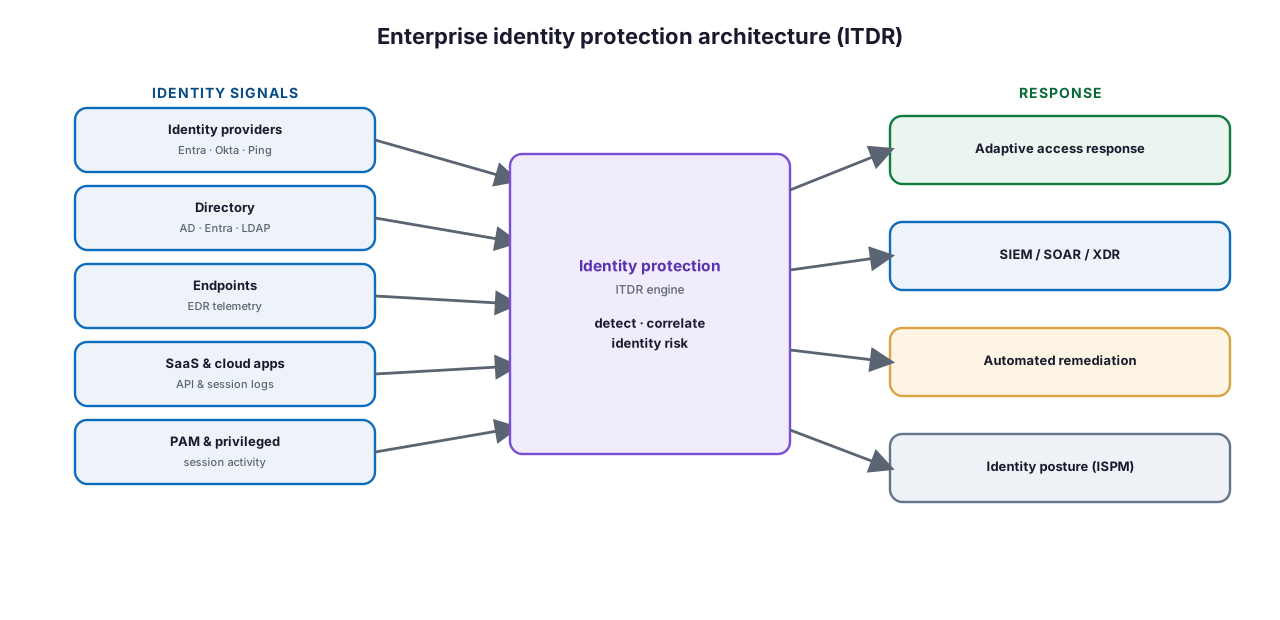
Figure 2. An enterprise identity protection (ITDR) architecture — identity signals correlated into risk, driving adaptive response and SOC integration.
Diagram description: An enterprise identity protection architecture collects identity signals from identity providers (such as Microsoft Entra ID, Okta, and Ping), directories (Active Directory, Entra, LDAP), endpoints (EDR telemetry), SaaS and cloud apps (API and session logs), and PAM and privileged sessions. An identity protection / ITDR engine detects and correlates identity risk, and produces response: adaptive access response, integration with SIEM / SOAR / XDR, automated remediation, and identity posture management (ISPM).
Table 1. Common identity risk detections.
| Category | Example detections |
|---|---|
| Credential compromise | Leaked/breached credentials, password spray, brute force |
| Phishing & session theft | Adversary-in-the-middle, token/cookie replay, MFA fatigue |
| Anomalous access | Impossible travel, anonymous IP, unfamiliar device or location |
| Directory attacks | Kerberoasting, DCSync, forged tickets, risky changes |
| Privilege abuse | Unexpected elevation, dormant admin activation, lateral movement |
| Behavioral anomalies (UEBA) | Deviation from a user’s normal activity baseline |
How does risk-based adaptive response work?
Detection is only valuable if it drives action. Modern identity protection scores risk continuously and responds proportionately — allowing low-risk access with minimal friction, stepping up verification when risk rises, and containing or revoking access when compromise is likely.
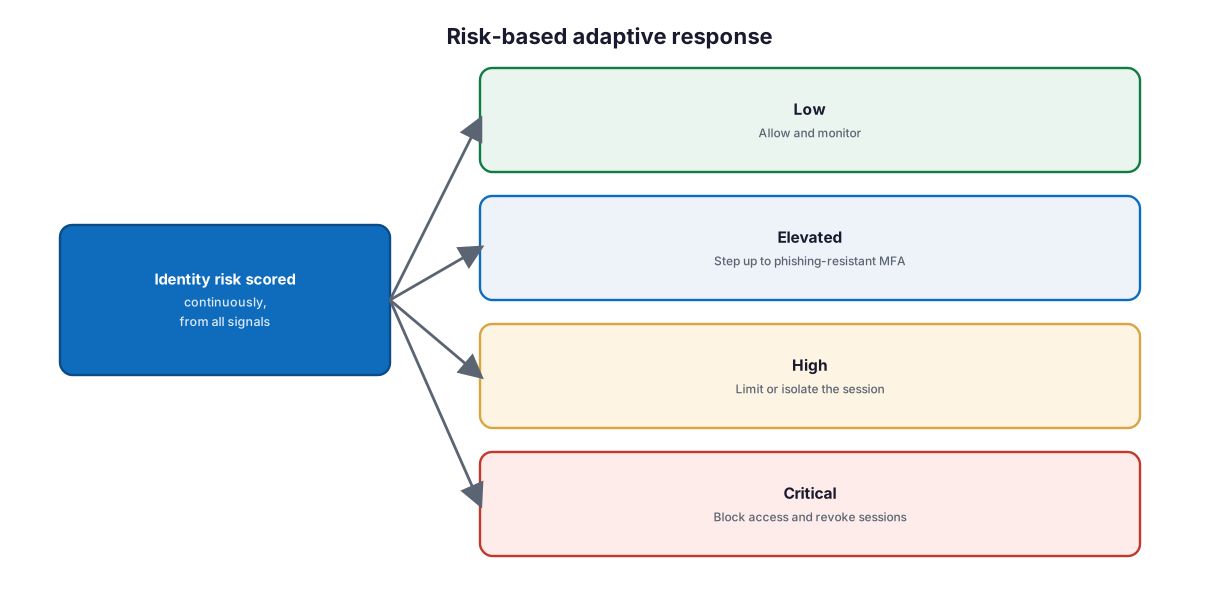
Figure 3. Risk-based adaptive response — the control scales with the identity risk score.
Diagram description: Identity risk is scored continuously from all signals, and the response scales with it: low risk allows access and monitors; elevated risk steps up to phishing-resistant MFA; high risk limits or isolates the session; and critical risk blocks access and revokes active sessions.
Critically, response should reach into active sessions, not just new logins. Session revocation and continuous access evaluation let an identity protection system terminate an attacker’s stolen session the moment risk is confirmed — closing the gap that token theft exploits. Automated response through SOAR playbooks (disable account, force password reset, revoke sessions, open a case) is what lets a SOC keep pace with the speed of identity attacks.
What is Identity Security Posture Management (ISPM)?
ITDR catches attacks in progress; ISPM stops many of them from being possible. ISPM is the proactive half of identity protection — continuously assessing the identity attack surface and reducing it: eliminating standing privilege, finding and fixing misconfigurations and stale or orphaned accounts, hardening directories and identity providers, and closing the gaps attackers exploit. Together, posture management and threat response form a defense-in-depth model for identity.
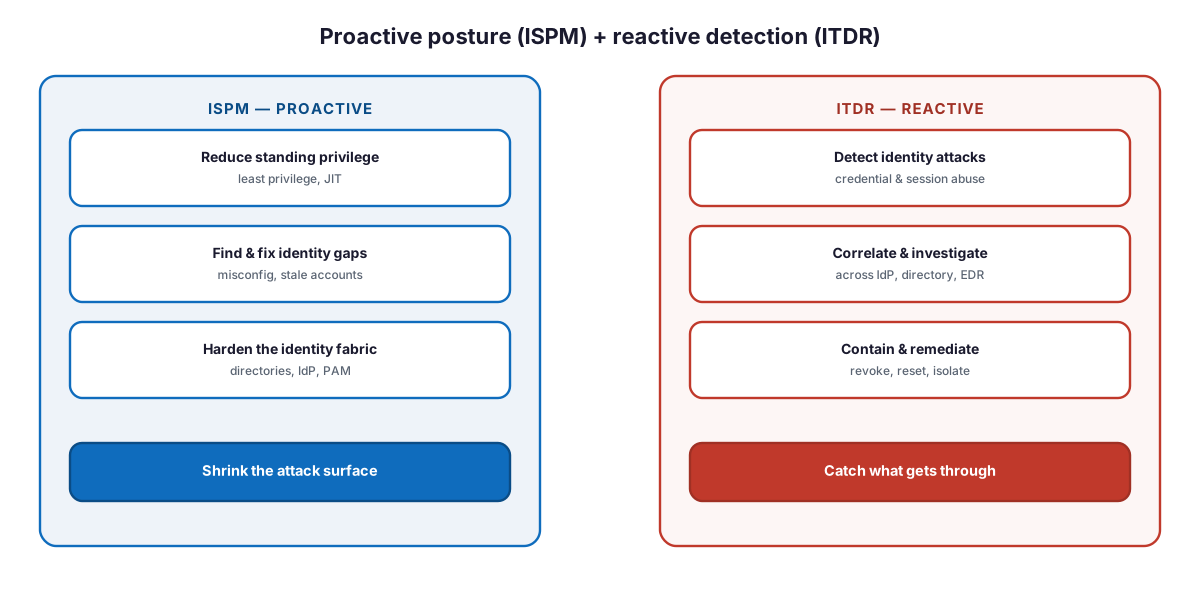
Figure 4. ISPM and ITDR are complementary — proactive posture reduction plus reactive detection and response.
Diagram description: Identity Security Posture Management (ISPM) is proactive: reduce standing privilege (least privilege, just-in-time), find and fix identity gaps (misconfigurations, stale accounts), and harden the identity fabric (directories, IdPs, PAM) — shrinking the attack surface. Identity Threat Detection and Response (ITDR) is reactive: detect identity attacks (credential and session abuse), correlate and investigate across IdP, directory, and EDR, and contain and remediate (revoke, reset, isolate) — catching what gets through. The two together deliver defense in depth.
How does identity protection fit Zero Trust?
Zero Trust rests on verify explicitly, use least privilege, and assume breach. Identity protection delivers the last principle at the identity layer: it assumes any identity may be compromised and continuously verifies. It also reinforces the others — its risk signals feed the adaptive, explicit verification of access policies, and its posture management enforces least privilege. In a mature Zero Trust architecture, identity protection is the sensor-and-response layer that makes the whole model self-correcting.
What does the vendor landscape look like?
No single platform delivers complete identity protection; enterprises assemble it. The categories below map the market so architects can build coverage without lock-in, and compare approaches on their merits.
Table 2. The enterprise identity protection landscape.
| Category | Representative technologies | Focus |
|---|---|---|
| IdP-native risk & protection | Microsoft Entra ID Protection, Okta Identity Threat Protection, PingOne Protect | Risk scoring and response inside the identity provider |
| Dedicated ITDR / directory defense | CrowdStrike Falcon Identity Protection, Microsoft Defender for Identity, Silverfort, Semperis, SentinelOne Singularity Identity | Detect attacks on directories and identities across the estate |
| Identity governance (IGA / ISPM) | SailPoint, Saviynt, One Identity | Posture, least privilege, access reviews, lifecycle |
| Privileged access (PAM) | CyberArk, Delinea, BeyondTrust | Protect and monitor privileged sessions |
| Strong authentication / MFA | Cisco Duo, RSA, Beyond Identity, YubiKey, HID, FIDO2 | Reduce credential and phishing risk at the source |
| SIEM / SOAR / XDR | Vendor-agnostic SOC platforms | Correlate identity signals; automate response |
The practical guidance is to define the architecture — signal sources, a correlation and risk layer, and automated response integrated with the SOC — and then select platforms to fill each role, favoring open integration (standards, APIs, and shared telemetry) so components remain interchangeable.
How do you build an identity protection program?
Identity protection is a program, not a purchase. A phased approach builds coverage and confidence without overwhelming the SOC.

Figure 5. An identity protection program roadmap — assess, instrument, detect, respond, and govern.
Diagram description: A five-phase identity protection program: Assess (identity posture and attack surface), Instrument (collect signals from IdPs, directories, EDR, and SaaS), Detect (score identity risk and threats), Respond (adaptive access and automated remediation), and Govern (continuous review and improvement).
Table 3. Program phases.
| Phase | Focus |
|---|---|
| 1 · Assess | Map the identity estate, posture, and attack surface |
| 2 · Instrument | Collect signals from IdPs, directories, endpoints, SaaS, and PAM |
| 3 · Detect | Score identity risk and detect threats and anomalies |
| 4 · Respond | Enforce adaptive access; automate remediation via SOAR |
| 5 · Govern | Review coverage, tune detections, and reduce posture gaps |
Which standards and frameworks apply?
Table 4. Standards and frameworks for identity protection.
| Framework | Relevance |
|---|---|
| MITRE ATT&CK | Techniques for credential access, valid accounts, and directory attacks |
| NIST SP 800-63 / Zero Trust (SP 800-207) | Identity assurance and Zero Trust architecture |
| CISA guidance | Phishing-resistant MFA and identity-attack mitigations |
| ISO/IEC 27001, SOC 2 | Access control and monitoring requirements |
Best practices
- Treat identity as a monitored attack surface with the same rigor as endpoints and networks.
- Combine ITDR (detection and response) with ISPM (posture reduction) — not one or the other.
- Correlate signals across IdPs, directories, endpoints, SaaS, and PAM, not in silos.
- Make response adaptive and automated; revoke sessions, not just block new logins.
- Reduce standing privilege and enforce least privilege and just-in-time access.
- Harden and monitor the directory and identity providers themselves.
- Integrate identity protection with the SOC (SIEM, SOAR, XDR) for coordinated response.
- Prefer phishing-resistant authentication to remove credential risk at the source.
- Choose interoperable, standards-based tools to avoid lock-in.
Common mistakes
- Monitoring endpoints but not identities. The directory and IdP are prime targets and often blind spots.
- Detection without response. Alerts that no one automates or actions leave attackers time to escalate.
- Only blocking new sign-ins. Without session revocation, stolen sessions persist.
- Ignoring posture (ISPM). Standing privilege and misconfiguration keep the attack surface large.
- Signal silos. Isolated IdP, directory, and EDR data miss cross-domain attacks.
- One-vendor tunnel vision. Assuming a single platform covers everything creates gaps.
- Set-and-forget. Identity attack techniques evolve; detections and posture need continuous tuning.
Implementation checklist
Before considering enterprise identity protection mature, confirm that:
- The identity estate and attack surface are mapped and assessed
- Signals are collected from IdPs, directories, endpoints, SaaS, and PAM
- Identity threat detections cover the MITRE ATT&CK identity techniques you face
- Risk-based adaptive access policies are enforced
- Automated response can revoke sessions, reset credentials, and isolate accounts
- Identity protection is integrated with SIEM/SOAR/XDR
- ISPM continuously reduces standing privilege and fixes identity gaps
- Directories and identity providers are hardened and monitored
- Phishing-resistant authentication is deployed to reduce credential risk
- Detections and posture are reviewed and tuned on a cadence
Frequently asked questions
What is enterprise identity protection?
It is the practice of defending the identity fabric against attack — detecting and responding to identity threats (ITDR) and proactively reducing the identity attack surface (ISPM) — across identity providers, directories, endpoints, SaaS, and privileged access.
What is ITDR?
Identity Threat Detection and Response is a discipline and tooling category focused on detecting identity-based attacks (credential theft, account takeover, directory attacks, privilege abuse) and enabling rapid response, complementing endpoint and network detection.
What is ISPM, and how is it different from ITDR?
Identity Security Posture Management is the proactive side — assessing and reducing the identity attack surface (least privilege, fixing misconfigurations and stale accounts, hardening directories). ITDR is the reactive side — detecting and responding to attacks in progress. Both are needed.
Is identity protection a Microsoft feature?
No. It is a vendor-neutral architecture. Identity providers (Entra ID, Okta, Ping, Google Cloud Identity), dedicated ITDR tools (CrowdStrike, Microsoft Defender for Identity, Silverfort, Semperis), governance (SailPoint, Saviynt), PAM (CyberArk, Delinea, BeyondTrust), and SOC platforms all play a role.
How does risk-based adaptive response work?
The system scores identity risk continuously and scales the response — allow and monitor at low risk, step up to phishing-resistant MFA at elevated risk, isolate the session at high risk, and block and revoke sessions at critical risk.
How does this relate to MFA and passwordless?
Strong, phishing-resistant authentication reduces credential and phishing risk at the source, shrinking what identity protection must detect. Identity protection then catches the attacks that still get through and abuses of legitimate access.
Where do we start?
Assess your identity attack surface, instrument signals across the identity fabric, deploy detection and risk-based response, automate remediation with your SOC, and govern continuously — reducing posture gaps as you go.
Key takeaways
- Identity is the primary attack surface; protect it as deliberately as endpoints and networks.
- Combine ITDR (detect and respond) with ISPM (reduce the attack surface).
- Correlate identity signals across the whole fabric and automate adaptive response.
- Revoke sessions and enforce least privilege — not just block new sign-ins.
- Build a vendor-neutral architecture and integrate it with the SOC.
Summary
Enterprise identity protection is the recognition that, in a Zero Trust world, identity is where attacks begin and where they must be stopped. The winning approach is two-sided and vendor-neutral: proactively shrink the identity attack surface with posture management (ISPM), and continuously detect and respond to identity threats (ITDR), correlating signals from every identity provider, directory, endpoint, SaaS application, and privileged session into a risk-based, automated response integrated with the SOC. Pair it with phishing-resistant authentication and least privilege, build the architecture before choosing products, and treat it as a continuous program — and identity becomes a defended, monitored control rather than the enterprise’s soft underbelly.
Organizations can begin with the Data & AI Readiness Checklist, review the Microsoft 365 Governance Knowledge Center, or schedule a technology assessment.
Authoritative references
Verified against publicly available standards and vendor documentation. Source access date: 23 July 2026. Frameworks and product capabilities evolve — confirm current details before deployment.
- MITRE ATT&CK: Credential Access tactics
- MITRE ATT&CK: Valid Accounts technique
- NIST SP 800-207: Zero Trust Architecture
- NIST SP 800-63B: Digital Identity Guidelines — Authentication
- CISA: Implementing phishing-resistant MFA
- Microsoft Learn: What is Microsoft Entra ID Protection?
- Microsoft Learn: What is Microsoft Defender for Identity?
- Okta: Identity Threat Protection
- Ping Identity: PingOne Protect
- CrowdStrike: Identity Threat Detection and Response (ITDR)
- Silverfort: Identity security platform
- Semperis: Identity threat detection and response
- SailPoint: Identity security
- CyberArk: Identity security and privileged access
Product capabilities, frameworks, and vendor features vary by version, configuration, and region. Verify current documentation before making architectural or purchasing decisions.
Related Knowledge Center resources
- Passwordless Authentication — Remove credential risk at the source.
- Why MFA Alone Is No Longer Enough — Phishing-resistant authentication.
- Identity Security Assessment Checklist — Measure your identity posture.
- Microsoft Entra Privileged Identity Management — Reduce standing privilege.
- Microsoft Defender XDR Deployment Guide — Correlate and respond in the SOC.
On this page
- Key points for executives
- Executive takeaways
- Why is identity the primary attack surface?
- What does an identity attack look like?
- What is Identity Threat Detection and Response (ITDR)?
- How does risk-based adaptive response work?
- What is Identity Security Posture Management (ISPM)?
- How does identity protection fit Zero Trust?
- What does the vendor landscape look like?
- How do you build an identity protection program?
- Which standards and frameworks apply?
- Best practices
- Common mistakes
- Implementation checklist
- Frequently asked questions
- Summary
- Authoritative references
- Related Knowledge Center resources