AI for IT Operations (AIOps): Turning Data Overload Into Insight and Action
Modern IT operations have a data problem that no amount of hiring can solve.
- Content owner
- Insyto Content Team
- Editorial reviewer
- Ritesh Mhatre
- Technical reviewer
- Navish Ansari
- Next review
- To be scheduled
- Last reviewed
- Review pending
- Technical level
- Intermediate · CIOs, data governance and Microsoft 365 teams
Executive Summary
Modern IT operations have a data problem that no amount of hiring can solve. A mid-sized estate produces millions of metric data points per minute, billions of log lines, and thousands of concurrent alert, event, and trace streams. No human team can read it all, let alone spot the one subtle pattern that signals a brewing outage or connect a symptom in one system to its cause in another. The traditional tools — static thresholds, per-system dashboards, and manual triage — were designed for a smaller, slower world, and they buckle under this volume. The predictable result is alert fatigue, slow incident response, and teams that are perpetually one step behind, finding out about problems only when users complain.
AIOps — Artificial Intelligence for IT Operations — is the application of machine learning to exactly this problem. It ingests the metrics, logs, and events that flood in from across the estate and uses ML to do the things humans cannot do fast enough at scale: learn what normal looks like and flag genuine anomalies, collapse a storm of alerts into a single correlated incident, trace a symptom to its likely root cause, forecast problems before they cause impact, and, for well-understood issues, trigger the fix automatically within guardrails. The outcome is fewer and smarter alerts, faster root cause, and a shift from reacting to problems after users are hurt toward preventing them entirely. Crucially, AIOps is not a replacement for the operations team. It is a force multiplier — an assistant that handles the scale and speed while people retain judgment, context, and accountability.
This vendor-neutral guide explains AIOps without hype. It describes what AIOps is and the flood of data it exists to tame, breaks down its five core capabilities, walks through the data-to-action pipeline and its all-important learning loop, illustrates the shift from reactive to proactive to predictive operations, and sets out how to adopt AIOps responsibly — earning trust in stages and keeping humans firmly in the loop. The guiding principle throughout is that AIOps is only as good as the data it learns from and the feedback it receives, and that its power should be granted gradually, in proportion to the trust it has earned.
What AIOps Does: From Data Overload to Insight
To understand AIOps, start with the problem it solves: there is far more operational data than any team can process, and the value is locked inside it. AIOps is the layer that unlocks it.
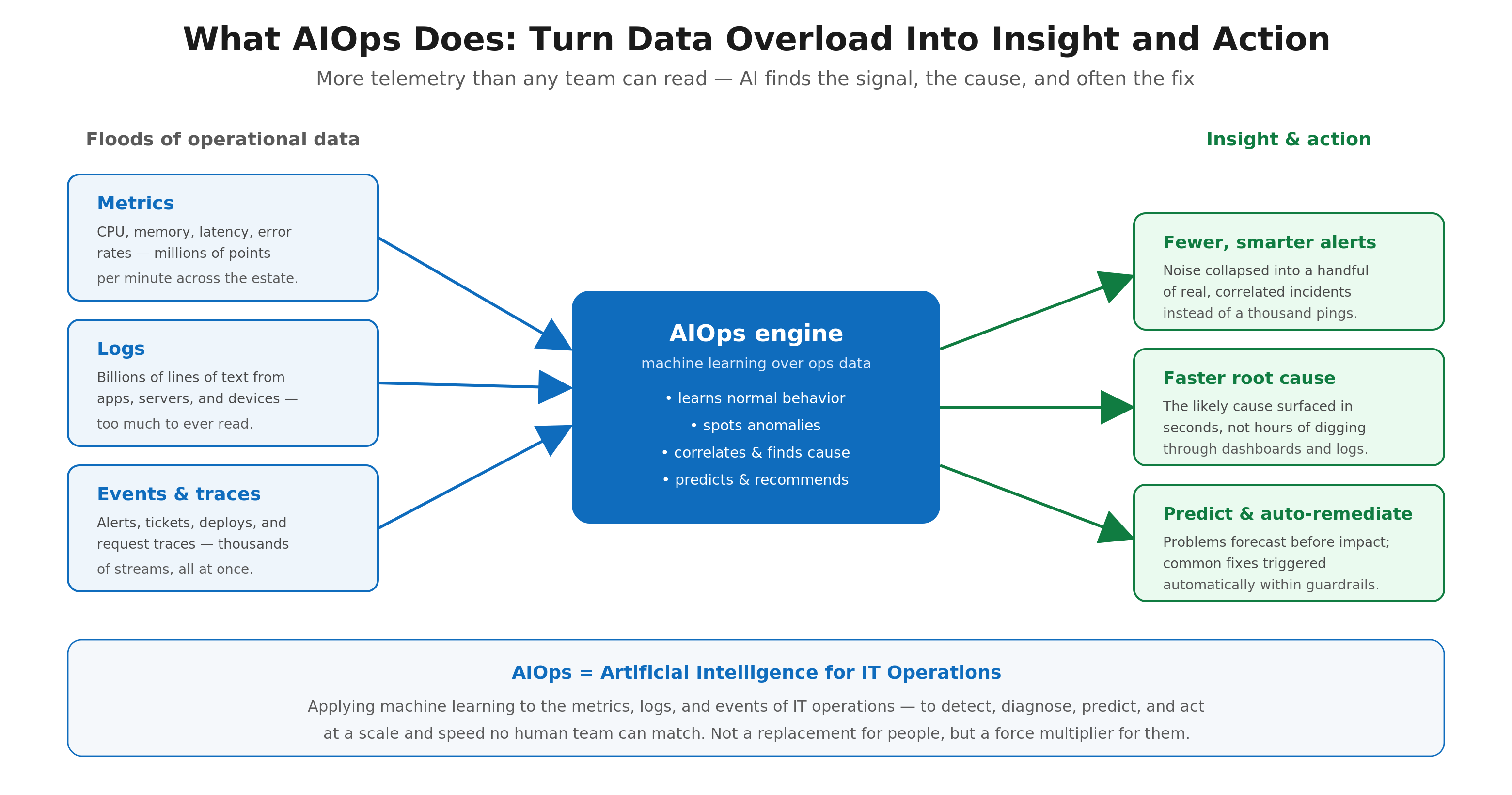
What AIOps does — turn data overload into insight and action
On one side pours in a flood of operational data: metrics (CPU, memory, latency, error rates — millions of points a minute), logs (billions of lines of text no one could ever read), and events and traces (alerts, tickets, deploys, and request traces, thousands of streams at once). In the middle sits the AIOps engine, applying machine learning to that data — learning normal behavior, spotting anomalies, correlating signals to find cause, and predicting and recommending. Out the other side comes insight and action: fewer, smarter alerts, with noise collapsed into a handful of real, correlated incidents; faster root cause, with the likely culprit surfaced in seconds rather than hours of digging; and prediction with automated remediation, forecasting problems before impact and triggering common fixes automatically within guardrails. In short, AIOps applies AI to the metrics, logs, and events of IT operations to detect, diagnose, predict, and act at a scale and speed no human team can match — not as a replacement for people, but as a force multiplier for them.
The Five Core Capabilities of AIOps
AIOps is not a single trick but a set of capabilities, each applying machine learning to a specific job that humans struggle to do fast enough. Understanding them separately makes it clear what AIOps can and cannot do.
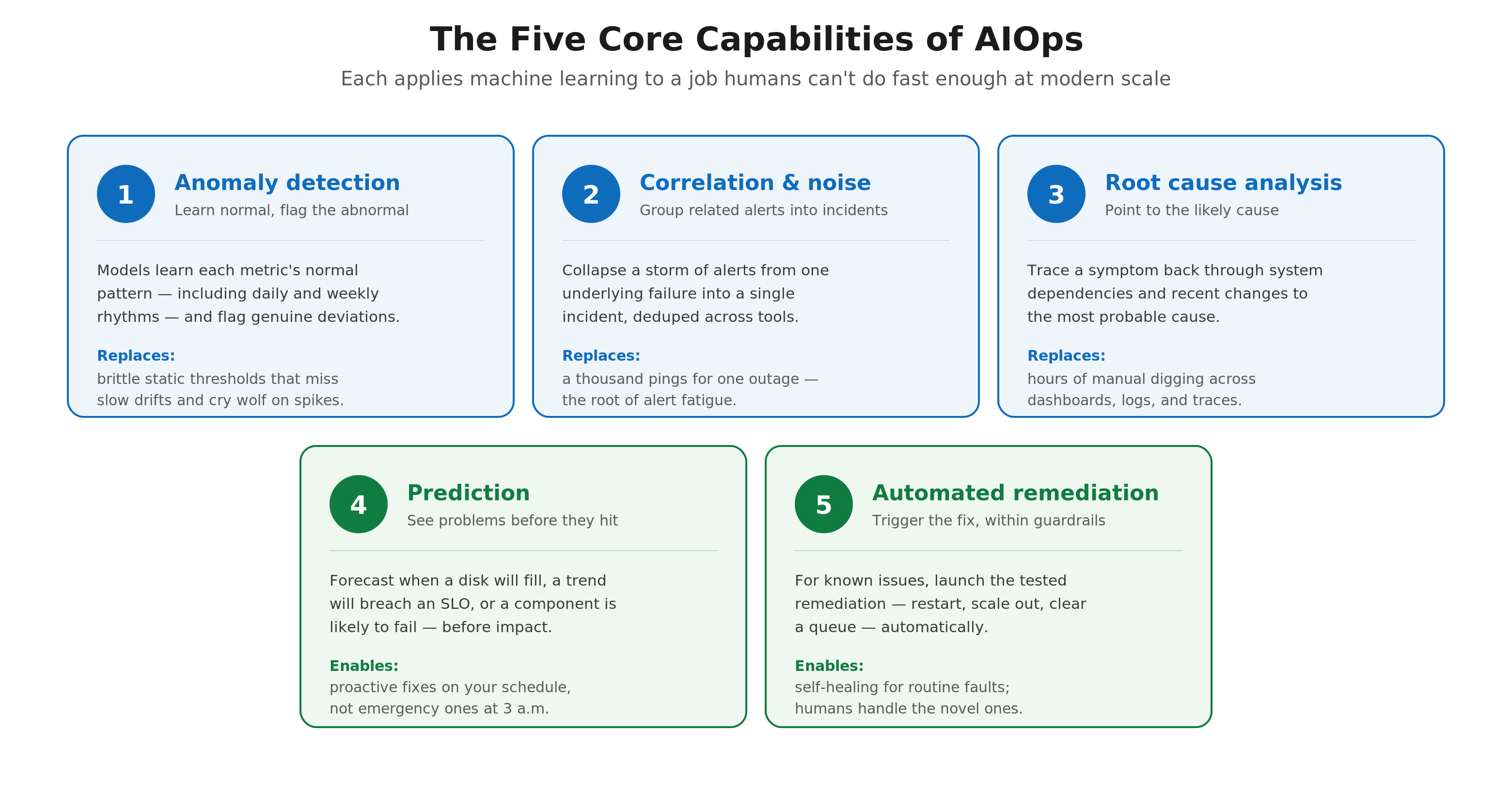
The five core capabilities of AIOps
The first capability is anomaly detection: models learn each metric’s normal pattern — including daily and weekly rhythms — and flag genuine deviations, replacing brittle static thresholds that miss slow drifts and cry wolf on ordinary spikes. The second is correlation and noise reduction: collapsing a storm of alerts from one underlying failure into a single, deduplicated incident, which strikes directly at the root of alert fatigue. The third is root cause analysis: tracing a symptom back through system dependencies and recent changes to the most probable cause, replacing hours of manual digging across dashboards, logs, and traces. The fourth is prediction: forecasting when a disk will fill, when a trend will breach an SLO, or when a component is likely to fail — enabling proactive fixes on your schedule rather than emergencies at 3 a.m. The fifth is automated remediation: for known issues, launching the tested fix — a restart, a scale-out, a queue clear — automatically, enabling self-healing for routine faults while humans handle the novel ones. Together these move operations from watching data to acting on understanding.
| Capability | What it does | What it replaces or enables |
|---|---|---|
| Anomaly detection | Learns normal; flags real deviations | Replaces brittle static thresholds |
| Correlation & noise reduction | Groups related alerts into one incident | Replaces alert storms; cuts fatigue |
| Root cause analysis | Traces a symptom to its likely cause | Replaces hours of manual digging |
| Prediction | Forecasts failures, capacity, SLO breaches | Enables proactive, scheduled fixes |
| Automated remediation | Runs tested fixes for known issues | Enables self-healing within guardrails |
How AIOps Works: From Raw Data to Action
Behind these capabilities is a pipeline that turns raw telemetry into action and, importantly, learns from the results. Seeing the flow clarifies both the power and the dependencies of AIOps.
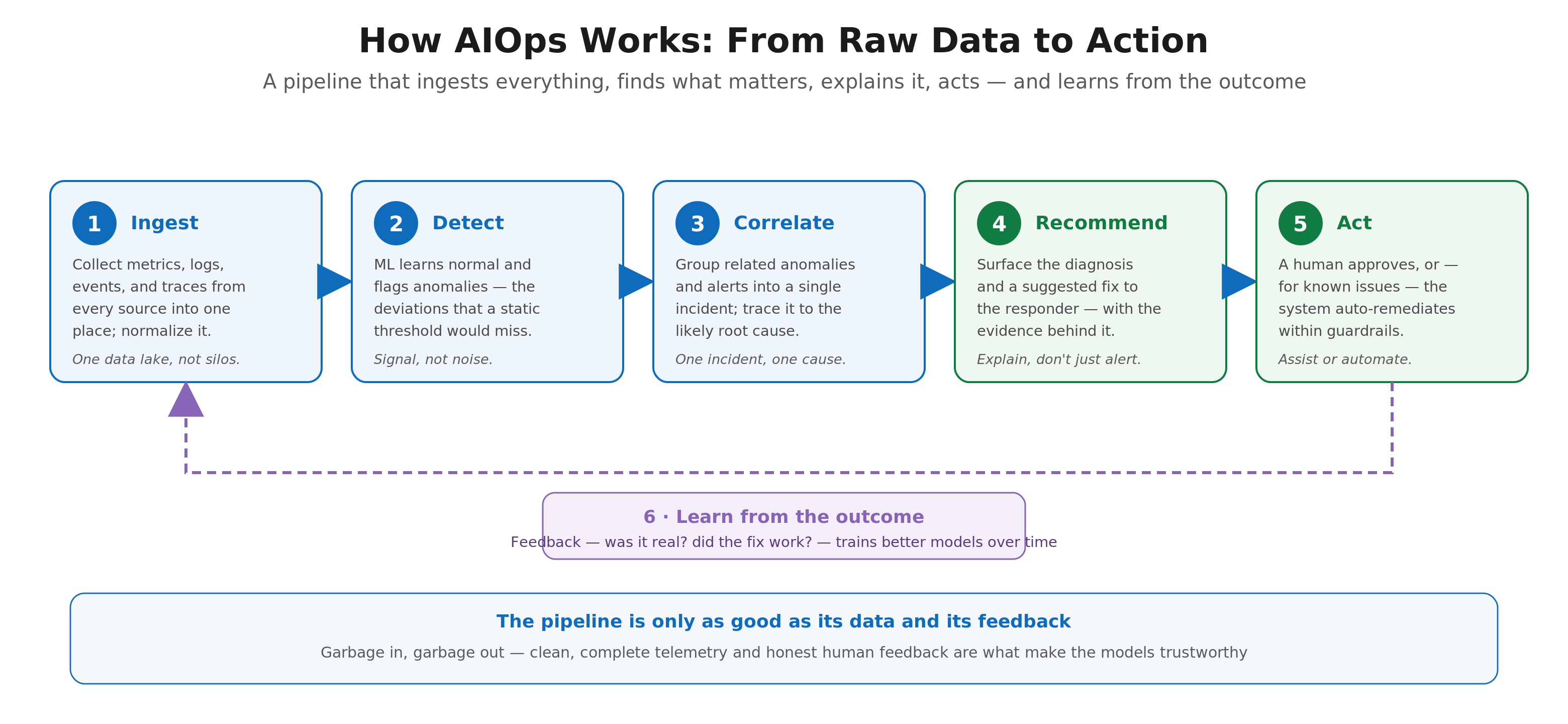
How AIOps works — from raw data to action
The pipeline runs in stages. First, ingest: collect metrics, logs, events, and traces from every source into one place and normalize them — one data lake, not silos. Second, detect: ML learns normal and flags the anomalies a static threshold would miss, surfacing signal rather than noise. Third, correlate: group related anomalies and alerts into a single incident and trace it to the likely root cause — one incident, one cause. Fourth, recommend: surface the diagnosis and a suggested fix to the responder, along with the evidence behind it, so the system explains rather than merely alerts. Fifth, act: a human approves, or — for known, well-tested issues — the system auto-remediates within guardrails. And sixth, closing the loop, learn from the outcome: feedback on whether the incident was real and whether the fix worked trains better models over time. This learning loop is what makes AIOps improve rather than stagnate. It also reveals the central dependency: the pipeline is only as good as its data and its feedback. Garbage in, garbage out — clean, complete telemetry and honest human feedback are what make the models trustworthy.
The Shift: Reactive to Proactive to Predictive
The practical payoff of AIOps is a change in when a team finds out about problems. That single shift — moving detection earlier — is what transforms operations, and it comes in stages.
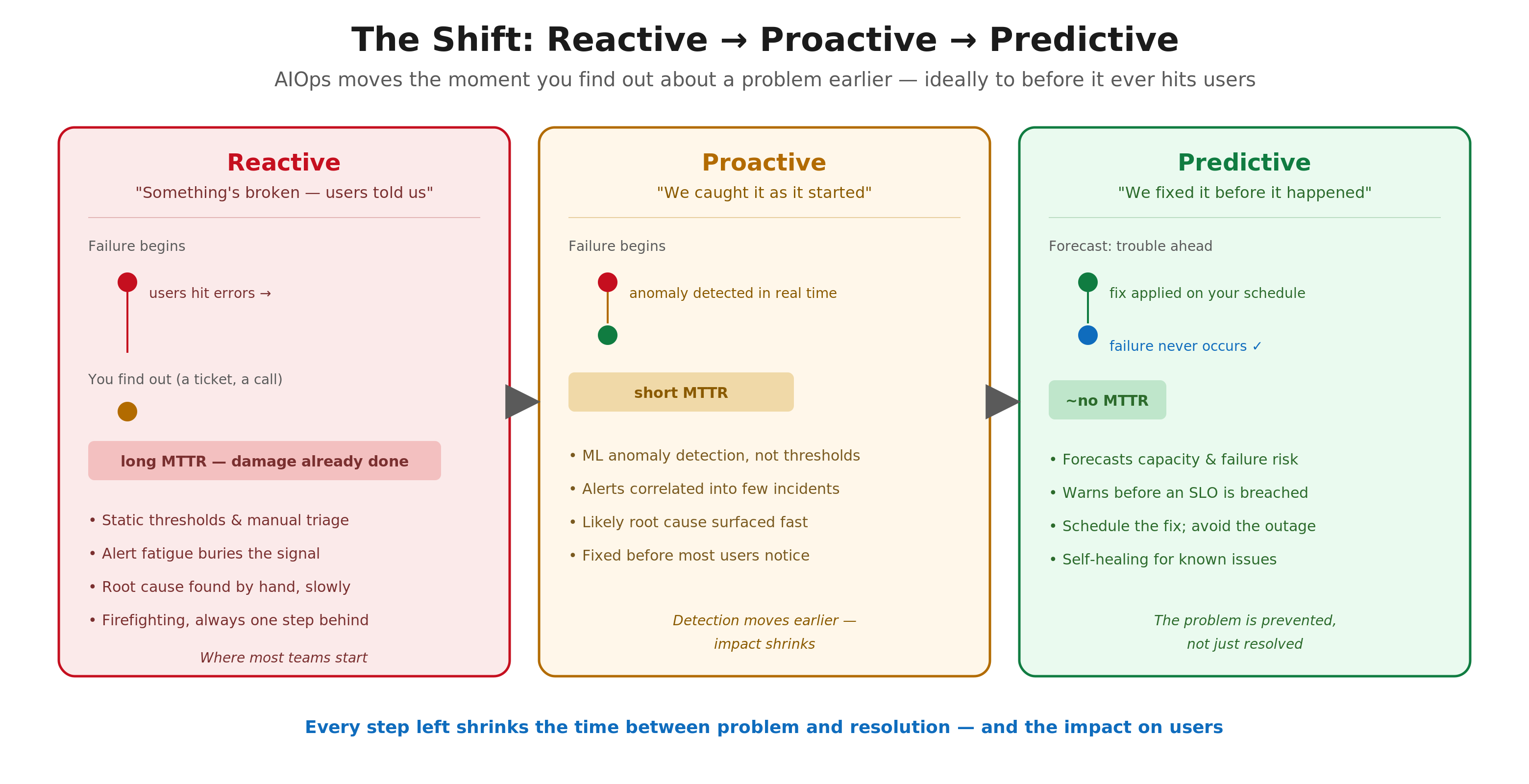
The shift — reactive to proactive to predictive
In the reactive mode where most teams start, you learn something is broken only after users are hurt and report it — a ticket, a call. Static thresholds and manual triage, alert fatigue that buries the signal, and root cause found slowly by hand all combine into a long mean-time-to-resolution with the damage already done. It is firefighting, always one step behind. AIOps moves a team to proactive: ML anomaly detection catches the failure as it starts, alerts are correlated into a few real incidents, the likely root cause is surfaced fast, and the problem is fixed before most users notice — a short MTTR because detection has moved earlier and impact has shrunk. The furthest stage is predictive: the system forecasts trouble ahead — a disk about to fill, a trend about to breach an SLO, a component likely to fail — and the fix is applied on your schedule, so the failure never occurs at all. Here MTTR approaches zero because the problem is prevented, not merely resolved. Every step leftward on this spectrum shrinks the time between problem and resolution, and with it the impact on users.
| Mode | When you find out | How it’s handled | Result |
|---|---|---|---|
| Reactive | After users are hurt | Manual triage, static thresholds | Long MTTR; damage done |
| Proactive | As the failure starts | ML detection, correlation, fast RCA | Short MTTR; minimal impact |
| Predictive | Before impact occurs | Forecasting and scheduled fixes | Near-zero MTTR; outage avoided |
Adopting AIOps Responsibly
AIOps is powerful, which is exactly why it should be adopted carefully. The goal is to earn trust in stages and to keep humans in the loop, granting the system autonomy only in proportion to the confidence it has demonstrated.
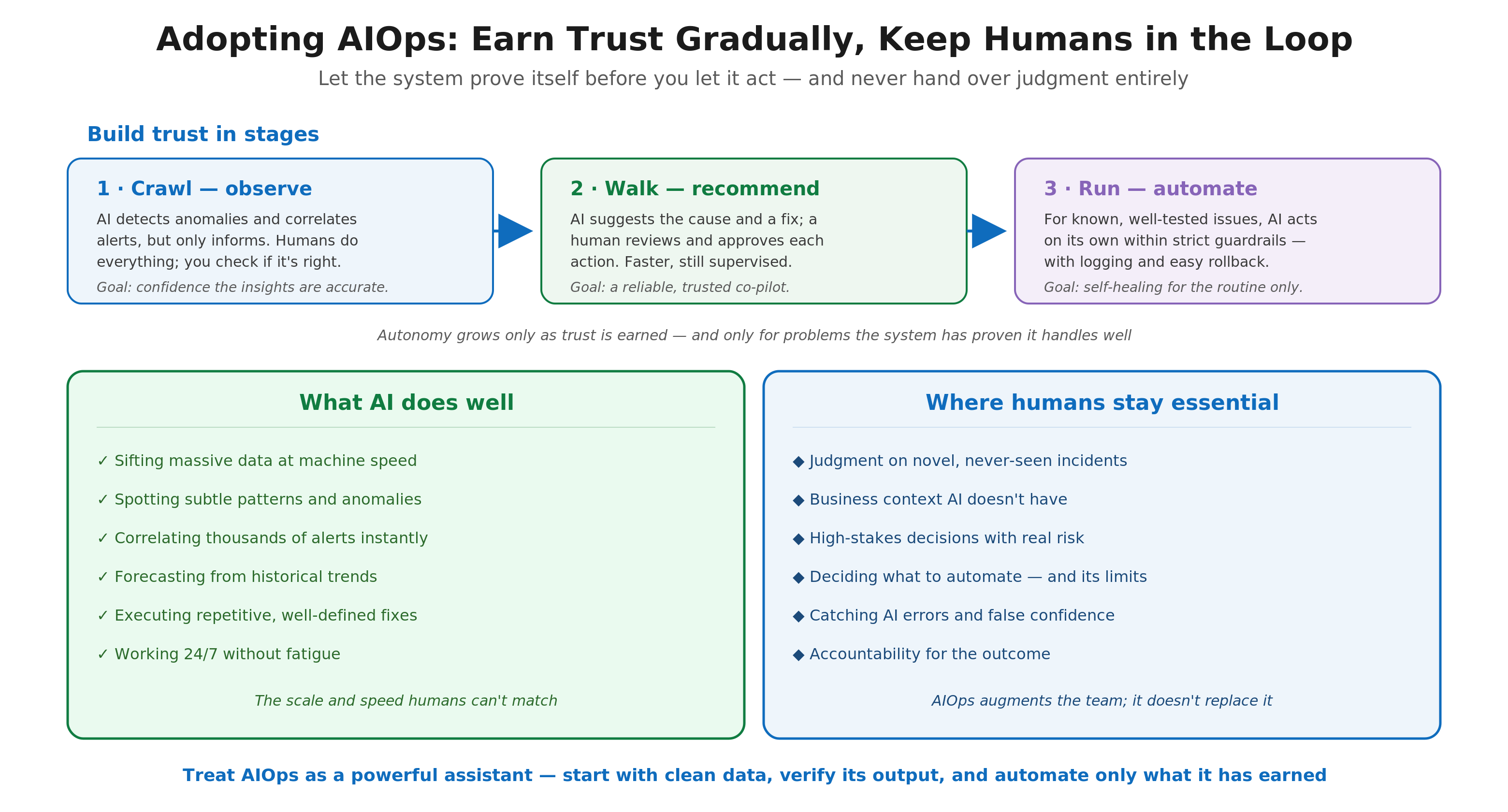
Adopting AIOps — earn trust gradually, keep humans in the loop
Trust is best built in three stages. In the crawl stage, AI detects anomalies and correlates alerts but only informs; humans do everything and check whether the system is right, with the goal of gaining confidence that its insights are accurate. In the walk stage, AI suggests the cause and a fix, but a human reviews and approves each action — faster, still supervised, and building toward a reliable co-pilot. Only in the run stage, and only for known, well-tested issues, does AI act on its own within strict guardrails, with full logging and easy rollback, delivering self-healing for the routine while everything novel still goes to people. Autonomy grows only as trust is earned, and only for problems the system has proven it handles well. Underpinning this is a clear-eyed division of labor. AI does some things far better than people: sifting massive data at machine speed, spotting subtle patterns, correlating thousands of alerts instantly, forecasting from history, executing repetitive fixes, and working around the clock without fatigue. But humans stay essential for judgment on novel incidents, business context the AI lacks, high-stakes decisions, deciding what to automate and where its limits are, catching the AI’s errors and false confidence, and — always — accountability for the outcome. AIOps augments the team; it does not replace it.
| Stage | AI’s role | Human’s role | Automate? |
|---|---|---|---|
| Crawl — observe | Detects anomalies, correlates alerts, informs | Does everything; verifies AI is right | No — insight only |
| Walk — recommend | Suggests cause and fix with evidence | Reviews and approves each action | Only with approval |
| Run — automate | Executes tested fixes within guardrails | Sets policy; monitors; owns outcome | Yes — known issues only |
AIOps Adoption Checklist
- Consolidate metrics, logs, events, and traces into clean, normalized data first.
- Fix data quality before expecting good models — garbage in, garbage out.
- Start with anomaly detection and alert correlation for the fastest, safest wins.
- Use AIOps to attack alert fatigue by collapsing noise into real incidents.
- Adopt in stages: crawl (observe), walk (recommend), run (automate).
- Keep a human approving actions until the system has demonstrably earned trust.
- Automate remediation only for known, well-tested issues, within strict guardrails.
- Require logging and easy rollback on every automated action.
- Feed honest feedback back into the models so they improve over time.
- Keep humans responsible for novel incidents, business context, and accountability.
- Set realistic expectations — AIOps augments the team, it does not replace it.
- Measure the impact: alert volume, MTTR, and incidents prevented.
Best Practices
Fix the data before the models. AIOps learns from telemetry, so its quality is capped by the quality of that data. Consolidate and clean your metrics, logs, and events first; a model trained on gappy, siloed data will produce untrustworthy results no matter how good the algorithm.
Start where the risk is lowest and the value is highest. Anomaly detection and alert correlation deliver immediate benefit — less noise, less fatigue — without taking any risky action. Prove value there before moving toward automated remediation.
Earn autonomy in stages. Move deliberately from observe, to recommend, to automate. Let the system demonstrate accuracy at each stage before granting it more power, and only ever automate problems it has proven it handles well.
Keep humans in the loop by design. Require human approval for actions until trust is established, and keep people responsible for novel, high-stakes, and context-dependent decisions permanently. The best outcomes come from AI and humans together, not either alone.
Close the feedback loop. AIOps improves only if it learns from outcomes. Give it honest feedback on whether incidents were real and whether fixes worked, so the models get better rather than drifting.
Set realistic expectations. AIOps is a powerful assistant, not a magic autopilot. Communicate clearly that it augments the team’s capacity and speed rather than replacing judgment, so it is trusted appropriately — neither over-relied on nor dismissed.
Common Mistakes
Expecting magic from bad data. Deploying AIOps on top of incomplete, inconsistent, or siloed telemetry produces unreliable insights and erodes trust quickly. Data quality is the foundation, not an afterthought.
Automating actions too soon. Granting the system authority to take action before it has proven its accuracy risks automating mistakes at machine speed. Earn trust through observation and recommendation first.
Treating AIOps as a staff replacement. Framing AIOps as a way to cut the operations team misunderstands it and demoralizes the people whose judgment it depends on. It is a force multiplier for the team, not a substitute.
Blindly trusting the output. Accepting every AI diagnosis or recommendation without scrutiny lets false confidence and subtle errors slip through. Humans must remain able to question and override the system.
Ignoring the feedback loop. Deploying models and never feeding back whether they were right leaves them static and slowly less accurate as the environment changes. Feedback is what keeps AIOps improving.
Boiling the ocean. Trying to apply AIOps to everything at once, rather than starting with a high-value use case like alert correlation, leads to stalled, over-complex projects. Start focused and expand.
Frequently Asked Questions
What is AIOps? AIOps stands for Artificial Intelligence for IT Operations. It is the use of machine learning on operational data — metrics, logs, events, and traces — to detect anomalies, correlate alerts, find root causes, predict problems, and, for known issues, automate fixes, at a scale and speed beyond manual operations.
Will AIOps replace IT operations staff? No. AIOps augments teams rather than replacing them. It handles the scale and speed — sifting data, spotting patterns, correlating alerts — while people retain judgment on novel incidents, business context, high-stakes decisions, and accountability. The best results come from AI and humans working together.
How does AIOps help with alert fatigue? Its correlation and noise-reduction capability collapses a storm of alerts from a single underlying failure into one deduplicated incident, and its anomaly detection replaces noisy static thresholds. Together these dramatically cut the volume of alerts, so the ones that remain are real and worth acting on.
Where should we start with AIOps? Start by consolidating and cleaning your telemetry, then apply anomaly detection and alert correlation — the highest-value, lowest-risk capabilities. These reduce noise and speed up response without taking any automated action, building confidence before you consider automated remediation.
Is it safe to let AIOps take automated actions? It can be, if introduced carefully. Adopt in stages — observe, then recommend, then automate — and only automate known, well-tested issues within strict guardrails, with logging and easy rollback. Keep a human approving actions until the system has clearly earned trust.
What makes an AIOps deployment succeed or fail? Data quality and feedback. AIOps learns from telemetry, so incomplete or siloed data produces poor results. And it improves only if it receives honest feedback on its outputs. Clean, complete data and a working feedback loop are what separate a trustworthy deployment from a disappointing one.
Conclusion
The scale of modern IT operations has outgrown the tools built for an earlier era. Static thresholds, isolated dashboards, and manual triage cannot keep pace with millions of metrics, billions of log lines, and thousands of simultaneous event streams — and the cost of that mismatch is alert fatigue, slow response, and teams stuck firefighting. AIOps addresses the mismatch directly by applying machine learning to the data itself: learning what is normal, flagging what is not, collapsing noise into real incidents, tracing symptoms to causes, forecasting trouble ahead, and healing the routine faults automatically.
Its real value is a shift in timing — from finding out about problems after users are hurt, to catching them as they start, to preventing them before they happen. But that power has to be handled with care. AIOps is only as good as the data it learns from and the feedback it receives, and its autonomy should be granted in stages, in proportion to the trust it has demonstrably earned. Keep the data clean, start with the low-risk high-value capabilities, automate only what the system has proven it handles, and keep humans in the loop for judgment, context, and accountability. Approached this way, AIOps is neither a threat to the operations team nor a magic autopilot, but what it should be: a powerful assistant that lets a team operate at a scale and speed it never could alone.
References
- Google SRE Book — Monitoring Distributed Systems
- Google SRE Book — Eliminating Toil (automated remediation)
- Google SRE Workbook — Alerting on SLOs
- NIST AI Risk Management Framework (AI RMF 1.0)
- NIST — Four Principles of Explainable AI (NISTIR 8312)
- OpenTelemetry — Observability primer (metrics, logs, traces)
- Google SRE Book — Effective Troubleshooting
On this page
- Executive Summary
- What AIOps Does: From Data Overload to Insight
- The Five Core Capabilities of AIOps
- How AIOps Works: From Raw Data to Action
- The Shift: Reactive to Proactive to Predictive
- Adopting AIOps Responsibly
- AIOps Adoption Checklist
- Best Practices
- Common Mistakes
- Frequently Asked Questions
- Conclusion
- References