IT Budget Planning
Every business spends money on IT. Far fewer plan that spending before it happens.
- Content owner
- Insyto Content Team
- Editorial reviewer
- Ritesh Mhatre
- Technical reviewer
- Navish Ansari
- Next review
- To be scheduled
- Last reviewed
- Review pending
- Technical level
- Beginner · CIOs, IT directors, procurement leaders
IT Finance · Executive & Business Topics
Executive Summary
Every business spends money on IT. Far fewer plan that spending before it happens. IT budget planning is the process of forecasting and allocating technology spend across a fiscal period — categorized by what it costs to keep the lights on, what it costs to grow, and what it costs to manage risk — and tied explicitly to business goals rather than approved one request at a time.
The stakes are real. Without a plan, IT spend arrives as a series of surprises: renewals nobody tracked, emergency replacements, security work funded only after an incident. With one, finance can forecast cash flow, leadership can see which investments drive which outcomes, and IT stops looking like an unpredictable cost center. Well-run budget planning does not necessarily reduce total spend — it makes spend defensible, phased, and aligned to what the business is actually trying to do. The decision to plan properly is a finance and leadership decision as much as a technical one.
This guide is a vendor-neutral walkthrough of how to build an IT budget. It defines what IT budget planning is, explains how it differs from simply approving purchases, sets out the factors that should shape it, and provides the ownership, category, and scorecard tables a CIO needs to build and govern one. It is deliberately technology-agnostic — the approach applies whatever platforms and vendors an organization runs — and focuses on the planning process rather than any particular tool.
Who should read this:
- CIOs, CTOs, and IT directors building or defending a technology budget
- Business owners and operators funding IT spend
- Finance leaders forecasting cash flow and evaluating IT requests
- Board members and investors evaluating technology cost and risk
What is IT budget planning?
IT budget planning is not simply approving purchases as they come up, and it is not last year’s total plus a percentage. It is a forecast: every dollar categorized, phased across the year, and tied to a reason.
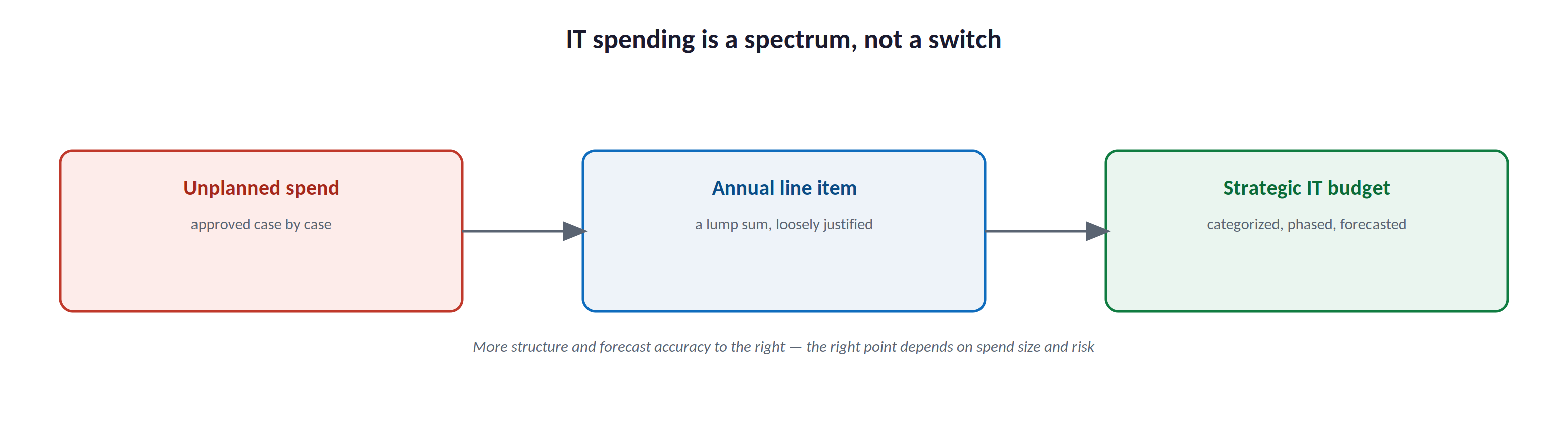
IT spending is a spectrum, not a switch: from unplanned spend approved case by case, to an annual line item that is a lump sum, loosely justified, to a strategic IT budget that is categorized, phased, and forecasted — more structure and forecast accuracy to the right, with the right point depending on spend size and risk.
Most organizations start at the reactive end of this spectrum: purchases and renewals get approved individually, as they come up, with little visibility into the total picture until the bill arrives. Many move one step further and set a single annual IT line item — better than nothing, but still a lump sum that’s hard to justify or analyze by category. A true budget goes further: spend is split into categories, phased across the fiscal year, and modeled against both known run-costs and planned initiatives. None of these stages is wrong for every organization — a very small business may manage well with a simple annual estimate — but the further right an organization sits, the more predictable and defensible its technology spending becomes.
What changes when you plan properly?
The practical effect of a planned budget is not necessarily less spend — it’s a different relationship between IT and the money it costs to run and grow.
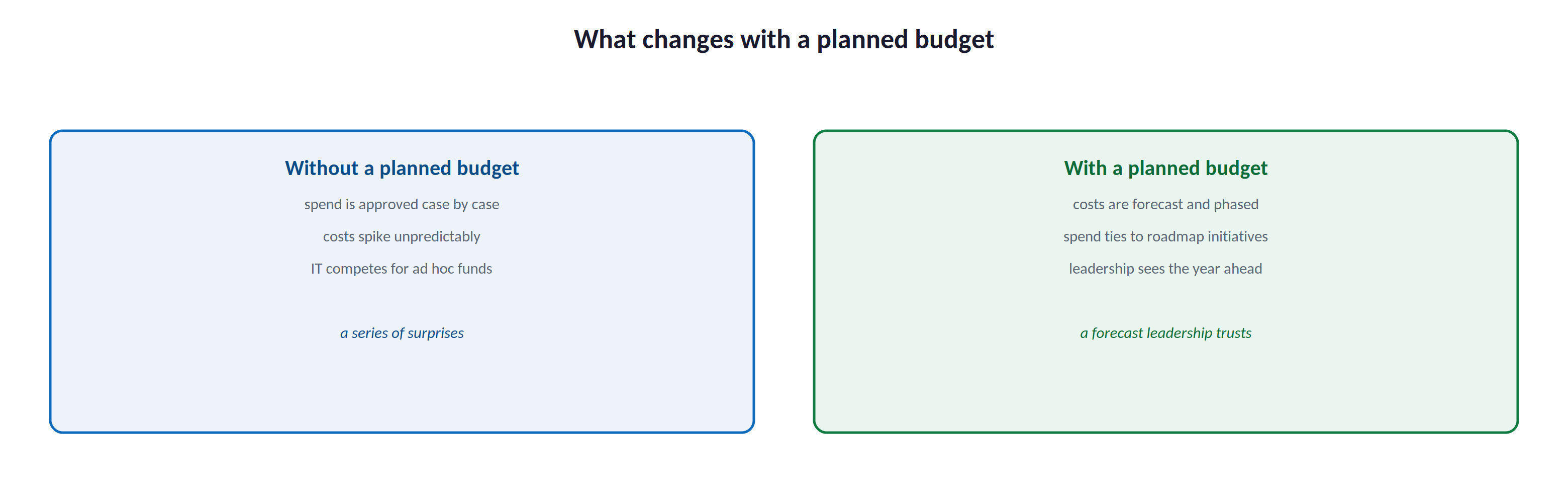
What changes with a planned budget: without one, spend is approved case by case, costs spike unpredictably, and IT competes for ad hoc funds — a series of surprises; with one, costs are forecast and phased, spend ties to roadmap initiatives, and leadership sees the year ahead — a forecast leadership trusts.
Without a plan, every purchase is its own negotiation, and finance has no way to distinguish a routine renewal from a strategic investment — both just look like an IT request. Costs spike unpredictably because nothing was forecast, and emergency spending crowds out planned work. With a plan, the same spend is categorized and phased months in advance, actuals can be tracked against forecast, and leadership can see — and defend — why the technology budget looks the way it does.
How does the budget connect strategy to spend?
A budget is the layer that turns strategic intent into authorized, trackable dollars.
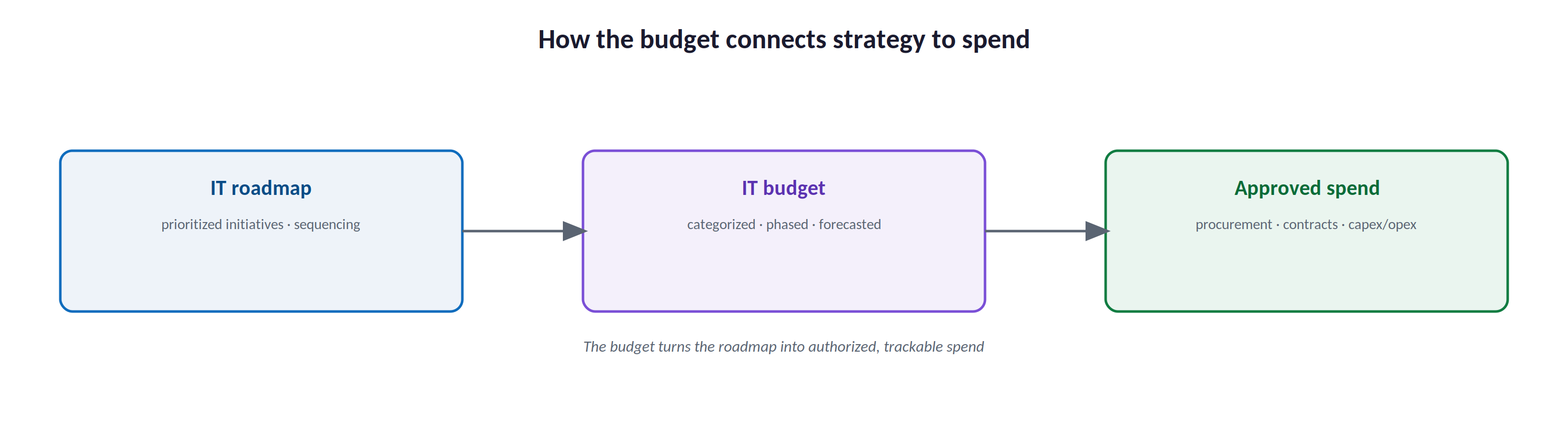
How the budget connects strategy to spend: the IT roadmap — prioritized initiatives, sequencing — flows into the IT budget, which is categorized, phased, and forecasted, which in turn becomes approved spend — procurement, contracts, capex and opex. The budget turns the roadmap into authorized, trackable spend.
A roadmap says what should happen and in what order; it doesn’t by itself authorize spending. The budget is where each roadmap initiative — along with the recurring cost of running existing systems — gets a dollar figure, a category, and a place in the fiscal calendar. Approved spend then follows the budget rather than being negotiated line by line as the year unfolds. When this translation layer is missing, IT ends up requesting money project by project, and finance has no framework for weighing one request against another.
Which factors should drive the IT budget?
The right budget follows from an honest look at four cost drivers, not from simply inflating last year’s number.
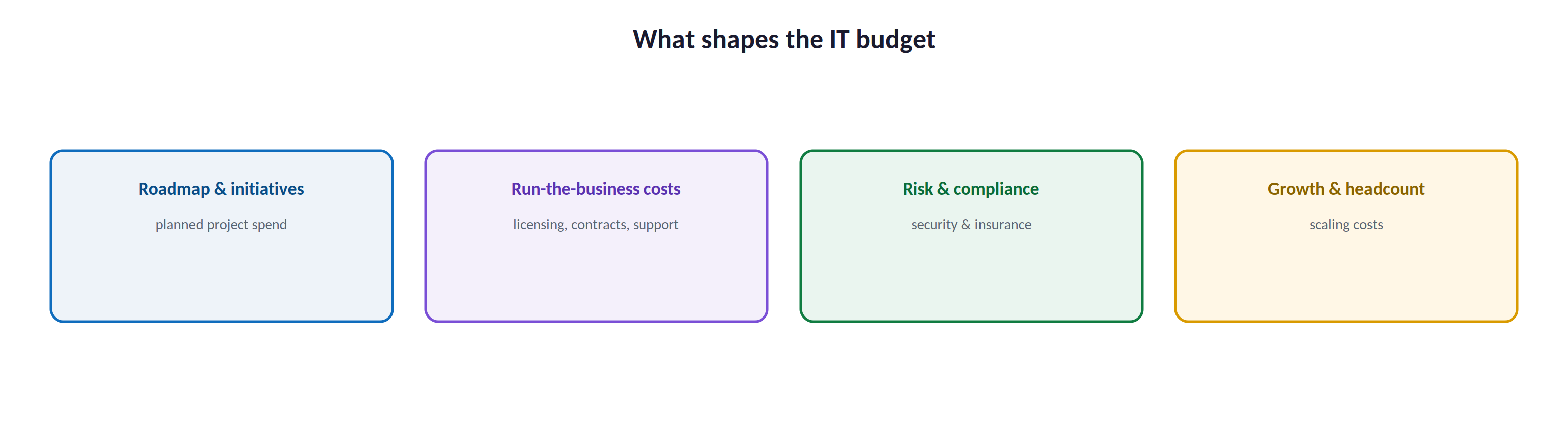
What shapes the IT budget: roadmap and initiatives (planned project spend), run-the-business costs (licensing, contracts, support), risk and compliance (security and insurance), and growth and headcount (scaling costs).
The first driver is the roadmap: whatever strategic initiatives are planned for the period need a funded line. The second is run-the-business cost — the recurring licensing, contracts, and support that keep existing systems working, which is often the largest and most under-examined part of the budget. The third is risk and compliance: security tooling, insurance, and regulatory obligations that carry outsized consequences if underfunded. The fourth is growth: adding users, devices, or locations changes IT costs in ways a flat budget won’t capture. A budget that accounts for all four is defensible in a finance review; one that only rolls forward last year’s total usually isn’t.
How is an IT budget built in practice?
Building an IT budget is a repeatable cycle, not a once-a-year spreadsheet exercise, and it works best when actuals feed back into the plan.
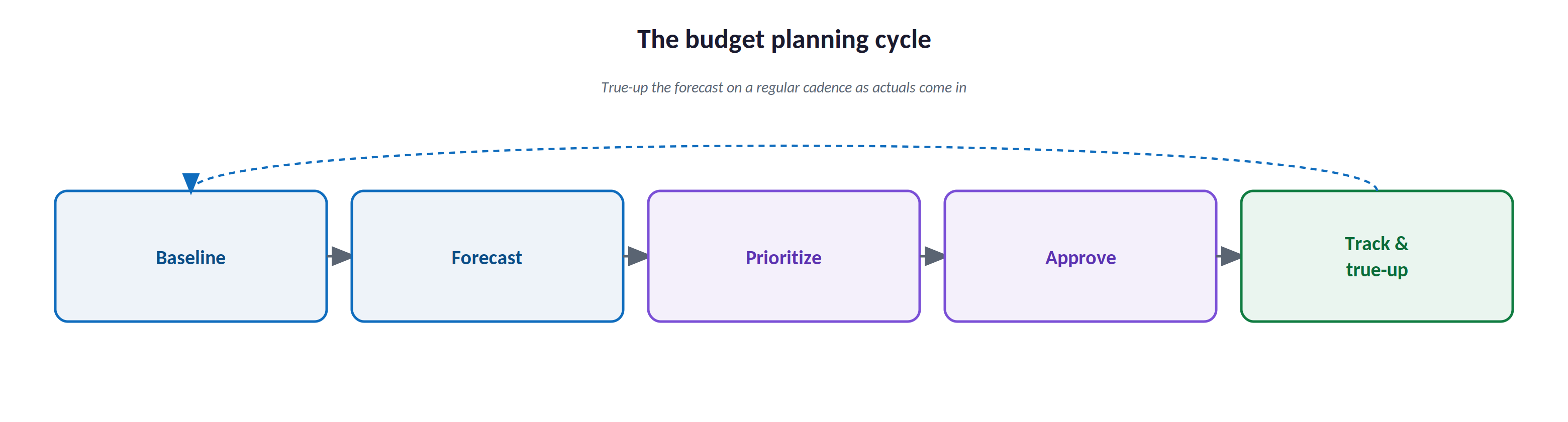
The budget planning cycle: establish a baseline of current spend, forecast costs against the roadmap and run-rate, prioritize when funds are limited, secure approval, and track actuals with a quarterly true-up — looping back to baseline. True-up the forecast on a regular cadence as actuals come in.
The cycle starts with a baseline: an honest audit of current contracts, licenses, and run-costs, since you cannot forecast what you haven’t inventoried. Forecasting models those run-costs alongside the roadmap’s planned initiatives to produce a draft budget by category. Prioritization ranks spend by business impact for the (common) case where funds don’t stretch to cover every request. Approval secures sign-off from finance and leadership, converting the forecast into an authorized budget. Tracking and true-up then monitors actuals against the plan and adjusts the forecast — quarterly at minimum — because a budget that’s never revisited is only accurate on the day it was approved.
Ad hoc IT spending vs a planned IT budget at a glance
The comparison below summarizes the practical differences that most influence how technology costs actually get managed.
| Dimension | Ad hoc IT spending | Planned IT budget |
|---|---|---|
| Planning horizon | As needed, no fixed period | Annual, phased quarterly |
| Ownership | Whoever approves the purchase | Finance and IT jointly own; CIO/vCIO builds it |
| Visibility | Low; finance is surprised by bills | High; forecast shared with leadership |
| Cost categories | Mixed together, hard to analyze | Split by run, grow, and risk categories |
| Link to strategy | None; reactive to breakage or requests | Directly maps to roadmap initiatives |
| Capex vs opex | Rarely distinguished | Planned and modeled separately |
| Main risk | Overruns, poor forecast accuracy | Plan going stale without a quarterly true-up |
| Scales by | Approving more one-off requests | Adjusting categories within the same framework |
Budget governance: ownership, categories, and scorecards
A budget only stays credible if it’s governed the way a CFO and CIO both need to evaluate it — who is responsible, what the money is for, the cadence, the risk if it lapses, and the business value it protects. The tables below frame a typical budget planning process where finance and IT share ownership; in a fully outsourced arrangement, the provider or vCIO carries the Responsible role across most rows.
Responsibility matrix (RACI)
| Budget function | Activity | Responsible | Accountable | Consulted | Informed | Tooling category | Business impact |
|---|---|---|---|---|---|---|---|
| Baseline & spend audit | Inventory existing contracts, licenses, run-costs | IT / provider | CIO | Finance | Executive team | Asset / PSA | Accurate starting point |
| Roadmap-to-budget mapping | Translate initiatives into budget lines | vCIO | CIO | Department heads | Board | Roadmap / financial planning | Spend tied to strategy |
| Forecasting | Model costs across the fiscal year | Finance & IT | CFO | CIO | Board | Financial planning tools | Predictable cash flow |
| Prioritization | Rank budget lines when funds are constrained | vCIO | CIO | Department heads, finance | End users | Roadmap / PM tooling | Highest-impact spend funded first |
| Approval & governance | Approve budget and changes | CFO / exec | CEO | CIO | Board | Financial approval workflow | Controlled spend authority |
| Risk & compliance costing | Cost security and compliance requirements | Security / provider | CIO | Compliance | Auditors | GRC / security tooling | Adequately funded risk posture |
| Tracking & true-up | Monitor actuals vs plan, adjust forecast | Finance & IT | CFO | CIO | Board | Reporting / dashboards | Budget stays accurate |
Budget category matrix
| Category | Component | Description | Tooling category | Cadence | Risk if missing |
|---|---|---|---|---|---|
| Run the business | Licensing & subscriptions | Recurring software and service costs | Asset / PSA | Annual / monthly | Untracked renewals, overspend |
| Run the business | Support & maintenance | Contracts keeping current systems running | PSA / contract mgmt | Annual | Lapsed coverage, downtime |
| Grow the business | Roadmap initiatives | Project-funded technology investment | Roadmap / PM tooling | Annual / quarterly | Underfunded strategic work |
| Grow the business | Capacity & scaling | Infrastructure and licensing for growth | Asset / RMM | Quarterly | Growth outpaces capacity |
| Manage risk | Security & compliance | Tooling and services addressing exposure | GRC / security | Annual | Unfunded risk exposure |
| Governance | Budget review | Track variance, true-up forecast | Reporting / dashboards | Quarterly | Budget drifts from reality |
Budget planning lifecycle
| Stage | Activity | Outcome | Tooling category | Business impact |
|---|---|---|---|---|
| Baseline | Audit current contracts, licenses, and run-costs | Documented current spend | Asset / PSA | Accurate starting point |
| Forecast | Model costs against the roadmap and run-rate | Draft budget by category | Financial planning | Realistic plan |
| Prioritize | Rank spend by business impact when funds are limited | Ranked budget lines | Roadmap / PM tooling | Highest-impact spend funded |
| Approve | Present and secure sign-off from finance and leadership | Approved budget | Financial approval workflow | Authorized spend |
| Track & true-up | Monitor actuals against plan, adjust quarterly | Updated forecast | Reporting / dashboards | Budget stays accurate |
Decision matrix
| Scenario | Recommended approach | Justification | Key consideration |
|---|---|---|---|
| No formal IT budget exists | Build a baseline budget from current spend first | You can’t plan what you haven’t inventoried | Start with a 12-month baseline, then layer in the roadmap |
| Roadmap already exists | Map every initiative to a specific budget line | Keeps spend tied to strategy, not guesswork | Phase costs to match roadmap sequencing |
| Rapid growth | Model capacity and scaling costs separately from run-costs | Growth costs behave differently and shouldn’t hide in the baseline | Revisit quarterly, not annually |
| Tight fiscal year | Rank all lines by business impact and fund top-down | Ensures the highest-impact work survives cuts | Document what got deferred and why |
| Heavy compliance exposure | Ring-fence a risk & compliance line item | Prevents security spend from being the first thing cut | Justify against specific regulatory or risk requirements |
| Board or investor scrutiny | Present the budget with variance tracked each quarter | Leadership needs to see forecast accuracy, not just a number | Report actual vs. planned by category |
Budget KPI scorecard
| Metric | Target | Tooling category | Business value |
|---|---|---|---|
| Budget variance | Within ±10% of plan | Financial planning | Cost predictability |
| Spend mapped to roadmap initiatives | ≥ 80% | Roadmap / financial planning | Alignment, not guesswork |
| Quarterly forecast accuracy | Within ±5–10% | Reporting / dashboards | Trustworthy planning |
| Unplanned / emergency spend | ≤ 10% of total budget | Reporting / dashboards | Reduced surprises |
| Renewal & contract review completion | 100% before renewal date | Asset / PSA | No lapsed coverage |
| Budget review cadence | Quarterly | vCIO / reporting | Plan stays current |
Implementation checklist
- Current IT spend — licenses, contracts, support, infrastructure — is fully inventoried
- The IT roadmap’s initiatives are mapped to specific budget lines
- Run, grow, and risk/compliance costs are categorized separately
- Capex and opex are distinguished and modeled appropriately
- The budget is phased across the fiscal year, not lumped into one number
- Every budget line has an owner and a justification tied to business impact
- A contingency or reserve is built in for unplanned work
- The budget is presented to finance and leadership in business terms
- A quarterly review and true-up cadence is set and calendared
- Renewal and contract dates are tracked so nothing lapses unnoticed
- Actuals are tracked against plan and variance is explained
Best practices
- Start from the roadmap, not from last year’s number plus a percentage.
- Separate run-the-business costs from growth and transformation spend.
- Build in a contingency line for the inevitable unplanned work.
- Track actuals against plan monthly, even if the formal review is quarterly.
- Present the budget in business categories leadership can evaluate.
- Ring-fence security and compliance spend so it survives budget cuts.
- Review renewal dates early enough to negotiate, not just to renew.
- Treat the budget as a living forecast, not a number fixed in January.
Common mistakes
- Budgeting from last year’s total instead of this year’s roadmap.
- Mixing run-the-business and strategic spend into one undifferentiated number.
- Leaving no contingency, so any surprise blows the plan.
- Letting security and compliance spend be the first thing cut.
- Never tracking actuals against plan until the year is already over.
- Presenting the budget as a spreadsheet of line items with no narrative.
- Missing renewal dates and paying for unused or auto-renewed licenses.
- Treating the budget as fixed even after business goals or risks change.
Frequently asked questions
What is IT budget planning?
IT budget planning is the process of forecasting and allocating technology spend across a fiscal period, categorized by run-the-business costs, strategic initiatives, and risk and compliance needs, and tied explicitly to business goals.
How is an IT budget different from an IT roadmap?
The roadmap sequences initiatives over time; the budget puts a number and a timeframe on each of them, plus the recurring cost of keeping existing systems running. The budget should be built from the roadmap, not the other way around.
How should IT costs be categorized?
Most organizations split spend into three buckets: running the business (licensing, support, maintenance), growing the business (roadmap initiatives, capacity), and managing risk (security, compliance). Separating these makes trade-offs visible.
How much contingency should an IT budget include?
There’s no universal number, but many organizations reserve 10–15% of the total IT budget for unplanned work, since some emergency spend is nearly always inevitable.
How often should the IT budget be reviewed?
Monthly tracking against actuals, with a formal quarterly review and true-up, keeps the forecast accurate without waiting for year-end to discover variance.
Who should own the IT budget?
Ownership is typically shared: IT — internal, provider, or both — builds the forecast and justifies spend, while finance and executive leadership approve it and hold the organization to it.
Conclusion
An IT budget is not a spreadsheet handed to finance once a year; it’s a forecast built jointly by IT and finance, tied to the roadmap, and revisited as the year unfolds. Done well, it replaces case-by-case approvals and an undifferentiated annual number with a categorized, phased plan that leadership can trust. Done poorly — rolled forward from last year without examination — it becomes a number nobody can defend when spend inevitably drifts from it.
The path forward is to plan it deliberately: baseline current spend honestly, map costs to the roadmap and to run-the-business needs, prioritize by business impact when funds are tight, secure real approval, and govern the plan with a fixed review cadence. Because the right budget is a living forecast rather than a fixed number, the best ones are the ones that get trued up and rebalanced as actuals come in.
References
This is a vendor-neutral overview of IT budget planning. The following industry sources informed the definitions and comparisons; verify current market specifics independently before making a financial planning decision. Source access date: 14 August 2026.
- Guide: Tips and Best Practices for IT Budgeting — NinjaOne
- IT Budgeting: Basics, Best Practices, and Mistakes to Avoid — N-able
- IT Budget Basics: Best Practices for 2026 — Ramp
- IT Budget Planning: Strategies, Best Practices & Forecasts — Sterling Technology
- IT Budget Planning: A Practical Guide for Business Owners — PennComp
On this page
- Executive Summary
- What is IT budget planning?
- What changes when you plan properly?
- How does the budget connect strategy to spend?
- Which factors should drive the IT budget?
- How is an IT budget built in practice?
- Ad hoc IT spending vs a planned IT budget at a glance
- Budget governance: ownership, categories, and scorecards
- Responsibility matrix (RACI)
- Budget category matrix
- Budget planning lifecycle
- Decision matrix
- Budget KPI scorecard
- Implementation checklist
- Best practices
- Common mistakes
- Frequently asked questions
- Conclusion
- References