Building an IT Roadmap
Every growing business eventually hits the same wall: technology decisions are being made one at a time, under pressure, with no shared sense of what comes next.
- Content owner
- Insyto Content Team
- Editorial reviewer
- Ritesh Mhatre
- Technical reviewer
- Navish Ansari
- Next review
- To be scheduled
- Last reviewed
- Review pending
- Technical level
- Beginner · CIOs, CTOs, IT directors
IT Strategy · Executive & Business Topics
Executive Summary
Every growing business eventually hits the same wall: technology decisions are being made one at a time, under pressure, with no shared sense of what comes next. An IT roadmap is the answer — a prioritized, time-sequenced plan that connects technology initiatives to business goals, budget, and risk over a defined period, usually one to three years. It replaces a list of pending tickets and aging hardware with a document leadership can actually govern.
The stakes are real. Without a roadmap, IT spend is reactive and lumpy, priorities shift with whoever complains loudest, and risk gets addressed only after it becomes an incident. With one, technology investment becomes predictable, defensible, and aligned to where the business is actually headed. Get it right and the roadmap becomes a planning tool the whole leadership team relies on; get it wrong — build it once and never revisit it — and it becomes a stale document nobody trusts. Building the roadmap is a business exercise conducted with IT input, not an IT exercise handed to leadership as a fait accompli.
This guide is a vendor-neutral walkthrough of how to build an IT roadmap. It defines what a roadmap is, explains how it differs from a budget or a wish list, sets out the factors that should shape it, and provides the ownership, planning, and scorecard tables a CIO needs to build and govern one. It is deliberately technology-agnostic — the approach applies whatever platforms and vendors an organization runs — and focuses on the planning process rather than any particular tool.
Who should read this:
- CIOs, CTOs, and IT directors building or refreshing a technology plan
- Business owners and operators funding IT investment
- Finance leaders forecasting IT spend
- Board members and investors evaluating technology risk
What is an IT roadmap?
An IT roadmap is not a budget and it is not a wish list. It is the plan that sits between them: a sequenced set of initiatives, each tied to a business goal, a cost, an owner, and a timeframe.
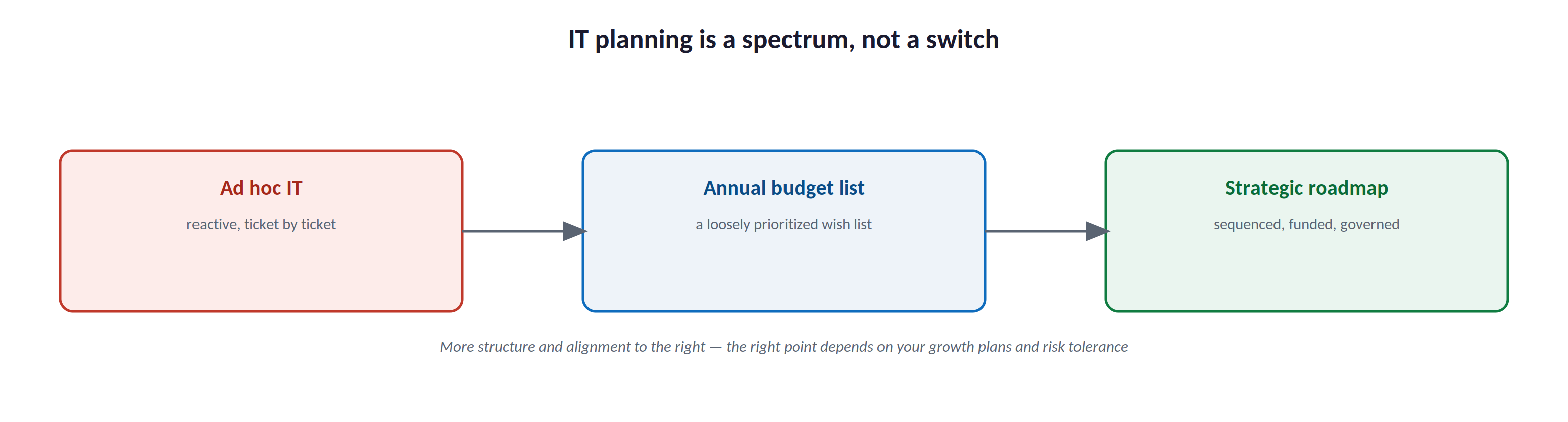
IT planning is a spectrum, not a switch: from ad hoc IT, handled reactively ticket by ticket, to an annual budget list that is a loosely prioritized wish list, to a strategic roadmap that is sequenced, funded, and governed — more structure and alignment to the right, with the right point depending on growth plans and risk tolerance.
Most organizations start at the reactive end of this spectrum: IT responds to what breaks or what’s requested, and spending happens as problems appear. Many move one step further and produce an annual list of projects and purchases — better than nothing, but still loosely prioritized and rarely tied explicitly to business outcomes. A true roadmap goes further still: every initiative is scored against business impact, sequenced against dependencies and budget cycles, and revisited on a fixed cadence rather than once a year. None of these stages is wrong for every organization — a very small business may not need the full rigor of a formal roadmap — but the further right an organization sits, the more predictable and defensible its technology spending becomes.
What changes when you build one?
The practical effect of a roadmap is not more technology — it’s a different relationship between the business and its IT spending.
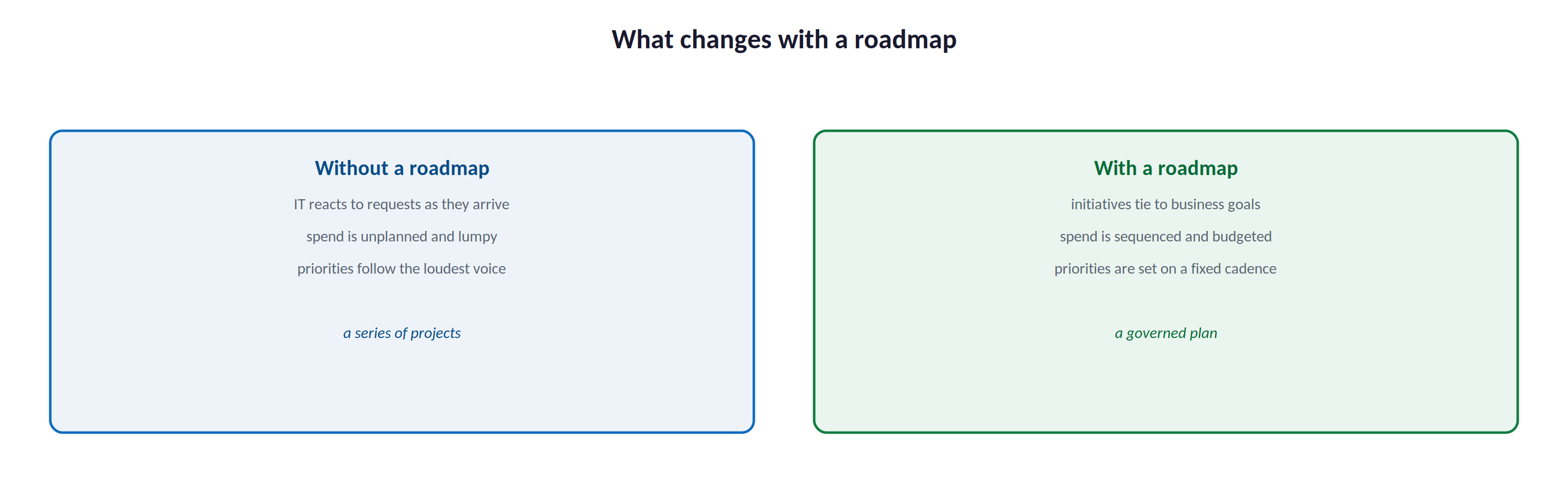
What changes with a roadmap: without one, IT reacts to requests as they arrive, spend is unplanned and lumpy, and priorities follow the loudest voice — a series of projects; with one, initiatives tie to business goals, spend is sequenced and budgeted, and priorities are set on a fixed cadence — a governed plan.
Without a roadmap, every initiative competes for attention on its own terms, and the initiative that gets funded is often the one that made the most noise rather than the one that matters most. Costs surprise finance because nothing was forecast. Security and compliance gaps sit unaddressed until they cause an incident, because there was never a plan that named them. With a roadmap, the same initiatives are weighed against each other up front, spend is phased across the fiscal year instead of arriving in shocks, and leadership can see — and defend — why one project is happening before another.
How does a roadmap connect strategy to execution?
A roadmap is the translation layer between what the business wants and what IT actually does day to day.
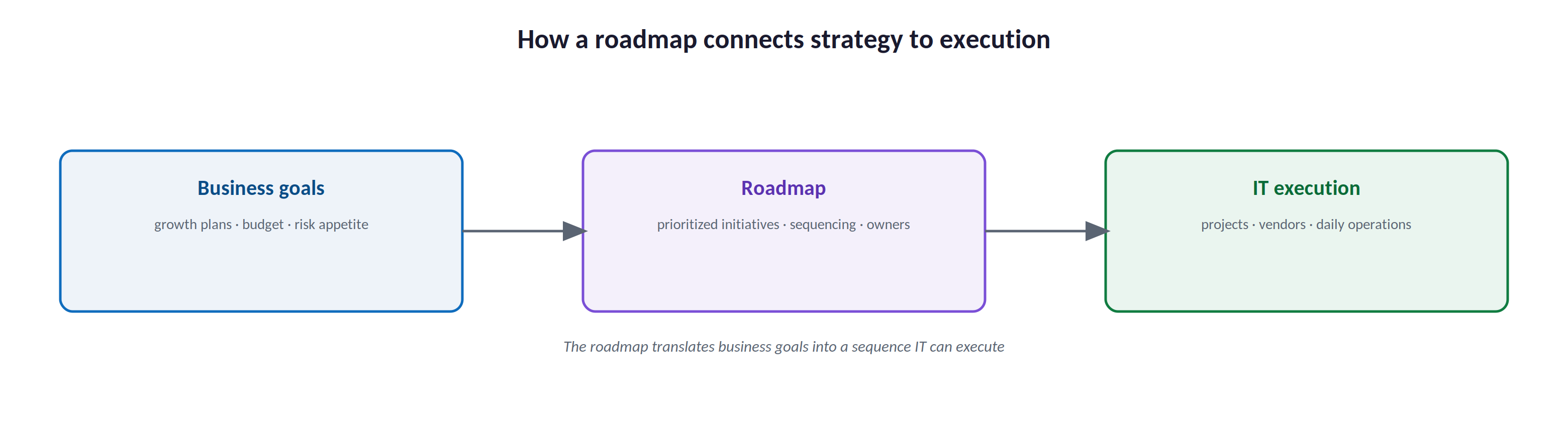
How a roadmap connects strategy to execution: business goals — growth plans, budget, risk appetite — flow into the roadmap, which sets prioritized initiatives, sequencing, and owners, which in turn drives IT execution — projects, vendors, and daily operations. The roadmap translates business goals into a sequence IT can execute.
Business goals rarely arrive as technology requirements — “enter a new market” or “reduce operating costs” says nothing directly about servers, software, or security. The roadmap is where those goals get converted into a sequence of concrete initiatives: which systems to build, replace, or retire, in what order, at what cost, and against what risk. IT execution then follows the roadmap rather than improvising against each new request. When this translation layer is missing, IT ends up executing against whichever goal was most recently discussed in a hallway, not the one that matters most to the business.
Which factors should shape the roadmap?
The right roadmap follows from an honest look at four things, not from a generic best-practice template.
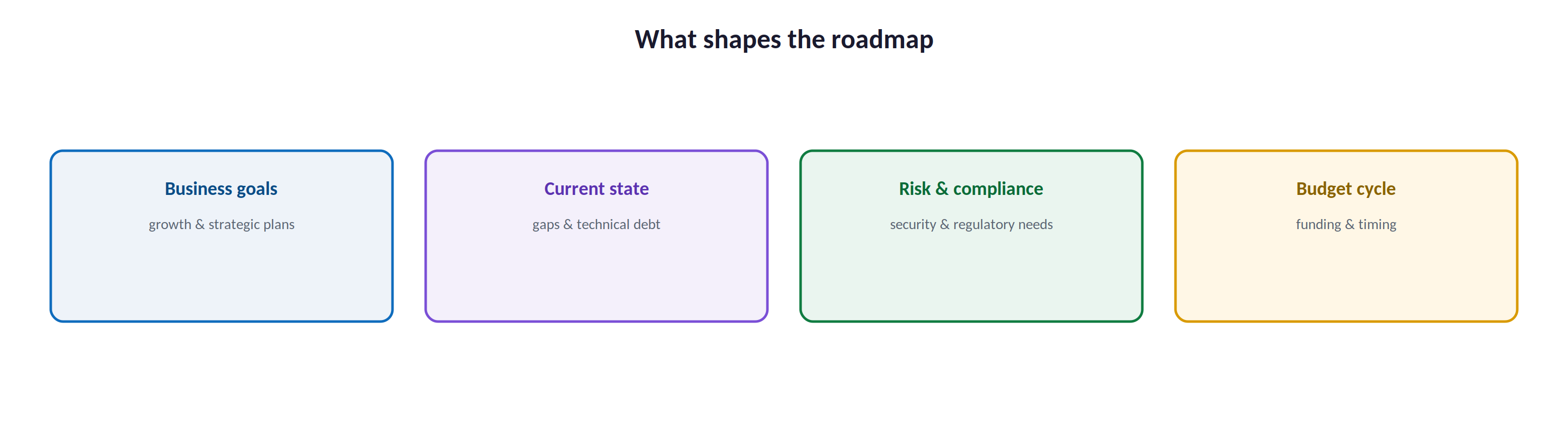
What shapes the roadmap: business goals (growth and strategic plans), current state (gaps and technical debt), risk and compliance (security and regulatory needs), and budget cycle (funding and timing).
The first input is the business’s own goals and growth plans — a roadmap built without them is just an equipment list. The second is the current state: an honest audit of infrastructure, applications, and technical debt, since you cannot sequence work you haven’t inventoried. The third is risk and compliance — security exposure and regulatory obligations often force certain initiatives earlier than the business would otherwise choose. The fourth is the budget cycle: a roadmap has to fit the way the organization actually funds and approves spending, or it will be ignored at the first budget meeting. A roadmap that gets all four inputs right earns leadership’s trust; one that skips the current-state audit or ignores the budget cycle rarely survives contact with the next fiscal year.
How is a roadmap built in practice?
Building a roadmap is a repeatable cycle, not a one-time project, and it works best when the same cycle runs on a fixed schedule.
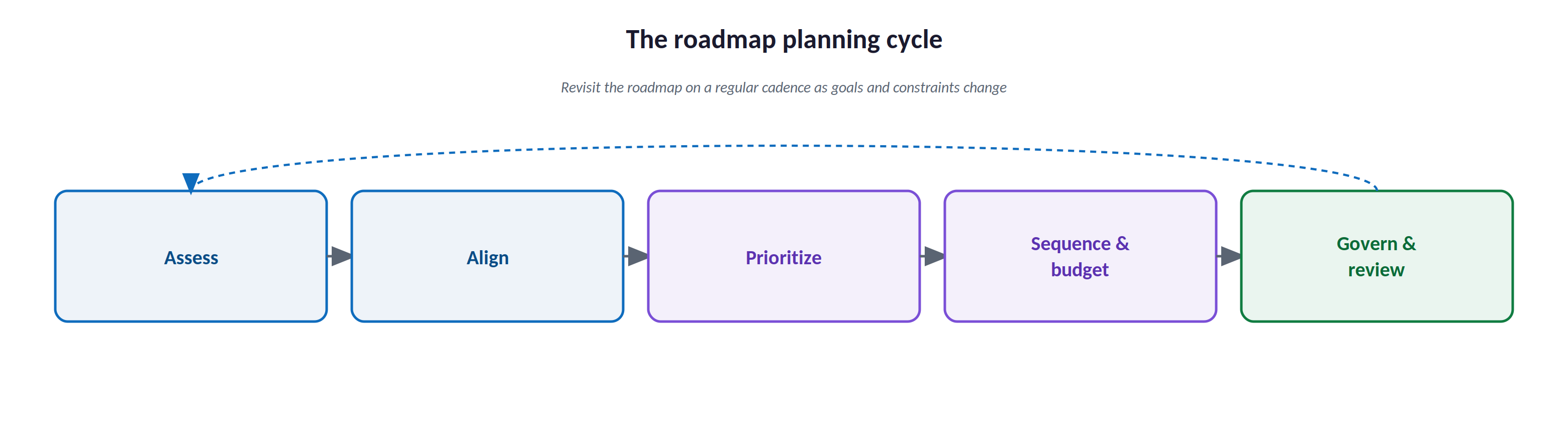
The roadmap planning cycle: assess the current environment, align on business goals, prioritize initiatives, sequence them with a budget, and govern and review — looping back to assess as goals and constraints change. Revisit the roadmap on a regular cadence as goals and constraints change.
The cycle starts with an honest assessment of infrastructure, applications, security posture, and spend — you cannot prioritize what you haven’t measured. Alignment gathers goals from leadership and department heads so the roadmap reflects the whole business, not just IT’s view of it. Prioritization scores each candidate initiative against business impact, risk, and cost, producing a ranked list rather than a flat one. Sequencing places that ranked list on a realistic timeline with phased budget, so cost and delivery are predictable rather than lumped into one number. Governance then tracks delivery and revisits the plan on a fixed cadence — quarterly for near-term detail, at least annually for the full plan — because a roadmap that is never revisited drifts out of step with the business it was built to serve.
Reactive IT vs a strategic roadmap at a glance
The comparison below summarizes the practical differences that most influence how technology decisions actually get made.
| Dimension | Reactive / ad hoc IT | Strategic IT roadmap |
|---|---|---|
| Planning horizon | Days to weeks, ticket by ticket | 1–3 years, reviewed quarterly |
| Ownership | Whoever raises the request | Business sets priority; IT sequences delivery |
| Budget | Unplanned, approved case by case | Forecast and phased across the plan |
| Risk & compliance | Addressed after an incident | Mapped and scheduled in advance |
| Prioritization | Loudest voice or most recent outage | Weighed against business impact and risk |
| Visibility to leadership | Low — IT is a black box | High — a shared, reviewable plan |
| Main risk | Firefighting, technical debt, surprise costs | Initiatives drifting from goals if not revisited |
| Scales by | Adding more firefighting capacity | Re-ranking and resequencing the same framework |
Roadmap governance: ownership, planning, and scorecards
A roadmap only stays credible if it is governed the way a CIO needs to evaluate it — who is responsible, what capability delivers it, the cadence, the risk if it lapses, and the business value it protects. The tables below frame a typical roadmap engagement where business leadership and IT share ownership; in a fully outsourced arrangement, the provider or vCIO carries the Responsible role across most rows.
Responsibility matrix (RACI)
| Roadmap function | Activity | Responsible | Accountable | Consulted | Informed | Tooling category | Business impact |
|---|---|---|---|---|---|---|---|
| Business goal alignment | Translate strategy into IT priorities | vCIO / IT leadership | CEO / exec sponsor | Department heads | Board | Strategy / roadmap software | Initiatives match business intent |
| Current-state assessment | Audit infrastructure, apps, security posture | IT / provider | CIO | In-house IT | Executive team | Asset / RMM tools | Accurate baseline |
| Prioritization & sequencing | Rank and order candidate initiatives | vCIO | CIO | Department heads, finance | End users | Roadmap / PM tooling | Highest-impact work first |
| Budget planning | Phase costs across the plan | Finance & IT | CFO | CIO | Board | Financial planning tools | Predictable spend |
| Risk & compliance mapping | Align initiatives to security and regulatory needs | Security / provider | CIO | Compliance | Auditors | GRC / security tooling | Reduced exposure |
| Vendor & lifecycle planning | Plan refresh and replacement timing | Provider | CIO | In-house IT | Finance | Asset / PSA | Controlled lifecycle cost |
| Governance & review | Track progress, revisit priorities | vCIO | CIO | Department heads | Board | Reporting / dashboards | Roadmap stays current |
Roadmap component matrix
| Domain | Component | Description | Tooling category | Cadence | Risk if missing |
|---|---|---|---|---|---|
| Strategy | Business goal mapping | Link every initiative to a stated goal | Roadmap / strategy | Annual | Misaligned spend |
| Infrastructure | Refresh & capacity plan | Hardware and cloud lifecycle timing | Asset / RMM | Annual | Emergency replacements |
| Security | Risk & compliance plan | Security initiatives sequenced to exposure | GRC / security | Quarterly | Undetected, unmanaged risk |
| Applications | App rationalization | Which systems to keep, replace, or retire | App portfolio | Annual | Redundant, unsupported tools |
| Budget | Phased investment plan | Costs mapped to fiscal periods | Financial planning | Annual / quarterly | Surprise costs |
| Governance | Roadmap review | Track status, adjust priorities | Reporting / dashboards | Quarterly | Roadmap goes stale |
Planning lifecycle
| Stage | Activity | Outcome | Tooling category | Business impact |
|---|---|---|---|---|
| Assess | Audit current infrastructure, apps, security, and spend | Documented baseline | Asset / RMM | Clear starting point |
| Align | Gather goals from leadership and department heads | Prioritized objectives | Strategy / roadmap | Buy-in and direction |
| Prioritize | Score initiatives by impact, risk, and cost | Ranked initiative list | Roadmap / PM tooling | Focus on what matters |
| Sequence & budget | Place initiatives on a timeline with phased costs | Funded, dated plan | Financial planning | Predictable spend |
| Govern & review | Track delivery, revisit quarterly | Updated roadmap | Reporting / dashboards | Plan stays current |
Decision matrix
| Scenario | Recommended approach | Justification | Key consideration |
|---|---|---|---|
| No IT plan exists yet | Build a baseline roadmap first | An assessment has to precede prioritization | Start with a lightweight 12–18 month plan |
| Rapid growth or new markets | Roadmap with a flexible near-term horizon | Priorities will shift as fast as the business does | Review quarterly, not annually |
| Aging infrastructure | Lead with an infrastructure refresh track | Technical debt compounds cost and risk | Sequence refresh before new initiatives |
| Heavy compliance exposure | Lead with a risk & compliance track | Regulatory gaps carry outsized business risk | Map every initiative to a control or requirement |
| Tight budget | Roadmap phased over multiple fiscal years | Spreads cost without losing direction | Rank strictly by business impact |
| Board or investor scrutiny | Formal roadmap with quarterly reporting | Leadership needs a reviewable plan, not a ticket count | Present in business terms, not technical ones |
Roadmap KPI scorecard
| Metric | Target | Tooling category | Business value |
|---|---|---|---|
| Initiatives delivered on schedule | ≥ 85% | Roadmap / PM tooling | Predictable execution |
| Budget variance | Within ±10% of plan | Financial planning | Cost predictability |
| Roadmap review cadence | Quarterly | Reporting / vCIO | Plan stays current |
| Critical risk items addressed | 100% within planned window | GRC / security | Reduced exposure |
| Initiatives mapped to business goals | 100% | Strategy / roadmap | Alignment, not guesswork |
| Stakeholder satisfaction | At or above target | Survey / reporting | Trust and continued buy-in |
Implementation checklist
- Current infrastructure, applications, and security posture are honestly assessed
- Business goals and growth plans for the next 1–3 years are documented
- Initiatives are scored and ranked by business impact, risk, and cost
- The roadmap is sequenced on a realistic timeline with phased budget
- Security and compliance requirements are mapped to specific initiatives
- Ownership is assigned for every initiative — who leads, who funds, who approves
- The roadmap is presented to leadership in business terms, not technical ones
- A review cadence, quarterly or biannual, is set and calendared
- The roadmap is treated as a living document, not a one-time deliverable
- Vendor and asset lifecycle timing is factored into sequencing
- Progress and variance are tracked against the plan
Best practices
- Start from business goals, not from a list of aging equipment.
- Keep the near-term (0–6 months) specific and the long-term (18–36 months) directional.
- Score initiatives against impact, risk, and cost rather than urgency alone.
- Put a cost estimate and an owner on every initiative before it goes on the roadmap.
- Review the roadmap on a fixed cadence, not only when something breaks.
- Present the roadmap in business language leadership can act on.
- Treat compliance and security as roadmap line items, not a separate afterthought.
- Build in flexibility for the unplanned without abandoning the sequence.
Common mistakes
- Building a wish list instead of a prioritized, funded plan.
- Skipping the current-state assessment and roadmapping from assumptions.
- Letting the loudest stakeholder set priority instead of business impact.
- Treating the roadmap as a one-time document that’s never revisited.
- Leaving cost and ownership vague until the initiative is already late.
- Bolting security and compliance on after the roadmap is already built.
- Presenting the roadmap in technical terms leadership can’t evaluate.
- Over-planning three years out in detail that’s obsolete within months.
Frequently asked questions
What is an IT roadmap?
An IT roadmap is a prioritized, time-sequenced plan that maps technology initiatives to business goals, budget, and risk over a defined period, typically one to three years.
How far out should an IT roadmap look?
Most effective roadmaps cover 12–36 months, with the near-term detailed and funded and the outer periods directional. The plan should be revisited quarterly or biannually rather than fixed and forgotten.
Who should own the roadmap?
Ownership is typically shared: business leadership sets goals and approves budget, while IT — internal, provider, or both — assesses the current state, sequences initiatives, and executes. A CIO or vCIO usually facilitates the process.
How is a roadmap different from an IT budget?
A budget funds a period; a roadmap sequences initiatives over time and shows how they connect to goals and to each other. The budget should follow from the roadmap, not replace it.
Do small businesses need a formal roadmap?
Yes, in a lightweight form. Even a one-page, 12–18 month plan beats none, since it forces prioritization and prevents unplanned, reactive spending.
How often should the roadmap be reviewed?
Quarterly for near-term detail, and at least annually for the full plan — sooner if business goals, budget, or major risks change.
Conclusion
An IT roadmap is not a technical artifact handed down by IT; it is a business planning tool built with IT’s input. It replaces reactive spending and a loosely prioritized wish list with a sequenced, funded, governed plan that ties every initiative to a business goal. Done well, it gives leadership predictability and IT a clear mandate; done poorly — built once and left to gather dust — it becomes just another document nobody trusts.
The path forward is to build it deliberately: assess the current state honestly, gather real goals from leadership, prioritize by business impact rather than urgency, sequence the result against a realistic budget, and govern it with a fixed review cadence. Because the right roadmap is a living plan rather than a fixed destination, the best ones are the ones that get revisited and rebalanced as the business changes around them.
References
This is a vendor-neutral overview of IT roadmap planning. The following industry sources informed the definitions and comparisons; verify current market specifics independently before making a planning decision. Source access date: 14 August 2026.
- 5 Steps to Building an IT Roadmap that Strategically Aligns Technology for Business Growth — Centric Consulting
- How to Create an IT Roadmap: A Guide for CIOs & Leaders — Planisware
- IT Strategy Roadmap: The Complete 2026 Guide — ImpactMyBiz
- How to Build an IT Roadmap That Aligns With Your Business Growth Goals — Fantastic IT Solutions
- How Do I Build a 6-Step IT Roadmap for Business Growth? — IGTech365
On this page
- Executive Summary
- What is an IT roadmap?
- What changes when you build one?
- How does a roadmap connect strategy to execution?
- Which factors should shape the roadmap?
- How is a roadmap built in practice?
- Reactive IT vs a strategic roadmap at a glance
- Roadmap governance: ownership, planning, and scorecards
- Responsibility matrix (RACI)
- Roadmap component matrix
- Planning lifecycle
- Decision matrix
- Roadmap KPI scorecard
- Implementation checklist
- Best practices
- Common mistakes
- Frequently asked questions
- Conclusion
- References