Digital Transformation Roadmap
Digital transformation has a credibility problem, and it’s earned.
- Content owner
- Insyto Content Team
- Editorial reviewer
- Ritesh Mhatre
- Technical reviewer
- Navish Ansari
- Next review
- To be scheduled
- Last reviewed
- Review pending
- Technical level
- Beginner · CIOs, CTOs, IT directors
Digital Strategy · Executive & Business Topics
Executive Summary
Digital transformation has a credibility problem, and it’s earned. Too many organizations have bought new software, called it transformation, and seen little change in how the business actually operates. A digital transformation roadmap is what separates a real transformation from a collection of disconnected tools: a phased, prioritized plan that sequences technology, process, and cultural change against a shared business vision — with ownership, budget, and measurable outcomes at every phase.
The stakes are real. Without a roadmap, departments digitize independently, customer and employee experience stay fragmented across systems that don’t talk to each other, and initiatives stall the moment executive attention moves elsewhere. With one, the same initiatives are sequenced for early wins, change management is planned alongside the technology instead of bolted on afterward, and progress is visible enough that sponsorship survives past the kickoff meeting. The single biggest driver of failure isn’t the technology choice — it’s starting with tools instead of a business outcome, and skipping the human side of the change.
This guide is a vendor-neutral walkthrough of how to build a digital transformation roadmap. It defines what separates transformation from point-solution digitization, explains how the roadmap should connect current state to future state, sets out the factors that should shape it, and provides the ownership, category, and scorecard tables a leadership team needs to build and govern one. It is deliberately technology-agnostic — the approach applies whatever platforms and vendors an organization runs — and focuses on the planning and change process rather than any particular tool.
Who should read this:
- CEOs, COOs, and CIOs sponsoring or leading a transformation program
- Business owners and operators modernizing processes and customer experience
- Finance leaders funding transformation initiatives
- Board members and investors evaluating strategic technology risk and return
What separates transformation from point-solution digitization?
Buying software is not the same as transforming a business. The difference is whether the change is sequenced against a shared vision or scattered across independent decisions.
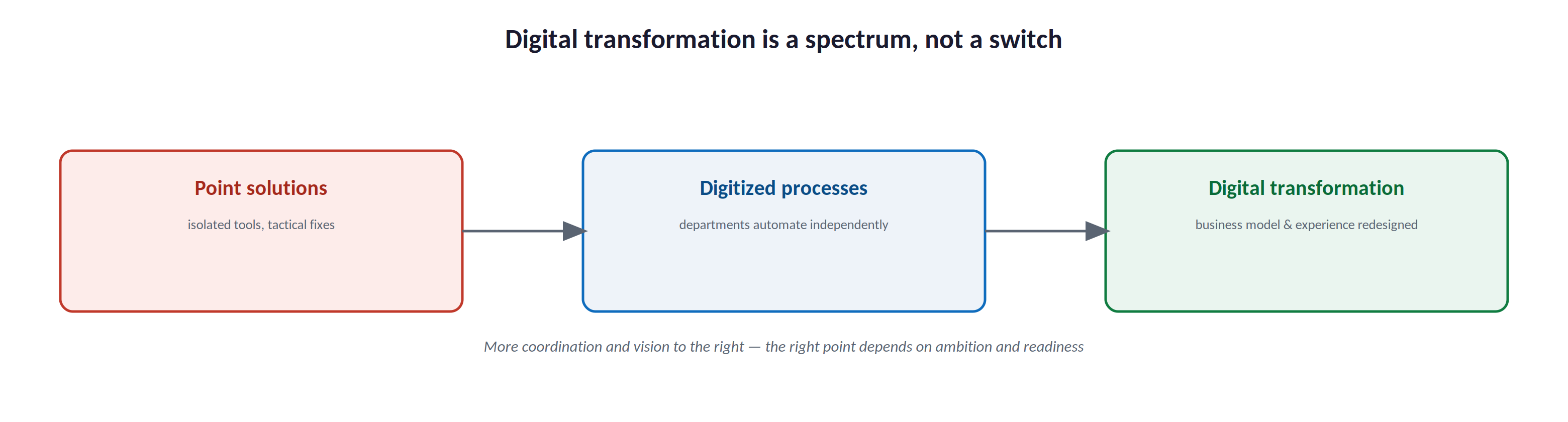
Digital transformation is a spectrum, not a switch: from point solutions — isolated tools, tactical fixes — to digitized processes where departments automate independently, to digital transformation where the business model and experience are redesigned — more coordination and vision to the right, with the right point depending on ambition and readiness.
Most organizations start at the point-solution end of this spectrum: a department buys a tool to solve its own problem, with no connection to what other departments are doing. Many move one step further and digitize whole processes within a function — better, but still siloed, and still missing a shared vision of what the business is trying to become. True transformation goes further: initiatives across customer experience, operations, data, and culture are sequenced against a common future state, with executive sponsorship holding the pieces together. None of these stages is inherently wrong — a well-run point solution can still deliver real value — but the further right an organization sits, the more the pieces reinforce each other instead of working at cross purposes.
What changes when you have a roadmap?
The practical effect of a transformation roadmap isn’t more initiatives — it’s the same initiatives working together instead of in isolation.
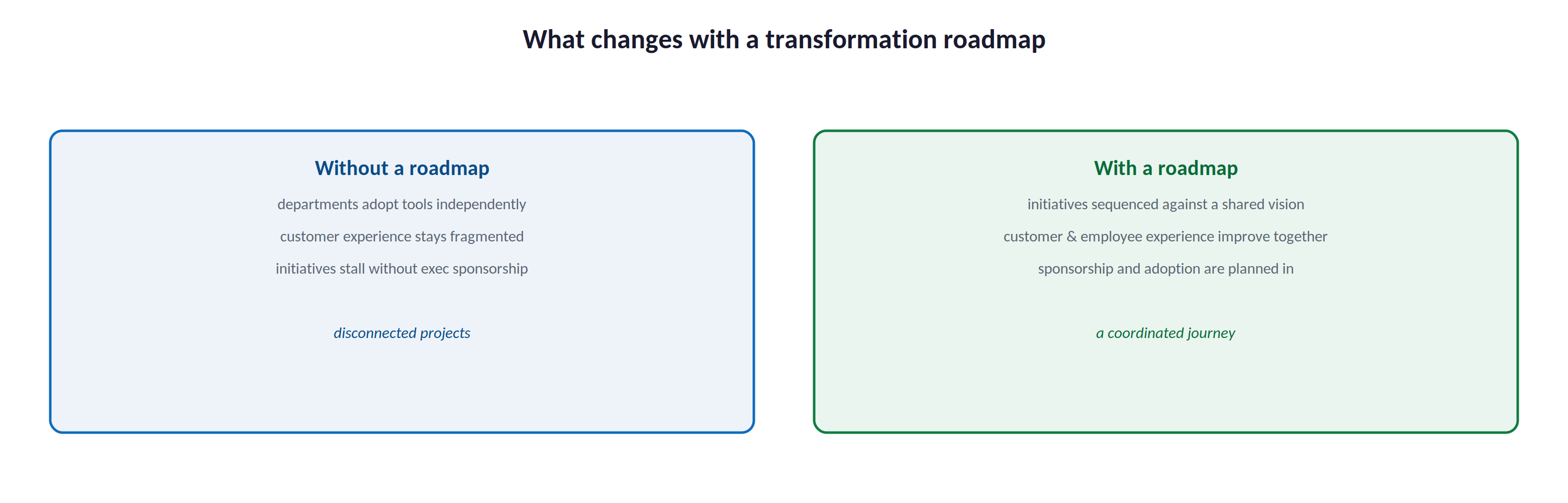
What changes with a transformation roadmap: without one, departments adopt tools independently, customer experience stays fragmented, and initiatives stall without executive sponsorship — disconnected projects; with one, initiatives are sequenced against a shared vision, customer and employee experience improve together, and sponsorship and adoption are planned in — a coordinated journey.
Without a roadmap, each department’s digitization effort solves a local problem while potentially creating a new inconsistency somewhere else — a new self-service portal that doesn’t connect to the system the support team still uses, for instance. Momentum depends entirely on whichever executive championed the last initiative, and it stalls the moment their attention moves on. With a roadmap, initiatives are sequenced so early efforts build toward later ones, customer and employee experience improve together instead of unevenly, and sponsorship and change management are planned as part of the program rather than left to chance.
How does the roadmap turn strategy into transformation?
The roadmap is the bridge between where the business is today and the future state leadership has defined.
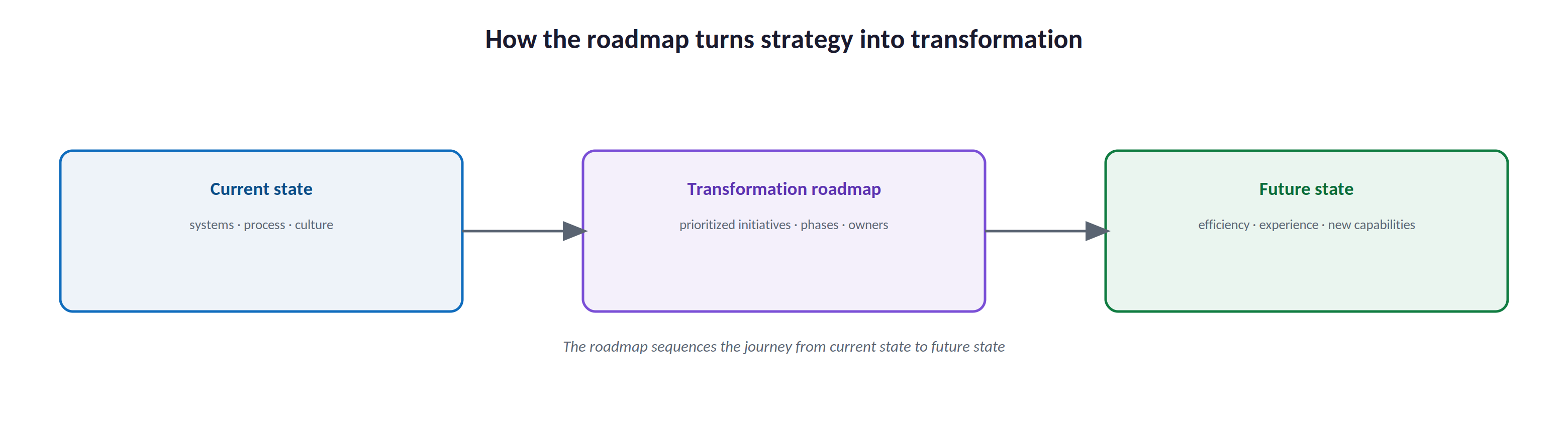
How the roadmap turns strategy into transformation: current state — systems, process, culture — feeds into the transformation roadmap, which sets prioritized initiatives, phases, and owners, which in turn produces the future state — efficiency, experience, and new capabilities. The roadmap sequences the journey from current state to future state.
An honest picture of the current state — not just systems, but process and culture — is the only reliable starting point, since transformation initiatives built on an inaccurate baseline tend to solve the wrong problem. The roadmap translates that baseline and the desired future state into a sequence: which initiatives happen first, who owns them, and what they cost. The future state then emerges in phases rather than all at once — each phase delivering a measurable piece of the efficiency, experience, or capability improvement the transformation was meant to achieve. Skip the roadmap and organizations tend to jump straight from current state to isolated initiatives, without the sequencing that makes each one build on the last.
What factors should shape the roadmap?
The right roadmap follows from an honest look at four dimensions of the business, not from whichever technology is generating the most industry attention.
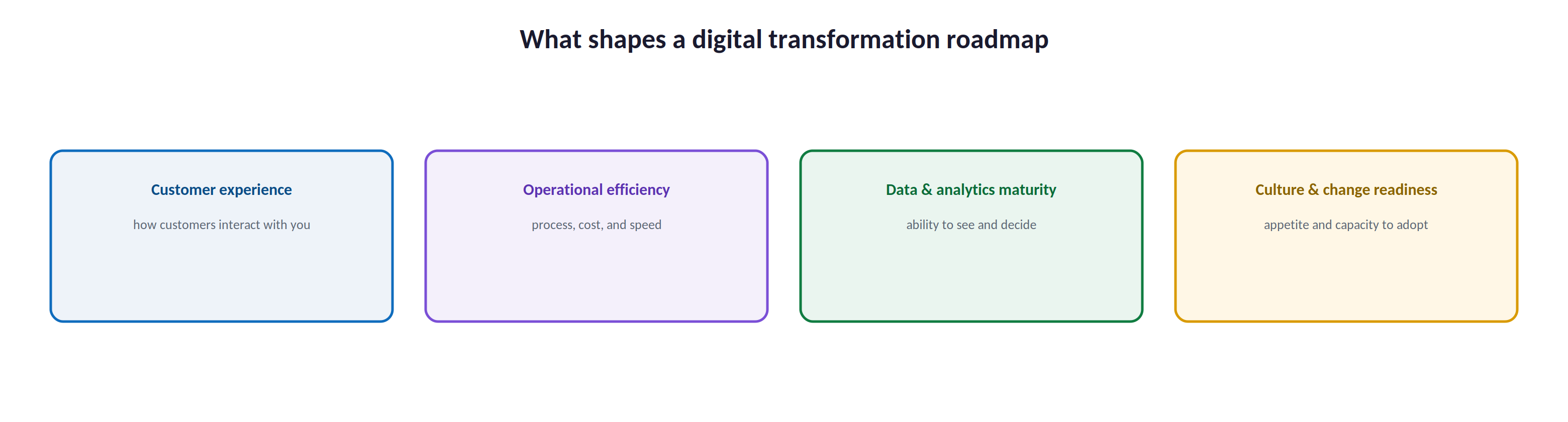
What shapes a digital transformation roadmap: customer experience (how customers interact with you), operational efficiency (process, cost, and speed), data and analytics maturity (ability to see and decide), and culture and change readiness (appetite and capacity to adopt).
The first factor is customer experience — how customers interact with the business today, and where digital tools could make that interaction faster, more consistent, or more personal. The second is operational efficiency: where manual, disconnected process is costing time or money that automation and integration could recover. The third is data and analytics maturity — how well the organization can currently see what’s happening, since many transformation initiatives depend on data the business doesn’t yet have in usable form. The fourth is culture and change readiness: how much appetite and capacity the organization actually has to adopt new ways of working, which determines how ambitious the pace of the roadmap can realistically be. A roadmap that accounts for all four earns adoption; one that only accounts for the technology tends to stall on the human side.
How is a digital transformation roadmap built in practice?
Building a digital transformation roadmap is a repeatable cycle, not a one-time strategy document, and it works best when each phase delivers a visible result that funds and justifies the next one.
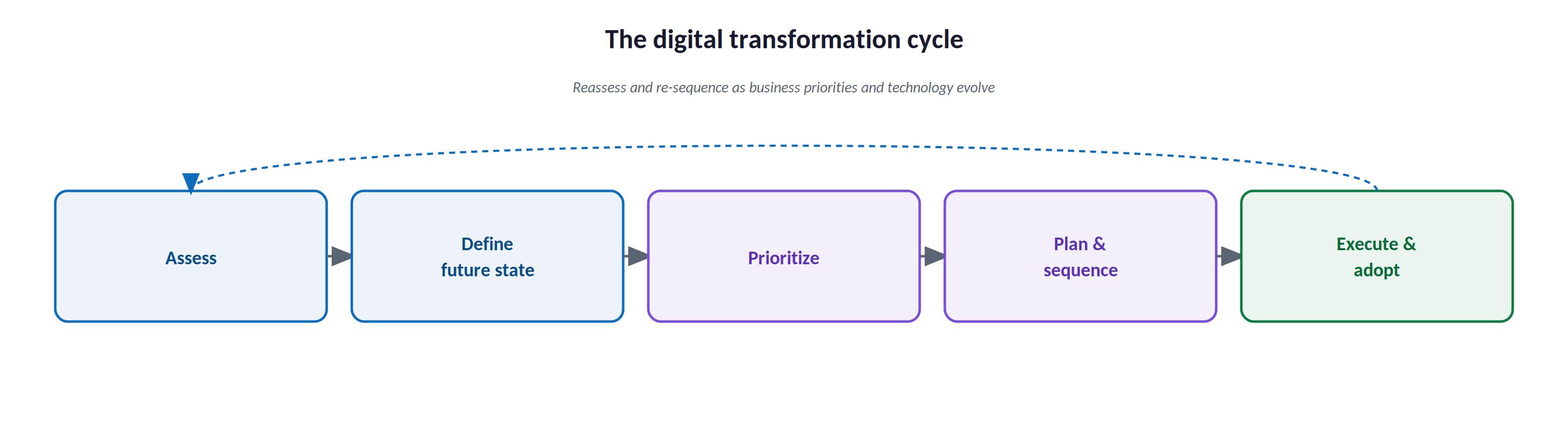
The digital transformation cycle: assess the current state, define the future state, prioritize candidate initiatives, plan and sequence them, and execute and adopt — looping back to assess as priorities and technology evolve. Reassess and re-sequence as business priorities and technology evolve.
The cycle starts with an honest assessment of current systems, process, data, and culture — the same discipline any serious planning effort needs. Defining the future state converts that assessment, plus leadership’s goals, into a measurable vision everyone can work toward. Prioritization ranks candidate initiatives by business value and feasibility, resisting the temptation to fund whichever department asks loudest. Planning and sequencing phases those initiatives with real budget, ownership, and timelines, aiming for early wins that build credibility for the initiatives that follow. Execution and adoption then delivers the work and — critically — tracks whether people are actually using what was built, since a deployed tool nobody adopts delivers no transformation at all.
Point-solution digitization vs a digital transformation roadmap at a glance
The comparison below summarizes the practical differences that most influence whether digital initiatives compound into real change or stay isolated.
| Dimension | Point-solution digitization | Digital transformation roadmap |
|---|---|---|
| Scope | One tool or department at a time | Cross-functional, tied to a shared vision |
| Driver | Whichever team requests a tool | Business objectives — experience, efficiency, growth |
| Sequencing | Ad hoc, opportunistic | Phased, prioritized by value and dependency |
| Change management | Often an afterthought | Planned alongside the technology |
| Ownership | IT or the requesting department | Executive sponsor plus cross-functional owners |
| Outcome measurement | Rarely tracked beyond adoption of the tool itself | KPIs tied to business outcomes |
| Main risk | Disconnected tools, inconsistent experience | Losing momentum without visible early wins |
| Scales by | Adding more disconnected tools | Sequencing the next phase against the same roadmap |
Transformation governance: ownership, categories, and scorecards
A transformation roadmap only stays credible if it’s governed the way leadership needs to evaluate it — who is responsible, what capability delivers it, the cadence, the risk if it stalls, and the business value it protects. The tables below frame a typical program with an executive sponsor and a transformation lead coordinating across departments.
Responsibility matrix (RACI)
| Transformation function | Activity | Responsible | Accountable | Consulted | Informed | Tooling category | Business impact |
|---|---|---|---|---|---|---|---|
| Current-state assessment | Audit systems, processes, data, culture | IT / transformation lead | CIO / exec sponsor | Department heads | Board | Process mapping / analytics | Accurate starting point |
| Future-state definition | Set the vision and measurable objectives | Exec sponsor | CEO | Department heads | Board | Strategy / roadmap | Shared direction |
| Use-case prioritization | Rank initiatives by value and feasibility | Transformation lead | Exec sponsor | Department heads, finance | End users | Roadmap / PM tooling | Highest-value work first |
| Roadmap & budget planning | Sequence initiatives with phased investment | Transformation lead / CIO | CFO | Department heads | Board | Financial planning / roadmap | Funded, sequenced plan |
| Change management & adoption | Prepare people and process for new ways of working | HR / transformation lead | Exec sponsor | Department heads | End users | Training / comms tooling | Sustained adoption |
| Execution & delivery | Implement initiatives across systems and process | IT / vendors | Transformation lead | Department heads | Exec sponsor | PM tooling / app platforms | Delivered capability |
| Measurement & review | Track KPIs, report progress | Transformation lead | Exec sponsor | Department heads | Board | Reporting / dashboards | Roadmap stays on track |
Initiative category matrix
| Category | Example initiatives | Description | Tooling category | Cadence | Risk if missing |
|---|---|---|---|---|---|
| Customer experience | Self-service portals, omnichannel support | Digitizing how customers interact with the business | CRM / CX platforms | Ongoing | Fragmented, inconsistent experience |
| Operations & process | Workflow automation, paperless processes | Removing manual steps and handoffs | Automation / workflow tools | Ongoing | Slower, error-prone operations |
| Data & analytics | Unified reporting, data integration | Turning scattered data into usable insight | BI / data platforms | Ongoing | Decisions made without visibility |
| People & culture | Digital skills training, new ways of working | Preparing the workforce for new tools and process | Training / change mgmt tooling | Ongoing | Low adoption, reverting to old habits |
| Technology foundation | Cloud migration, system consolidation | The infrastructure transformation runs on | Cloud / infrastructure | Project-based | New initiatives built on unstable foundations |
| Governance | Roadmap review, KPI tracking | Keeping the transformation on course | Reporting / dashboards | Quarterly | Initiatives drift from original vision |
Execution lifecycle
| Stage | Activity | Outcome | Tooling category | Business impact |
|---|---|---|---|---|
| Assess | Audit current systems, process, data, and culture | Documented baseline | Process mapping / analytics | Clear starting point |
| Define future state | Set vision and measurable objectives | Shared direction | Strategy / roadmap | Alignment on what “done” looks like |
| Prioritize | Rank use cases by business value and feasibility | Ranked initiative list | Roadmap / PM tooling | Focus on highest-value work |
| Plan & sequence | Phase initiatives with budget, owners, timeline | Funded, sequenced roadmap | Financial planning / roadmap | Predictable, achievable plan |
| Execute & adopt | Deliver initiatives and drive adoption | Delivered capability, sustained use | PM tooling / training | Realized business value |
Decision matrix
| Scenario | Recommended approach | Justification | Key consideration |
|---|---|---|---|
| No transformation plan exists | Start with a current-state assessment and a small set of early wins | Momentum and credibility come from visible early results | Target a 90-day first phase with measurable outcomes |
| Customer experience is the main driver | Lead with customer-facing initiatives | Value is most visible where customers feel it directly | Sequence internal process work to support it, not delay it |
| Legacy systems constrain everything | Lead with a technology foundation phase | New initiatives can’t scale on unstable infrastructure | Balance foundation work with at least one visible early win |
| Low organizational change readiness | Invest in change management before or alongside technology | Adoption failure is a leading cause of stalled transformation | Sponsor visibly and communicate the “why,” not just the “what” |
| Multiple departments competing for priority | Rank initiatives by business value and dependency, not politics | A shared framework prevents the loudest department winning by default | Get executive sponsorship to make the ranking stick |
| Board or investor scrutiny | Report the roadmap with phased KPIs and milestones | Leadership needs to see progress, not just a long-term vision | Tie every phase to a measurable business outcome |
Transformation KPI scorecard
| Metric | Target | Category | Business value |
|---|---|---|---|
| Initiatives delivered on schedule | ≥ 85% | Roadmap / PM tooling | Predictable execution |
| Adoption rate of new tools or processes | ≥ 80% within 90 days of launch | Training / change mgmt | Realized value, not shelfware |
| Customer experience metric (e.g. CSAT / NPS) | Improving trend | CRM / CX platforms | Visible customer impact |
| Process efficiency gain (time or cost per transaction) | Measurable reduction vs baseline | Process mapping / analytics | Demonstrated ROI |
| Data and reporting availability | Key metrics available within one day | BI / data platforms | Faster, better decisions |
| Roadmap review cadence | Quarterly | Reporting / dashboards | Plan stays aligned to business reality |
Implementation checklist
- Current systems, processes, data, and culture are honestly assessed
- A future-state vision is defined with measurable business objectives
- Candidate initiatives are prioritized by business value and feasibility, not politics
- The roadmap is phased with clear ownership, budget, and timeline
- Change management is planned alongside the technology, not after it
- Executive sponsorship is visible and communicated across the organization
- Early wins are targeted within the first 90 days to build momentum
- Adoption, not just deployment, is tracked as a measure of success
- KPIs tie each phase to a measurable business outcome
- The roadmap is reviewed and re-sequenced on a fixed cadence
Best practices
- Start from a current-state assessment, not from a list of trending technologies.
- Define the future state as a business outcome, not a list of new tools.
- Prioritize by business value and feasibility, not by which department asks loudest.
- Plan change management alongside the technology, not as an afterthought.
- Target visible early wins in the first 90 days to build momentum and credibility.
- Secure and maintain visible executive sponsorship throughout the program.
- Measure adoption, not just deployment, since unused tools deliver no value.
- Review and re-sequence the roadmap on a fixed cadence as the business changes.
Common mistakes
- Starting with tools and technology before defining the business outcome.
- Letting departments digitize independently with no shared roadmap.
- Treating change management as optional or an afterthought.
- Sequencing everything at once instead of phasing for early wins.
- Losing executive sponsorship partway through the program.
- Measuring deployment instead of adoption and business outcomes.
- Letting the roadmap become a static document nobody revisits.
- Underestimating how much legacy infrastructure constrains new initiatives.
Frequently asked questions
What is a digital transformation roadmap?
A digital transformation roadmap is a phased, prioritized plan for how an organization will use digital technology to change its processes, customer experience, and business model — sequenced against a shared vision, with ownership, budget, and measurable outcomes at each phase.
How is a digital transformation roadmap different from an IT roadmap?
An IT roadmap typically sequences infrastructure, applications, and security initiatives to keep technology running well. A digital transformation roadmap is broader — it includes business process, customer experience, and cultural change, and IT initiatives are just one part of it.
How long does a digital transformation take?
It varies significantly by scope. A focused initiative can show results within 90 days; a full enterprise transformation program often runs 12–24 months or longer, delivered in phases rather than all at once.
What causes digital transformation initiatives to fail?
Common causes include starting with technology instead of a business objective, skipping change management, losing executive sponsorship, and trying to do everything at once instead of sequencing for early wins.
Who should own a digital transformation roadmap?
Ownership is typically shared: an executive sponsor — often the CEO or COO — provides direction and authority, a transformation lead or CIO coordinates execution, and department heads own adoption within their teams.
How is success measured?
Through a mix of adoption metrics (is the new tool or process actually being used), efficiency metrics (time or cost saved), and experience metrics (customer or employee satisfaction), tied to the specific objectives each phase was meant to achieve.
Conclusion
A digital transformation roadmap is what turns a collection of software purchases into an actual transformation — the sequencing, ownership, and change management that make individual initiatives reinforce each other instead of working in isolation. Done well, it delivers visible early wins that build the credibility and sponsorship needed to sustain a multi-year program. Done poorly — technology bought ahead of a defined outcome, change management skipped, sponsorship allowed to lapse — it produces plenty of new tools and very little actual change.
The path forward is to build it deliberately: assess the current state honestly, define a future state in business terms, prioritize by value and feasibility rather than politics, phase the plan for early wins, and treat adoption — not deployment — as the real measure of success. Because the right roadmap reflects a business and a market that keep changing, the best transformation programs are the ones that get reassessed and re-sequenced, not the ones locked to the plan they started with.
References
This is a vendor-neutral overview of digital transformation roadmap planning. The following industry sources informed the definitions and comparisons; verify current market specifics independently before making a planning decision. Source access date: 17 August 2026.
- Digital Transformation Roadmap in Five Simple Steps — BOC Group
- Digital Transformation Roadmap: What It Is and Why It Matters — Lumivero
- Building a Digital Transformation Roadmap for Your Organization — AWS Executive Insights
- Digital Transformation Roadmap: Plan, Phase, and Execute It Right — InvGate
- Digital Transformation Roadmap Guide: Steps, Best Practices, and Real-World Examples — Afiniti Consultants
On this page
- Executive Summary
- What separates transformation from point-solution digitization?
- What changes when you have a roadmap?
- How does the roadmap turn strategy into transformation?
- What factors should shape the roadmap?
- How is a digital transformation roadmap built in practice?
- Point-solution digitization vs a digital transformation roadmap at a glance
- Transformation governance: ownership, categories, and scorecards
- Responsibility matrix (RACI)
- Initiative category matrix
- Execution lifecycle
- Decision matrix
- Transformation KPI scorecard
- Implementation checklist
- Best practices
- Common mistakes
- Frequently asked questions
- Conclusion
- References