Fractional CIO Services
Most growing businesses reach a point where technology decisions have outgrown whoever’s been making them.
- Content owner
- Insyto Content Team
- Editorial reviewer
- Ritesh Mhatre
- Technical reviewer
- Navish Ansari
- Next review
- To be scheduled
- Last reviewed
- Review pending
- Technical level
- Beginner · CIOs, CTOs, IT directors
IT Leadership · Executive & Business Topics
Executive Summary
Most growing businesses reach a point where technology decisions have outgrown whoever’s been making them. IT spend is significant enough to scrutinize, security risk is significant enough to govern, and the roadmap is complex enough to need someone thinking about it full-time — except the business isn’t ready for a six-figure executive hire. Fractional CIO services exist for exactly that gap: part-time, outsourced executive IT leadership that provides strategy, roadmap planning, budget oversight, and governance, without the cost or commitment of a permanent C-suite addition.
The stakes are real. Without strategic IT leadership, technology decisions get made ad hoc, IT has no voice in the room when the business sets priorities, and spend and risk go unexamined until something forces the issue. With the right fractional CIO engagement, the business gets executive judgment on where technology should go, a defensible budget, and a governed roadmap — proportional to what the business actually needs, not what a full-time hire happens to cost. Getting it right depends on scoping the engagement clearly: strategy and governance are the fractional CIO’s job; day-to-day operations stay with internal IT or a managed service provider.
This guide is a vendor-neutral walkthrough of fractional CIO services. It defines what the model is, explains how it differs from day-to-day IT support, sets out the factors that determine whether a business needs one, and provides the ownership, scope, and scorecard tables a business needs to structure and govern the engagement. It is deliberately provider-agnostic — the approach applies whether the fractional CIO comes from an MSP, an independent consultant, or a dedicated advisory firm — and focuses on the engagement model rather than any particular vendor.
Who should read this:
- Business owners and operators evaluating strategic IT leadership options
- CFOs and finance leaders weighing a fractional CIO against a full-time hire
- Internal IT teams and managers who would work alongside a fractional CIO
- Board members and investors evaluating technology governance and risk
What are fractional CIO services?
A fractional CIO — also called a virtual CIO or vCIO — is not an outsourced help desk, and it’s not the same as an MSP handling day-to-day support. It’s part-time executive leadership: strategy, roadmap, budget, and governance, delivered on a scoped, ongoing basis.
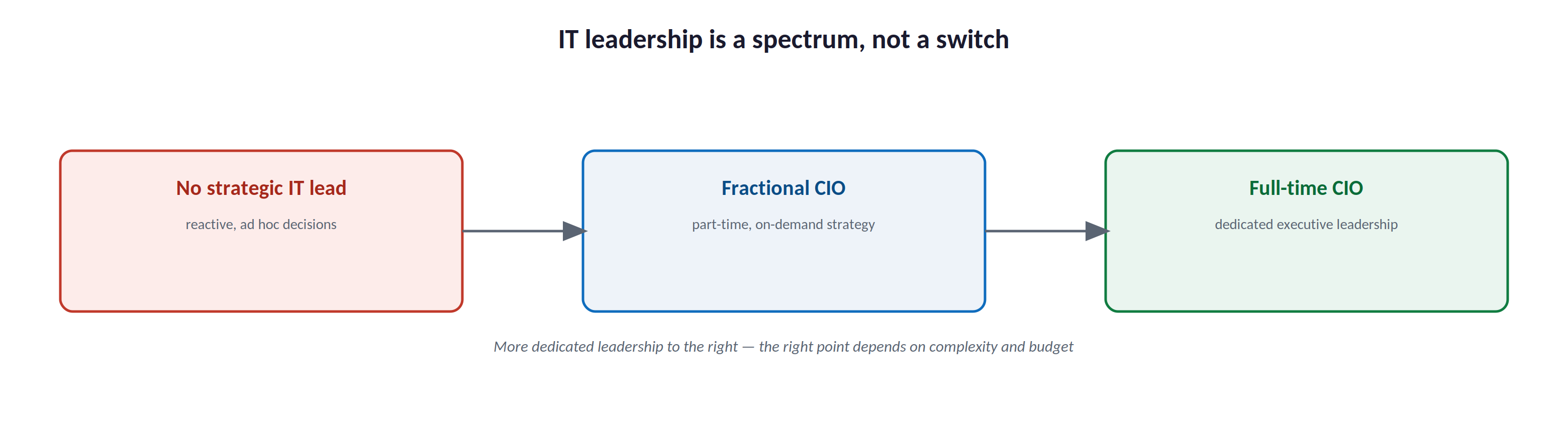
IT leadership is a spectrum, not a switch: from no strategic IT leadership, reactive and ad hoc, to a fractional CIO providing part-time, on-demand strategy, to a full-time CIO as dedicated executive leadership — more dedicated leadership to the right, with the right point depending on complexity and budget.
Most organizations start at the reactive end of this spectrum: technology decisions get made individually, by whoever’s available, with no single person accountable for whether they add up to a coherent strategy. Many eventually recognize the gap but aren’t ready for — or don’t need — a full-time executive, and bring in a fractional CIO instead: an experienced leader providing strategic direction on a defined, ongoing basis. Larger or more complex organizations eventually cross a threshold where the strategic workload justifies a dedicated, full-time CIO. None of these stages is wrong for every organization — the right point on the spectrum depends on complexity and budget, not company age — but the further right an organization sits, the more dedicated the leadership attention technology gets.
What changes when you bring one in?
The practical effect of a fractional CIO isn’t just another vendor relationship — it’s technology getting an actual seat at the leadership table.
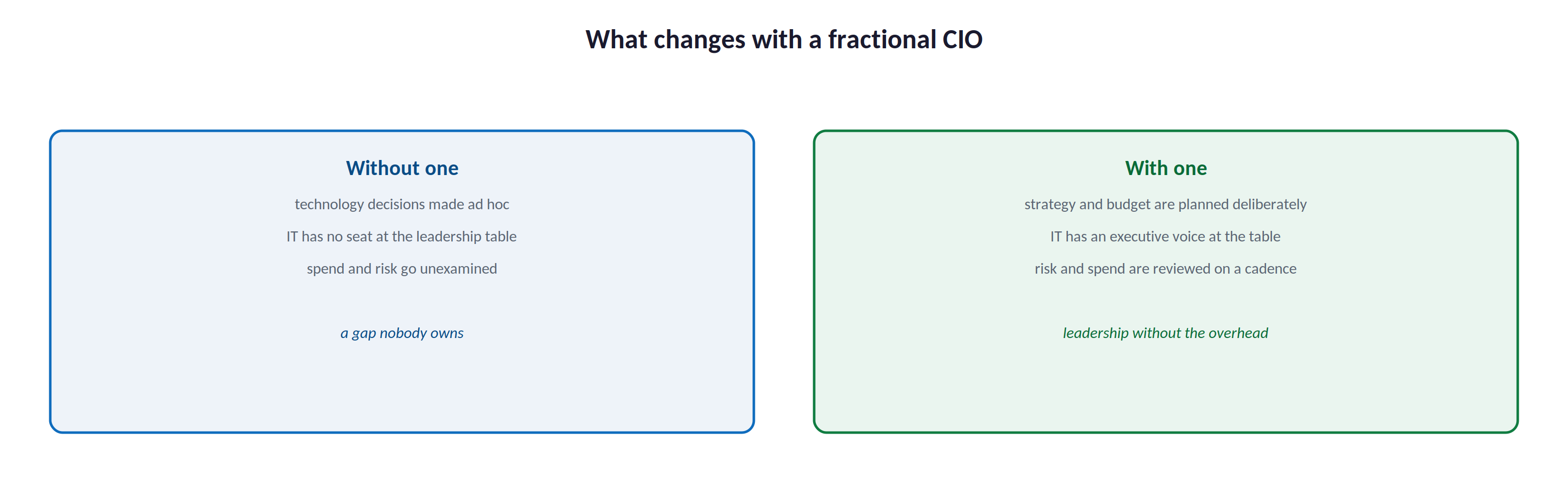
What changes with a fractional CIO: without one, technology decisions are made ad hoc, IT has no seat at the leadership table, and spend and risk go unexamined — a gap nobody owns; with one, strategy and budget are planned deliberately, IT has an executive voice at the table, and risk and spend are reviewed on a cadence — leadership without the overhead.
Without strategic IT leadership, every technology decision is essentially made in isolation — a renewal here, a new tool there — with nobody responsible for whether the sum of those decisions serves the business. Spend goes unexamined until a budget review forces the question, and risk goes unmanaged until an incident forces it into view. With a fractional CIO, the same decisions get made against a documented roadmap and budget, someone is accountable for whether IT spend and risk make sense, and leadership gets an experienced voice in the room — without carrying a full executive’s cost or org-chart weight.
How does a fractional CIO connect goals to execution?
A fractional CIO is the layer between what the business wants and how IT actually delivers it — without taking over delivery itself.
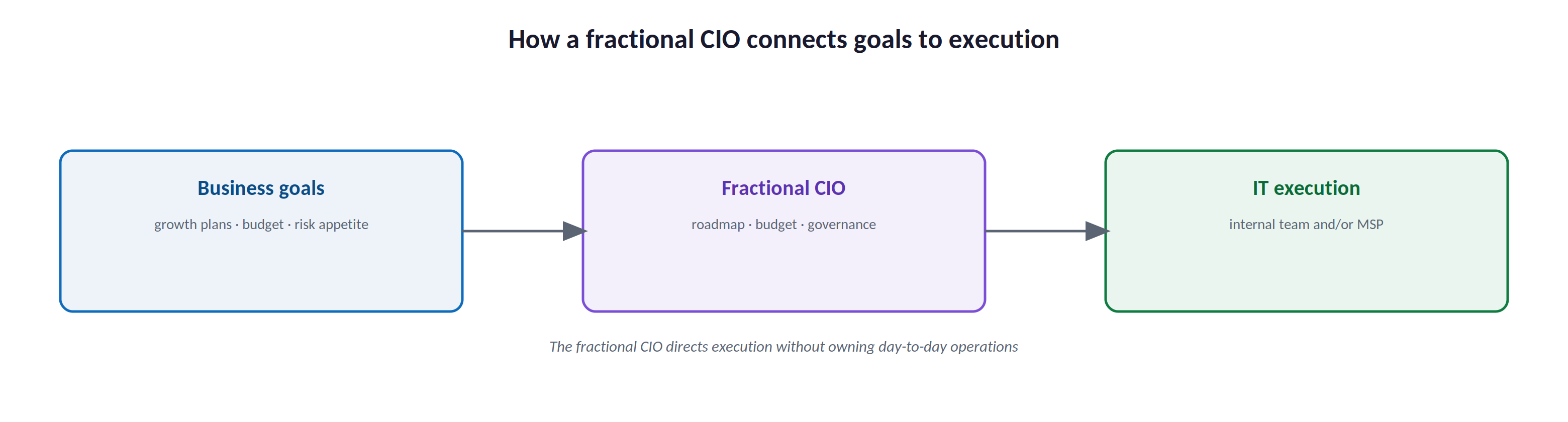
How a fractional CIO connects goals to execution: business goals — growth plans, budget, risk appetite — flow into the fractional CIO, who owns roadmap, budget, and governance, which in turn directs IT execution — carried out by the internal team and/or an MSP. The fractional CIO directs execution without owning day-to-day operations.
Business goals rarely translate directly into technology decisions on their own — a fractional CIO is the role that does that translation, converting growth plans, budget constraints, and risk appetite into a roadmap, a budget, and a governance structure. Execution then stays where it belongs: with an internal IT team, a managed service provider, or both. This separation is what makes the model work — the fractional CIO isn’t competing with internal IT or an MSP for operational control, but directing where their effort goes and holding them accountable for delivering it.
Which factors determine whether a business needs one?
The decision to bring in a fractional CIO follows from an honest look at four factors, not from company size alone.
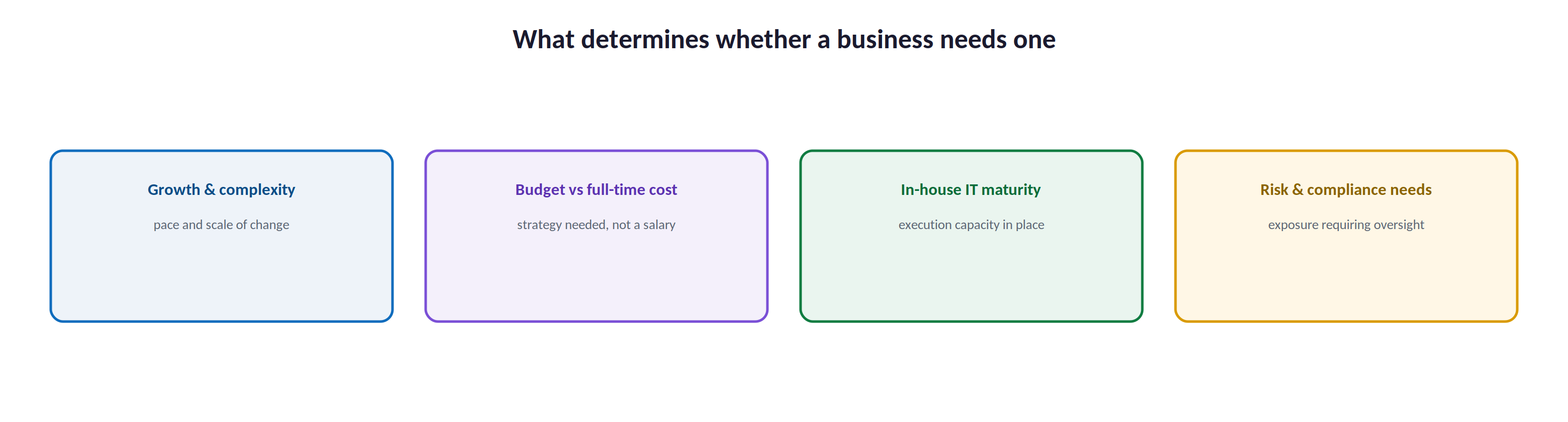
What determines whether a business needs one: growth and complexity (pace and scale of change), budget vs full-time cost (strategy needed, not a salary), in-house IT maturity (execution capacity in place), and risk and compliance needs (exposure requiring oversight).
The first factor is growth and complexity: businesses scaling quickly, entering new markets, or adding locations generate technology decisions faster than an ad hoc process can handle well. The second is the gap between what strategic leadership costs and what a full-time executive costs — many organizations need the judgment without needing 40 hours a week of it. The third is in-house IT maturity: a fractional CIO works best layered on top of a capable execution team, whether internal or an MSP, rather than filling an execution gap itself. The fourth is risk and compliance exposure — regulatory obligations or security risk significant enough to need dedicated oversight, not occasional attention. An organization strong on all four factors usually has an easy case for a fractional CIO; one weak on execution capacity may need to fix that gap first.
How does a fractional CIO engagement work in practice?
A fractional CIO engagement is a repeatable cycle, not a one-time consulting project, and it works best when it runs on a fixed cadence throughout the relationship.
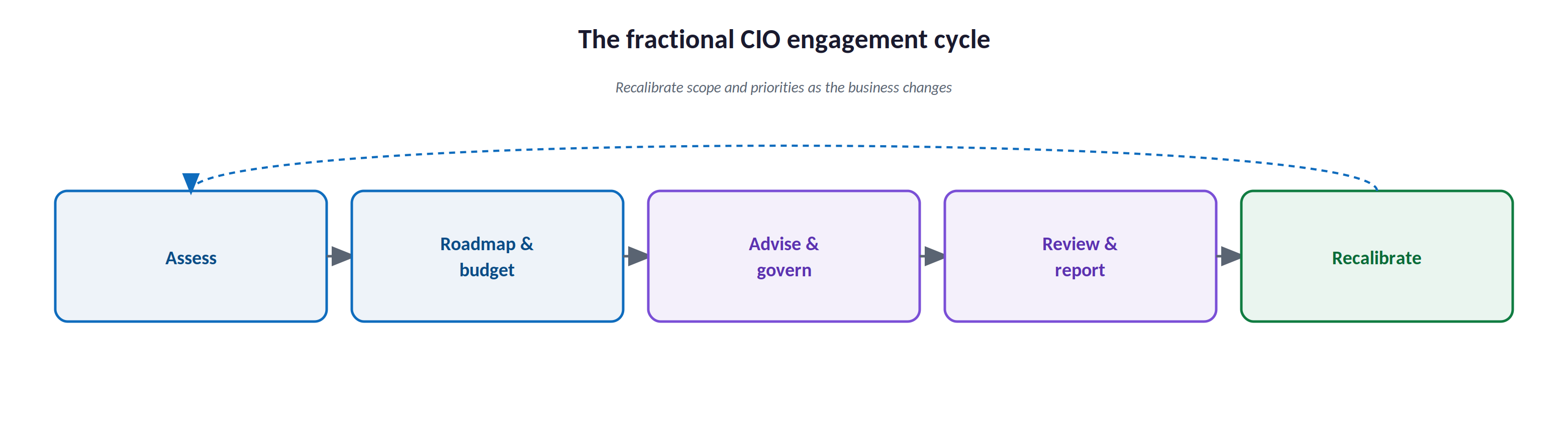
The fractional CIO engagement cycle: assess the current environment, build the roadmap and budget, advise and govern ongoing decisions, review and report to leadership, and recalibrate — looping back to assess as the business changes. Recalibrate scope and priorities as the business changes.
The cycle typically starts with an assessment of the current environment, spend, and risk — the same starting point any strategic engagement needs. Roadmap and budget building follows, usually within the first 90 days, converting that assessment into a funded, sequenced plan. Advising and governing is the ongoing core of the engagement: guiding decisions, overseeing vendors, and keeping risk in view between formal reviews. Review and reporting briefs leadership on progress against the roadmap, budget, and KPIs on a regular cadence. Recalibration closes the loop, adjusting the roadmap, budget, or even the engagement’s scope as the business’s needs change — because a fractional CIO engagement frozen at its original scope eventually stops fitting the business it serves.
Full-time CIO vs fractional CIO at a glance
The comparison below summarizes the practical differences that most influence which model fits a given organization.
| Dimension | Full-time CIO | Fractional CIO |
|---|---|---|
| Cost | Six-figure salary plus benefits and equity | A fraction of that, scaled to actual need |
| Time commitment | 40+ hours a week, one organization | Defined hours per month, often across a few clients |
| Time to start | Months-long executive search | Typically weeks |
| Scope | Strategy plus day-to-day leadership of IT staff | Strategy, roadmap, governance, vendor oversight |
| Day-to-day operations | Often involved directly | Stays with internal IT or an MSP |
| Best fit | Larger organizations needing full-time IT leadership | Growing or mid-market organizations needing strategy without a full executive |
| Main risk | High fixed cost, slow to hire or replace | Divided attention if over-committed across clients |
| Scales by | Growing an IT leadership team underneath them | Adding hours, or transitioning to full-time as needs grow |
Engagement governance: ownership, scope, and scorecards
A fractional CIO engagement only stays effective if it’s governed the way a business needs to evaluate it — who is responsible for what, the cadence, the risk if oversight lapses, and the business value it delivers. The tables below frame a typical engagement where the fractional CIO owns strategy and governance while internal IT or an MSP owns execution.
Responsibility matrix (RACI)
| Fractional CIO function | Activity | Responsible | Accountable | Consulted | Informed | Tooling category | Business impact |
|---|---|---|---|---|---|---|---|
| Strategy & roadmap | Set technology direction and priorities | Fractional CIO | CEO / exec sponsor | Department heads | Board | Roadmap / strategy | Technology aligned to goals |
| Budget planning | Build and defend the IT budget | Fractional CIO | CFO | Internal IT / MSP | Board | Financial planning | Predictable, defensible spend |
| Vendor & contract oversight | Evaluate and manage key vendors | Fractional CIO | Exec sponsor | Internal IT | Finance | PSA / contract mgmt | Better terms, reduced vendor risk |
| Risk & compliance governance | Oversee security and compliance posture | Fractional CIO | Exec sponsor | Compliance, security / MSP | Board | GRC / security tooling | Managed risk exposure |
| Day-to-day operations | Run tickets, systems, support | Internal IT / MSP | Fractional CIO (oversight) | End users | Fractional CIO | ITSM / RMM | Reliable daily service |
| Reporting & review | Present roadmap, budget, and KPI progress | Fractional CIO | CEO | Department heads | Board | Reporting / dashboards | Leadership visibility |
Engagement scope matrix
| Domain | Component | Description | Tooling category | Cadence | Risk if missing |
|---|---|---|---|---|---|
| Strategy | Roadmap ownership | Sets and maintains the IT roadmap | Roadmap / strategy | Annual / quarterly | Technology drifts from goals |
| Finance | Budget ownership | Builds and defends the IT budget | Financial planning | Annual / quarterly | Unplanned, undefended spend |
| Governance | Vendor oversight | Evaluates contracts and vendor performance | PSA / contract mgmt | Ongoing | Poor terms, vendor risk |
| Risk | Security & compliance oversight | Ensures risk posture matches obligations | GRC / security | Quarterly | Unmanaged exposure |
| Operations | Day-to-day IT | Handled by internal team or MSP, not the fCIO | ITSM / RMM | Continuous | Confusion over who owns what |
| Reporting | Executive reviews | Regular briefings to leadership | Reporting / dashboards | Monthly / quarterly | Leadership loses visibility |
Engagement lifecycle
| Stage | Activity | Outcome | Tooling category | Business impact |
|---|---|---|---|---|
| Assess | Audit current environment, spend, and risk | Documented baseline | Asset / RMM | Clear starting point |
| Roadmap & budget | Set priorities, sequence initiatives, phase costs | Funded roadmap | Roadmap / financial planning | Aligned, defensible plan |
| Advise & govern | Guide decisions, oversee vendors and risk | Ongoing strategic input | GRC / PSA | Better decisions, managed risk |
| Review & report | Brief leadership on progress and KPIs | Shared visibility | Reporting / dashboards | Informed leadership |
| Recalibrate | Adjust roadmap or budget as goals or risk change | Updated plan | Strategy / roadmap | Plan stays current |
Decision matrix
| Scenario | Recommended approach | Justification | Key consideration |
|---|---|---|---|
| No strategic IT leadership today | Start with a fractional CIO engagement | Provides executive-level direction without a full-time hire | Define scope clearly against internal IT / MSP responsibilities |
| Rapid growth, increasingly complex decisions | Fractional CIO with a defined roadmap and budget mandate | Growth raises the cost of misaligned technology decisions | Revisit engagement scope every 6–12 months |
| Heavy compliance or security exposure | Pair a fractional CIO with dedicated security oversight | Compliance often needs depth a generalist fCIO lacks alone | Clarify where CIO and security responsibilities split |
| Internal IT team exists, but no strategic leadership | Layer a fractional CIO on top of internal IT | Internal team executes; the fCIO sets direction and governs | Keep operational ownership clearly with internal IT |
| Considering a full-time CIO hire | Use a fractional CIO first to validate scope and need | Clarifies the role before committing to a six-figure hire | Track workload and hours to build the business case |
| Multiple locations or business units | Fractional CIO with a standardized governance cadence | Consistency matters more than any single site’s preference | Standardize reporting across all units |
Engagement KPI scorecard
| Metric | Target | Tooling category | Business value |
|---|---|---|---|
| Roadmap initiatives delivered on schedule | ≥ 85% | Roadmap / PM tooling | Predictable execution |
| Budget variance | Within ±10% of plan | Financial planning | Cost predictability |
| Executive / board review cadence | Monthly or quarterly, as scoped | Reporting / dashboards | Consistent leadership visibility |
| Vendor contracts reviewed annually | 100% | PSA / contract mgmt | Reduced vendor risk, better terms |
| Critical risk items addressed | 100% within planned window | GRC / security | Reduced exposure |
| Engagement hours vs scope | Within agreed range | PSA / time tracking | Engagement stays sustainable |
Implementation checklist
- Current IT environment, spend, and risk are assessed before the engagement starts
- Scope is clearly defined against internal IT / MSP operational responsibilities
- A roadmap and budget are built, or refreshed, within the first 90 days
- Vendor contracts and key relationships are reviewed for terms and risk
- Security and compliance posture is assessed against actual obligations
- A regular executive reporting cadence is scheduled and calendared
- Engagement hours are tracked against the agreed scope
- The engagement is reviewed periodically to confirm it still fits the business
- A path exists to transition to full-time leadership if the business outgrows the model
- Success is measured against defined KPIs, not just activity
Best practices
- Define scope clearly upfront: strategy and governance, not day-to-day operations.
- Use the first 90 days to build or refresh the roadmap and budget.
- Give the fractional CIO a real seat at the leadership table, not just a vendor role.
- Review vendor contracts and terms early; they’re often an easy early win.
- Set a fixed reporting cadence so leadership sees consistent progress.
- Revisit the engagement scope periodically as the business grows.
- Track hours against scope so the engagement stays sustainable for everyone.
- Treat the model as a stepping stone, not a permanent substitute, if growth eventually demands full-time leadership.
Common mistakes
- Blurring the line between strategic oversight and day-to-day IT operations.
- Hiring a fractional CIO without clarifying who owns execution.
- Treating the engagement as a vendor relationship instead of leadership.
- Skipping the initial assessment and jumping straight to recommendations.
- Setting no fixed reporting cadence, so leadership loses visibility over time.
- Never revisiting scope as the business outgrows the original engagement.
- Choosing based on price alone rather than fit with business complexity.
- Expecting a generalist fractional CIO to also cover deep security or compliance work without support.
Frequently asked questions
What is a fractional CIO?
A fractional CIO — also called a virtual CIO or vCIO — is a part-time, outsourced executive who provides technology strategy, roadmap planning, budget oversight, and governance, without the cost and commitment of a full-time hire.
How is a fractional CIO different from an MSP?
An MSP typically handles day-to-day IT operations — tickets, monitoring, support. A fractional CIO focuses on strategy, budget, and governance. Many organizations get both from the same provider, with clearly separated roles.
What size business needs a fractional CIO?
There’s no fixed threshold, but the need typically emerges as a business grows past ad hoc IT decision-making — often in the 20–500 employee range — and technology spend and risk become significant enough to require dedicated strategic oversight.
How much does a fractional CIO cost compared to a full-time CIO?
A full-time CIO typically commands a six-figure salary plus benefits and equity. A fractional CIO is scoped to actual need — often a defined number of hours per month — at a fraction of that total cost.
Can a fractional CIO work alongside an internal IT team?
Yes, and this is a common model: the fractional CIO sets strategy, roadmap, and governance, while the internal team, or an MSP, continues to own day-to-day operations.
When should a business transition from fractional to full-time CIO leadership?
When the complexity, budget, and strategic workload consistently exceed what a part-time engagement can reasonably cover — often signaled by IT becoming a full-time coordination job on its own, not just an advisory one.
Conclusion
Fractional CIO services exist for the gap between ad hoc technology decisions and a full-time executive hire — a gap most growing businesses pass through, whether or not they name it. Done well, the model gives leadership real strategic judgment on technology, a defensible roadmap and budget, and governance over risk and vendors, scoped to what the business actually needs. Done poorly — scope blurred with day-to-day operations, or treated as just another vendor relationship — it produces neither the strategic value of a CIO nor the operational reliability of an MSP.
The path forward is to structure the engagement deliberately: assess honestly, build a roadmap and budget early, keep execution clearly separated from strategic oversight, report to leadership on a fixed cadence, and revisit the arrangement as the business changes. Because the right model depends on where a business sits on the leadership spectrum today, not where it sat when the engagement started, the best fractional CIO relationships are the ones that get recalibrated as growth changes what the business actually needs.
References
This is a vendor-neutral overview of fractional CIO services. The following industry sources informed the definitions and comparisons; verify current market specifics independently before making an engagement decision. Source access date: 17 August 2026.
- Fractional CIO and vCISO Services: The Complete Guide for Mid-Market Companies — Meriplex
- 5 Signs Your Business Needs a Fractional CIO — GXA IT Consulting
- Benefits of a vCIO: Virtual CIO Services for SMB IT Strategy — Hero Managed
- What Is a vCIO? Role, Benefits & When You Need One — Anders
- Virtual CIO: What It Is, What It Does, and Why It’s a Smart Opportunity for Small Businesses — Ardham Technologies
On this page
- Executive Summary
- What are fractional CIO services?
- What changes when you bring one in?
- How does a fractional CIO connect goals to execution?
- Which factors determine whether a business needs one?
- How does a fractional CIO engagement work in practice?
- Full-time CIO vs fractional CIO at a glance
- Engagement governance: ownership, scope, and scorecards
- Responsibility matrix (RACI)
- Engagement scope matrix
- Engagement lifecycle
- Decision matrix
- Engagement KPI scorecard
- Implementation checklist
- Best practices
- Common mistakes
- Frequently asked questions
- Conclusion
- References