Business Continuity Planning: Keeping the Whole Business Running Through Disruption
Disruptions are not a question of if but when.
- Content owner
- Insyto Content Team
- Editorial reviewer
- Ritesh Mhatre
- Technical reviewer
- Navish Ansari
- Next review
- To be scheduled
- Last reviewed
- Review pending
- Technical level
- Intermediate · IT directors, infrastructure and recovery teams
Executive Summary
Disruptions are not a question of if but when. A cyberattack, a fire, a flood, a supplier collapse, a power outage, a pandemic, or simply the sudden loss of a key person — every organization will eventually face an event that threatens its ability to operate. Business continuity planning (BCP) is the discipline of preparing for those events so that the organization keeps functioning through them, rather than grinding to a halt and hoping to recover afterward. It is fundamentally a business concern, not merely a technical one: the goal is to keep serving customers, paying staff, fulfilling orders, and meeting obligations even when part of the operation has been knocked out.
Business continuity is often confused with disaster recovery, and the distinction matters. Disaster recovery is about restoring IT systems and data after an outage; it is a vital capability, but it is only one piece of the puzzle. Business continuity is broader — it encompasses people, facilities, suppliers, and communications as well as technology, and it asks not only “how do we get the systems back?” but “how do we keep the business running in the meantime, whatever has failed?” A company can have flawless IT disaster recovery and still collapse if its only skilled operator is unreachable, its building is inaccessible, or its sole supplier goes dark. BCP addresses the whole picture.
This vendor-neutral guide lays out how to build a business continuity capability that works. It clarifies the difference between BCP and disaster recovery, walks through the continuity lifecycle from risk assessment to maintenance, explains the business impact analysis that determines what to protect first, sets out continuity strategies for each type of resource an organization depends on, and covers the testing and communications that turn a document into a genuine capability. Grounded in the established international standard for business continuity and public-sector guidance, the aim is a plan that is prioritized by real impact, exercised regularly, and ready to keep the business running when disruption arrives.
Business Continuity vs Disaster Recovery
The most important clarification at the outset is what BCP is and how it relates to the disaster recovery many organizations already have. They are related but not the same, and treating them as interchangeable leaves dangerous gaps.
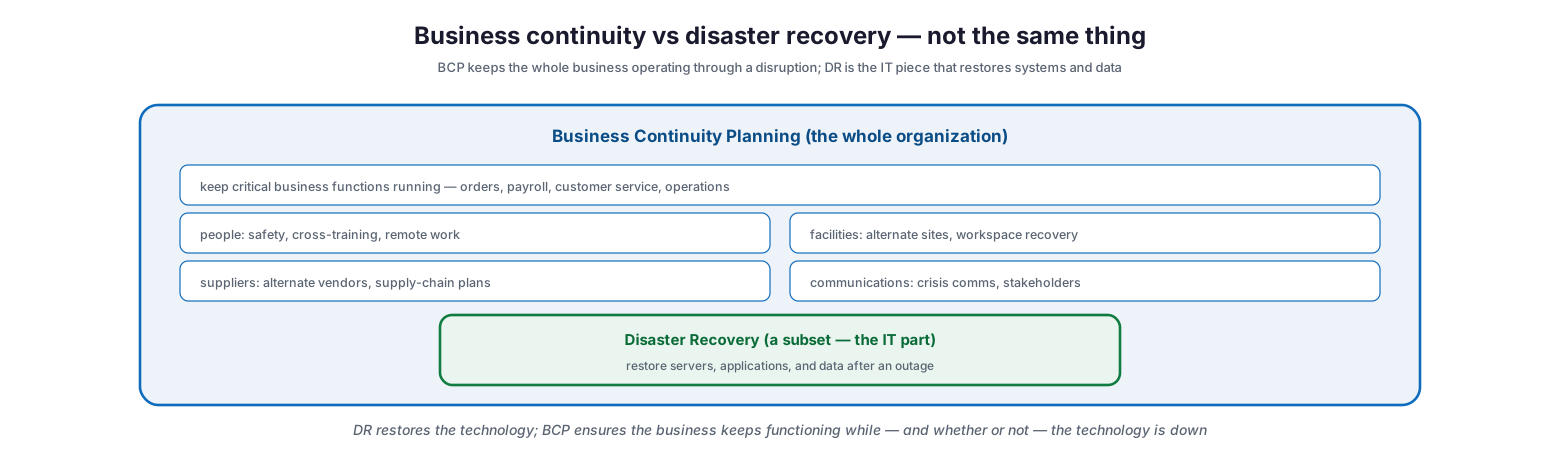
Business continuity vs disaster recovery — not the same thing
Business continuity planning covers the whole organization: keeping critical business functions running — order processing, payroll, customer service, operations — through a disruption. It spans people (safety, cross-training, remote work), facilities (alternate sites, workspace recovery), suppliers (alternate vendors and supply-chain plans), and communications (crisis communications and stakeholder management), as well as technology. Disaster recovery sits inside this broader picture as the IT-specific subset: restoring servers, applications, and data after an outage. The essential insight is that DR restores the technology, while BCP ensures the business keeps functioning while — and whether or not — the technology is available. An organization needs both, but if it has only disaster recovery, it has planned for the systems and forgotten the business that runs on them.
The Continuity Lifecycle
Business continuity is not a document you write once and file away; it is a continuous cycle. A plan that is never exercised or updated quietly decays until it is useless at the moment it is needed.
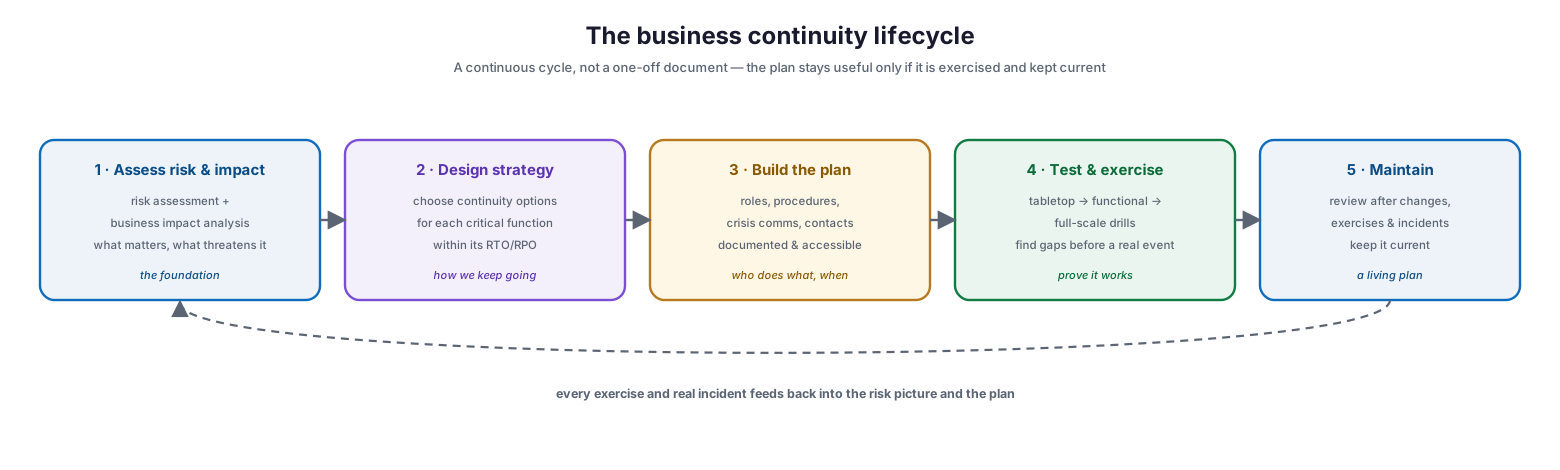
The business continuity lifecycle
The cycle begins with assessing risk and impact — a risk assessment identifying the threats the organization faces, paired with a business impact analysis identifying what matters and what would happen if it stopped. From that foundation comes strategy design: choosing continuity options for each critical function that fit within its recovery targets. Those choices are then built into a plan — roles and responsibilities, response procedures, crisis communications, and contact information, documented and accessible even when systems are down. The plan is then tested and exercised, from tabletop discussions through functional tests to full-scale drills, to find gaps before a real event does. And finally it is maintained: reviewed after organizational changes, exercises, and actual incidents, so it stays current. Each exercise and every real incident feeds back into the risk picture and the plan, which is why continuity is drawn as a loop rather than a line.
The risk assessment that opens the cycle should consider the full range of threats an organization faces, not just the obvious ones:
| Threat category | Examples | Typical continuity concern |
|---|---|---|
| Natural | Flood, fire, storm, earthquake | Facility loss, access denial |
| Technical | System outage, data corruption, network failure | IT downtime, data loss |
| Cyber | Ransomware, breach, DDoS | Data/system unavailability, trust |
| Human | Key-person loss, error, strike, illness | Skills and staffing gaps |
| Supply chain | Vendor failure, logistics disruption | Input shortages, delivery delays |
| Utility / external | Power, telecoms, pandemic, civil disruption | Broad, multi-resource impact |
| Stage | Purpose | Output |
|---|---|---|
| Assess risk & impact | Understand threats and what matters | Risk assessment + BIA |
| Design strategy | Decide how to keep each function going | Continuity strategies per function |
| Build the plan | Document roles, procedures, comms | Actionable continuity plan |
| Test & exercise | Prove the plan and find gaps | Validated plan, lessons learned |
| Maintain | Keep the plan current | Reviewed, up-to-date plan |
The Business Impact Analysis
At the heart of every credible continuity plan is the business impact analysis (BIA). It is the step that turns “we should be prepared” into a prioritized, defensible set of decisions about what to protect and how fast to recover it.
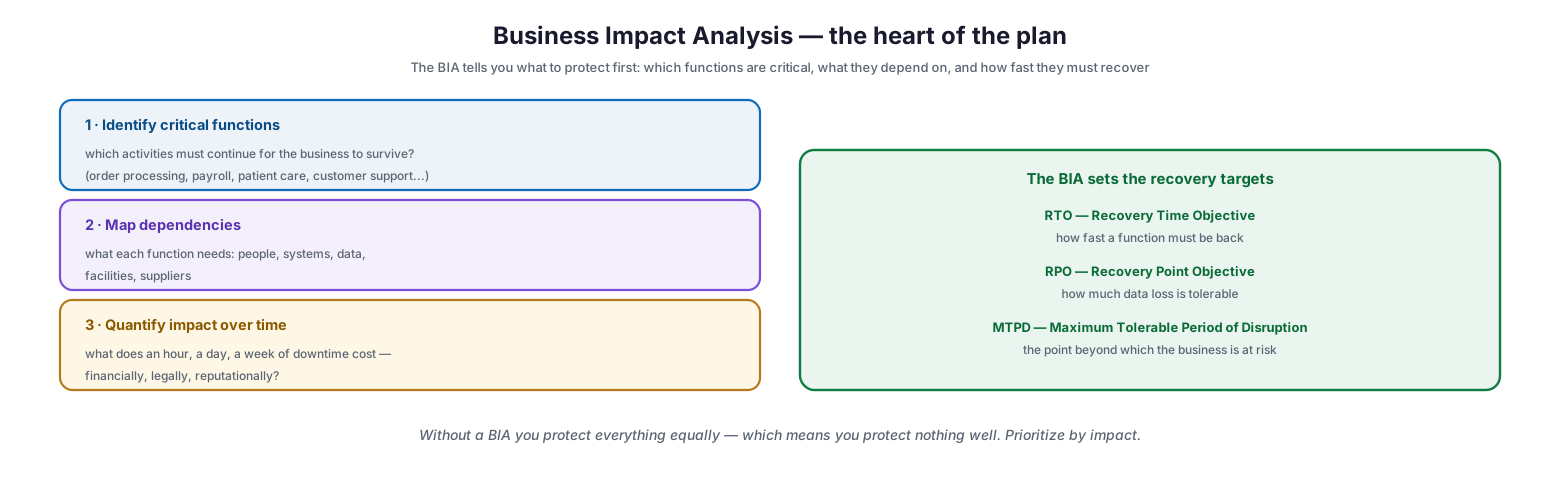
Business Impact Analysis — the heart of the plan
The BIA proceeds in three steps. First, identify the critical functions — the activities that must continue for the business to survive, such as order processing, payroll, patient care, or customer support. Second, map their dependencies — what each function needs to operate: people, systems, data, facilities, and suppliers. Third, quantify the impact over time — what an hour, a day, or a week of disruption would cost the organization financially, legally, and reputationally. From this analysis flow the recovery targets that drive the entire plan: the Recovery Time Objective (RTO), how fast a function must be back; the Recovery Point Objective (RPO), how much data loss is tolerable; and the Maximum Tolerable Period of Disruption (MTPD), the point beyond which the business itself is at risk. The value of the BIA is prioritization: without it, an organization tries to protect everything equally, which in practice means it protects nothing well. The BIA ensures effort and investment go where the impact is greatest.
Continuity Strategies by Resource
Once the BIA has identified the critical functions and their dependencies, the plan needs a concrete answer for what to do when each dependency is unavailable. Those dependencies fall into four resource types, and a complete strategy addresses each.
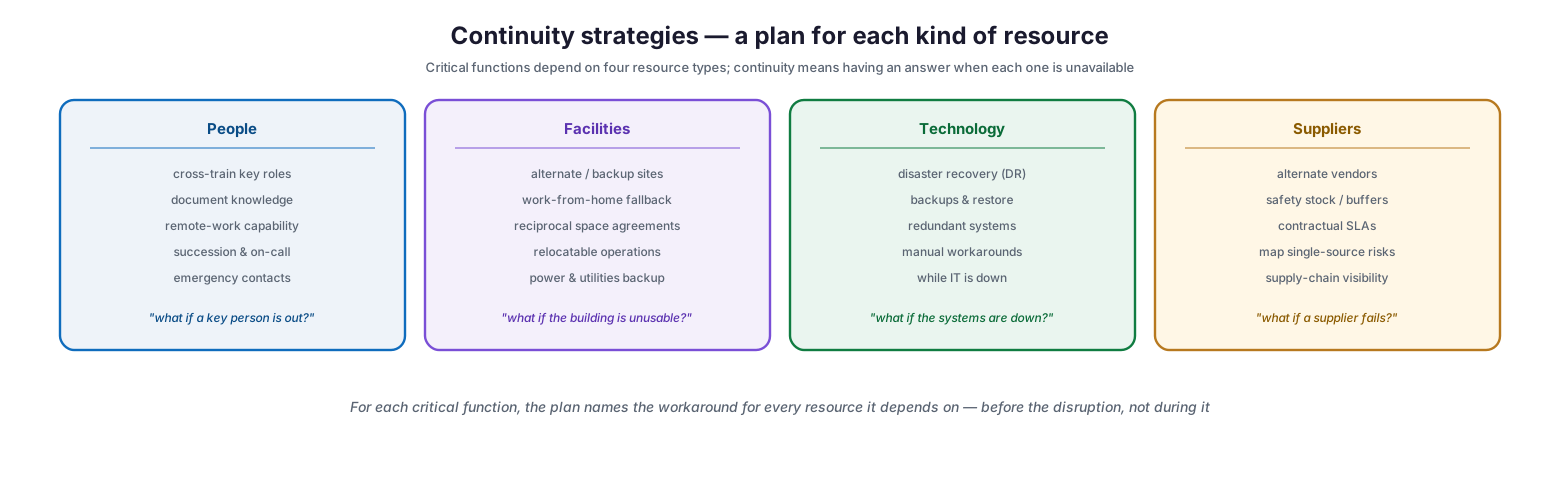
Continuity strategies — a plan for each kind of resource
For people, the strategies are cross-training key roles, documenting knowledge so it is not locked in one head, enabling remote work, planning succession and on-call coverage, and maintaining emergency contacts — answering “what if a key person is out?” For facilities, they are alternate or backup sites, a work-from-home fallback, reciprocal space arrangements, relocatable operations, and backup power and utilities — answering “what if the building is unusable?” For technology, they are disaster recovery, backups and restore, redundant systems, and crucially the manual workarounds that keep a function going while IT is down — answering “what if the systems are down?” And for suppliers, they are alternate vendors, safety stock and buffers, contractual service-level agreements, mapping single-source risks, and supply-chain visibility — answering “what if a supplier fails?” For each critical function, a good plan names the workaround for every resource it depends on, decided calmly in advance rather than improvised in the middle of a crisis.
| Resource | Key question | Example strategies |
|---|---|---|
| People | What if a key person is out? | Cross-training, documentation, remote work, succession |
| Facilities | What if the building is unusable? | Alternate sites, work-from-home, backup power |
| Technology | What if the systems are down? | DR, backups, redundancy, manual workarounds |
| Suppliers | What if a supplier fails? | Alternate vendors, safety stock, SLAs, risk mapping |
Testing, Communications, and Governance
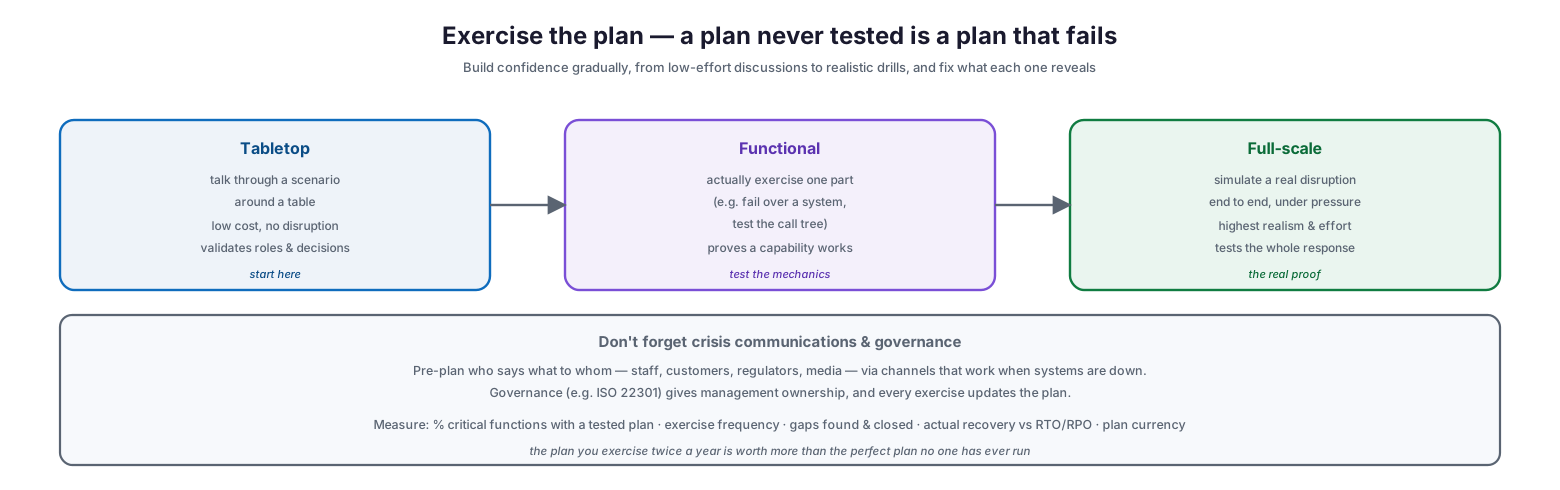
A plan that has never been tested is an assumption, and assumptions fail under pressure. Exercising the plan is what converts a document into a genuine capability, and it should build up gradually.
Exercise the plan — a plan never tested is a plan that fails
Exercises progress in realism and effort. A tabletop exercise talks through a scenario around a table — low cost, no disruption, and excellent for validating roles and decisions; it is where organizations should start. A functional exercise actually exercises one part of the plan, such as failing over a system or testing the emergency call tree, proving a specific capability works. A full-scale exercise simulates a real disruption end to end and under pressure, the highest realism and the truest proof of the whole response. Alongside testing, two things are easy to overlook. Crisis communications must be pre-planned — who says what, to whom (staff, customers, regulators, media), and through channels that still work when systems are down. And governance gives the whole effort ownership: adopting a recognized standard such as ISO 22301 puts management behind business continuity as a managed discipline, and every exercise and incident should feed updates back into the plan. The practical truth is that a modest plan exercised twice a year is worth far more than a perfect plan no one has ever run.
Business Continuity Planning Checklist
- Distinguish BCP from DR: plan for the whole business, not just IT recovery.
- Conduct a risk assessment covering natural, technical, human, supply-chain, and cyber threats.
- Perform a business impact analysis: identify critical functions, map dependencies, quantify impact over time.
- Set RTO, RPO, and MTPD for each critical function based on the BIA.
- Design continuity strategies for people, facilities, technology, and suppliers.
- Include manual workarounds to keep functions running while IT is being recovered.
- Document the plan with clear roles, procedures, and contacts, accessible when systems are down.
- Pre-plan crisis communications for staff, customers, regulators, and the public.
- Exercise the plan regularly, progressing from tabletop to functional to full-scale.
- Capture lessons from every exercise and real incident, and update the plan.
- Establish governance and management ownership, aligned to a recognized standard.
- Review and maintain the plan on a schedule and after any significant change.
Best Practices
Plan for the business, not just the systems. Disaster recovery restores technology, but continuity is about keeping the organization operating. Address people, facilities, and suppliers with the same rigor you apply to IT.
Let the BIA set priorities. Do not try to protect everything equally. Use the business impact analysis to identify what is truly critical and focus effort and investment where disruption would hurt most.
Have manual workarounds ready. Technology will sometimes be down longer than anyone wants. Knowing how to keep a critical function running on paper, by phone, or through an alternate process buys precious time.
Pre-plan communications. In a crisis, silence and confusion do their own damage. Decide in advance who communicates what to each audience, and through channels that survive an outage.
Exercise regularly and realistically. A plan proves itself only when run. Start with tabletops, progress to functional and full-scale exercises, and treat every gap found as a success, not a failure.
Keep it alive. Organizations, people, systems, and suppliers change constantly. Review the plan on a schedule and after every significant change, exercise, or incident so it reflects reality when needed.
Common Mistakes
Equating DR with BCP. Believing that IT disaster recovery covers business continuity leaves people, facilities, suppliers, and communications unplanned — and any of those can halt the business on its own.
Skipping the BIA. Without a business impact analysis, plans protect the wrong things or spread effort so thinly that nothing is genuinely resilient. Prioritization by impact is essential.
Writing a plan and shelving it. A continuity plan that is never exercised or updated becomes fiction. Untested procedures and stale contacts fail exactly when they are needed.
Ignoring the human element. Plans that focus only on systems overlook that people execute them. Cross-training, contacts, and clear roles are as important as any technical control.
Forgetting communications. Recovering operations while failing to communicate with staff, customers, and regulators turns a manageable incident into a reputational crisis.
Treating it as a one-time project. Continuity is a lifecycle, not a deliverable. Organizations that “did BCP” once and moved on are protected only against the world as it was on the day they finished.
Frequently Asked Questions
What is the difference between business continuity and disaster recovery? Disaster recovery restores IT systems and data after an outage. Business continuity is broader — it keeps the whole organization functioning through a disruption, covering people, facilities, suppliers, and communications as well as technology. DR is one component of BCP.
What is a business impact analysis? A BIA identifies the organization’s critical functions, maps what they depend on, and quantifies the impact of their disruption over time. It produces the recovery targets — RTO, RPO, and MTPD — that determine what to protect first and how quickly it must be restored.
What do RTO, RPO, and MTPD mean? RTO (Recovery Time Objective) is how quickly a function must be restored. RPO (Recovery Point Objective) is how much data loss is acceptable. MTPD (Maximum Tolerable Period of Disruption) is the longest a function can be down before the business is seriously threatened.
How often should we test the business continuity plan? At least annually, and after any significant change to the organization, its systems, or its suppliers. Build up from low-effort tabletop exercises to functional and full-scale drills, and update the plan with what each one reveals.
What is ISO 22301? ISO 22301 is the international standard for business continuity management systems. It provides a framework for establishing, running, and improving business continuity as a governed, management-owned discipline, and adopting it signals a mature, auditable approach.
Do small businesses need a continuity plan? Yes. Smaller organizations are often more vulnerable to disruption because they have less redundancy — fewer people, single suppliers, one location. A right-sized continuity plan, focused on the few truly critical functions, can be the difference between surviving a disruption and not.
Conclusion
Business continuity planning is how an organization ensures it can keep operating when something goes wrong — not by preventing every disruption, which is impossible, but by preparing to function through them. It is broader than disaster recovery: where DR restores the technology, BCP keeps the whole business running, spanning the people, facilities, suppliers, and communications that a company depends on as much as its systems. The discipline turns on a clear-eyed business impact analysis that prioritizes what matters, continuity strategies that provide an answer for each critical dependency, and a plan that names who does what before the crisis rather than during it.
Above all, business continuity is a living capability, not a shelved document. Its value comes from being exercised regularly, from crisis communications planned in advance, from governance that gives management ownership, and from maintenance that keeps it aligned with a changing organization. Build it around real impact, rehearse it until the response is second nature, and keep it current — and when disruption inevitably comes, the business will bend rather than break, continuing to serve its customers and meet its obligations while it recovers.
References
- ISO 22301 — Business continuity management systems
- NIST SP 800-34 Rev. 1 — Contingency Planning Guide for Federal Information Systems
- Ready.gov — Business Continuity Plan
- Ready.gov — Business Impact Analysis
- CISA — Business Continuity and Resilience resources
- Ready.gov — Testing and Exercises
- NIST SP 800-34 — Business Impact Analysis guidance