IT Asset Management: Knowing, Controlling, and Optimizing Every IT Asset
Ask most organizations for a complete, accurate list of every IT asset they own — every laptop, server, phone, network device, and the software on them, with who has each one, where it is, what it cost, and when its warranty expires — and you will usually be met with a stale spreadsheet, several disconnected lists, or an apologetic shrug.
- Content owner
- Insyto Content Team
- Editorial reviewer
- Ritesh Mhatre
- Technical reviewer
- Navish Ansari
- Next review
- To be scheduled
- Last reviewed
- Review pending
- Technical level
- Intermediate · IT directors, IT operations managers
Executive Summary
Ask most organizations for a complete, accurate list of every IT asset they own — every laptop, server, phone, network device, and the software on them, with who has each one, where it is, what it cost, and when its warranty expires — and you will usually be met with a stale spreadsheet, several disconnected lists, or an apologetic shrug. This gap is more consequential than it looks. You cannot secure a device you do not know exists, you cannot budget for refreshes you have not forecast, you cannot support hardware whose configuration is a mystery, and you cannot prove compliance for assets you cannot account for. IT asset management (ITAM) is the discipline that closes this gap: it creates and maintains a single, trusted record of every asset across its entire life, and turns that record into control.
ITAM is often underestimated as mere inventory-keeping, but it underpins a surprising amount of good IT practice. Security starts with knowing what you have — an unknown device is one that cannot be patched or protected, which is why asset inventory is the very first function of most security frameworks. Cost control depends on knowing what you own so you stop paying for unused, lost, or duplicate assets. Compliance and audit require the ability to prove what you own, where it is, and its status. Planning refreshes and warranties ahead of need depends on lifecycle data. And even day-to-day support is faster when the person fixing an issue knows the device and its history. Get ITAM right and these benefits compound; neglect it and every one of them suffers.
This vendor-neutral guide sets out ITAM best practices for organizations of any size. It explains why the asset inventory is foundational, walks through the asset lifecycle from planning to secure disposal, shows how to build and maintain a reliable asset register, addresses the frequently mishandled end-of-life stage where retired devices become breach risks, and clarifies how ITAM relates to software asset management and the configuration management database. Grounded in established asset-management standards and inventory principles, the aim is a practical path to knowing exactly what you have — and using that knowledge to control cost, reduce risk, and run IT with confidence.
Why the Asset Inventory Is Foundational
Before the mechanics, it is worth being clear about why ITAM matters so much, because the value radiates into nearly every part of IT. It all begins with a single, accurate inventory.
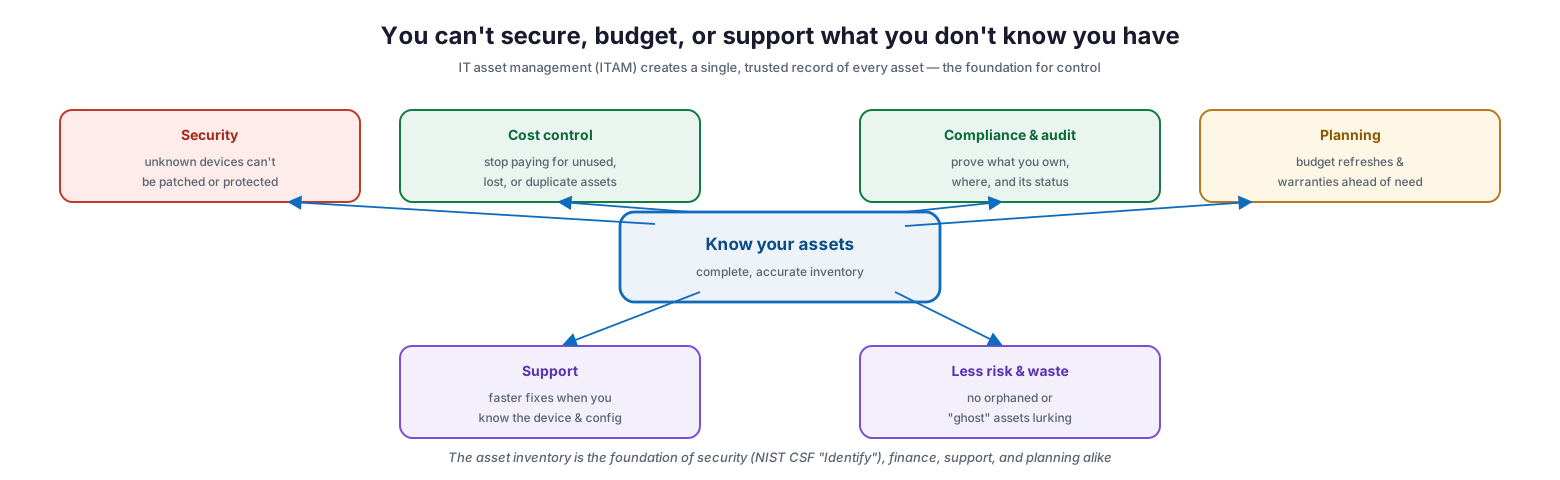
You can’t secure, budget, or support what you don’t know you have
Knowing your assets — maintaining a complete, accurate inventory — is the foundation on which several disciplines rest. Security depends on it, because unknown devices cannot be patched or protected; this is why maintaining a hardware and software inventory is the first function in most security frameworks. Cost control depends on it, to stop paying for unused, lost, or duplicate assets. Compliance and audit depend on it, to prove what you own, where, and its status. Planning depends on it, to budget refreshes and warranties ahead of need. Support depends on it, delivering faster fixes when the device and its configuration are known. And risk and waste are reduced by it, because no orphaned or “ghost” assets are left lurking. The asset inventory is not a clerical nicety; it is the shared foundation of security, finance, support, and planning alike, which is why building and maintaining it is the single highest-leverage move in IT operations.
The IT Asset Lifecycle
ITAM is not a one-time inventory but the management of each asset through its whole life. Tracking the lifecycle captures the cost, status, and ownership of every asset at each stage, and ensures nothing is lost, forgotten, or disposed of carelessly.
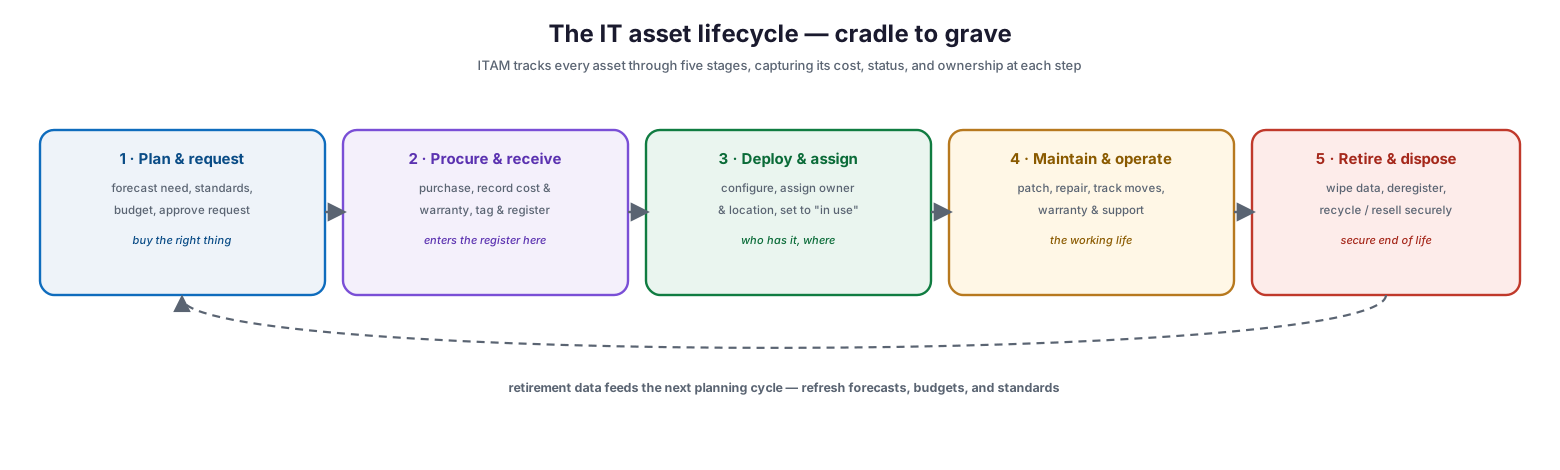
The IT asset lifecycle — cradle to grave
The lifecycle runs through five stages. Plan and request is where need is forecast, standards are set, budget is allocated, and a request is approved — buying the right thing. Procure and receive is where the asset is purchased, its cost and warranty recorded, and it is tagged and entered into the register; this is the moment it becomes a tracked asset. Deploy and assign configures the asset, assigns an owner and location, and sets its status to in use. Maintain and operate covers the working life — patching, repair, tracking moves, and managing warranty and support. And retire and dispose is where data is wiped, the asset is deregistered, and it is recycled or resold securely. Crucially, retirement is not the end of the process but feeds the next planning cycle: the data from disposals informs refresh forecasts, budgets, and standards, which is why the lifecycle is a loop rather than a line.
| Stage | Key activities | Register state |
|---|---|---|
| Plan & request | Forecast, standards, budget, approve | (Pre-asset) |
| Procure & receive | Purchase, record cost/warranty, tag, register | Enters the register |
| Deploy & assign | Configure, assign owner & location | In use |
| Maintain & operate | Patch, repair, track moves, warranty | In use (updated) |
| Retire & dispose | Wipe data, deregister, recycle/resell | Disposed / closed |
Building a Reliable Asset Register
At the centre of ITAM is the asset register — the single source of truth. Its value depends entirely on being accurate and complete, which means having the right fields and, above all, keeping them current through automation and process rather than heroic manual effort.
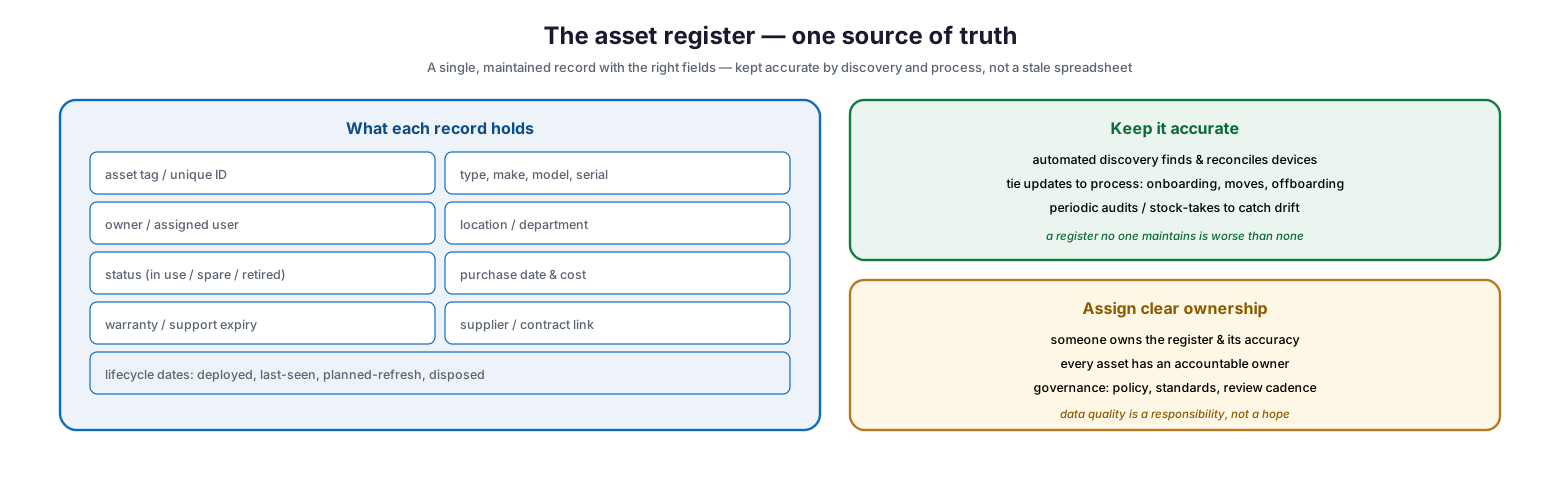
The asset register — one source of truth
Each record should hold the essentials: an asset tag or unique ID; type, make, model, and serial number; the owner or assigned user; location or department; status (in use, spare, retired); purchase date and cost; warranty or support expiry; the supplier and contract link; and lifecycle dates such as deployed, last-seen, planned-refresh, and disposed. But fields alone do not make a register useful — accuracy does. Automated discovery finds and reconciles devices on the network, updates are tied to processes like onboarding, moves, and offboarding, and periodic audits or stock-takes catch the inevitable drift. A register that no one maintains is worse than none, because it breeds false confidence. Equally important is ownership: someone must own the register and be accountable for its accuracy, every asset should have an accountable owner, and governance — policy, standards, and a review cadence — must be in place. Data quality is a responsibility, not a hope.
| Field group | Examples |
|---|---|
| Identity | Asset tag/ID, type, make, model, serial |
| Assignment | Owner/user, location, department, status |
| Financial | Purchase date, cost, supplier, contract |
| Support | Warranty/support expiry, maintenance history |
| Lifecycle | Deployed, last-seen, planned-refresh, disposed dates |
The Critical End-of-Life Stage
The stage of the lifecycle most likely to cause a security incident is the last one. A retired device is still full of company data, and disposing of it carelessly is a well-documented cause of breaches. Secure IT asset disposition (ITAD) protects data, the environment, and the integrity of the record.
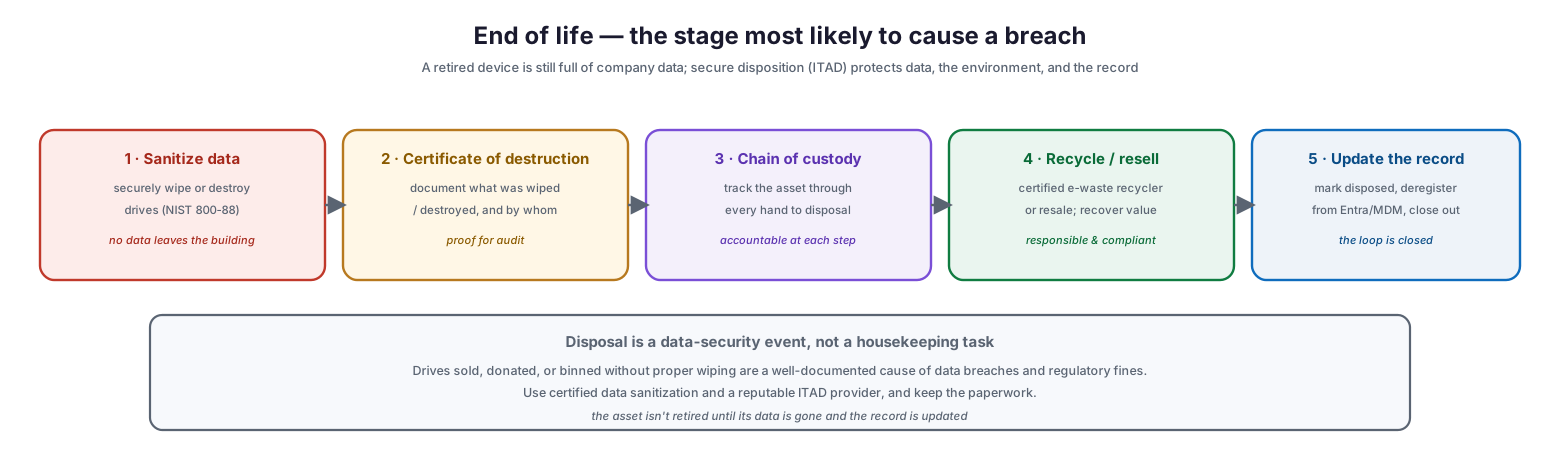
End of life — the stage most likely to cause a breach
Secure disposal follows five steps. First, sanitize the data — securely wipe or physically destroy drives following a recognized standard, so no data leaves the building. Second, obtain a certificate of destruction — documenting what was wiped or destroyed and by whom, as proof for audit. Third, maintain chain of custody — tracking the asset through every hand until final disposal, so it is accountable at each step. Fourth, recycle or resell responsibly — through a certified e-waste recycler or resale channel, recovering value while staying compliant. Fifth, update the record — marking the asset disposed, deregistering it from identity and management systems, and closing it out. The overarching point is that disposal is a data-security event, not a housekeeping task. Drives sold, donated, or thrown away without proper wiping have caused real data breaches and regulatory fines. Using certified data sanitization and a reputable ITAD provider — and keeping the paperwork — is essential, and an asset is not truly retired until its data is gone and the record is updated.
ITAM, SAM, and the CMDB
ITAM sits alongside two related disciplines that are frequently confused with it, and understanding the boundaries prevents effort from being either duplicated or dropped between them.
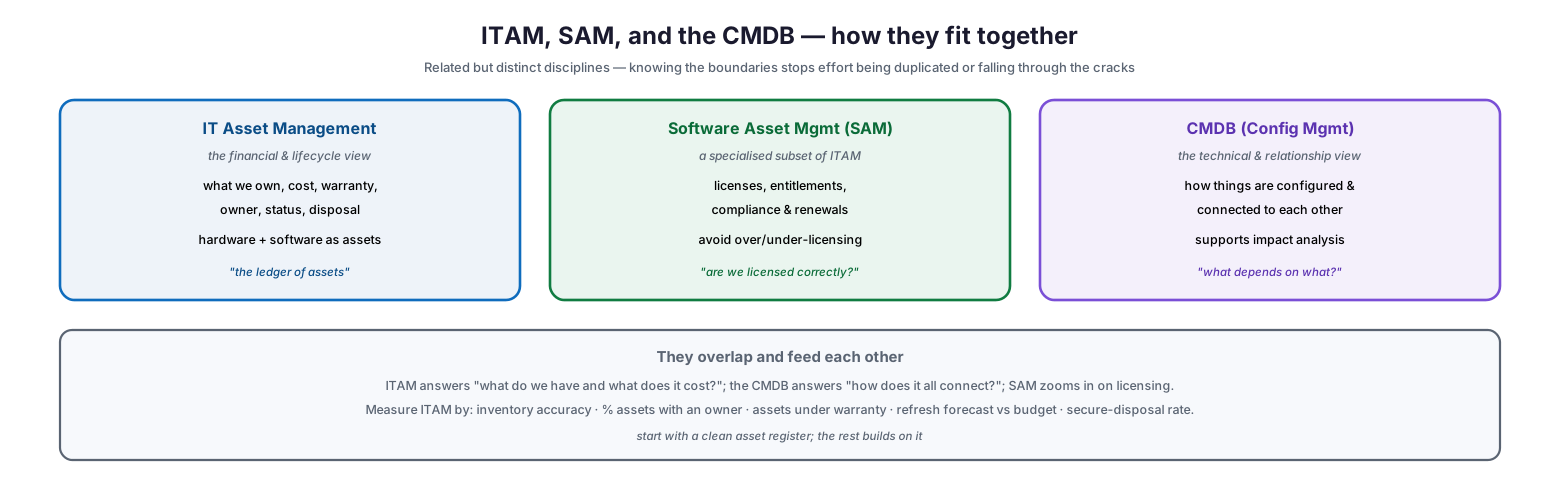
ITAM, SAM, and the CMDB — how they fit together
IT asset management is the financial and lifecycle view — what we own, its cost, warranty, owner, status, and disposal — covering both hardware and software as assets; it is, in effect, the ledger of assets. Software asset management (SAM) is a specialized subset of ITAM focused on licenses, entitlements, compliance, and renewals, answering the question “are we licensed correctly?” and avoiding both over- and under-licensing. The configuration management database (CMDB) is the technical and relationship view — how things are configured and connected to each other — supporting impact analysis and answering “what depends on what?” These overlap and feed each other: ITAM answers what you have and what it costs, the CMDB answers how it all connects, and SAM zooms in on licensing. The practical starting point for any organization is a clean asset register, because both SAM and the CMDB build on knowing what assets exist in the first place. ITAM is measured by inventory accuracy, the percentage of assets with an owner, assets under warranty, refresh forecast against budget, and secure-disposal rate.
| Discipline | View | Answers |
|---|---|---|
| IT Asset Management (ITAM) | Financial & lifecycle | What do we own, what does it cost, who has it? |
| Software Asset Management (SAM) | Licensing (subset of ITAM) | Are we licensed correctly? |
| Configuration Management (CMDB) | Technical & relationships | How is it configured and what depends on what? |
IT Asset Management Checklist
- Build a single asset register as the source of truth for all IT assets.
- Capture the essential fields: identity, assignment, financial, support, and lifecycle data.
- Assign an accountable owner to the register and to every asset.
- Use automated discovery to find and reconcile devices, supplemented by audits.
- Tie register updates to processes: onboarding, moves, and offboarding.
- Track every asset through the full lifecycle from planning to disposal.
- Record cost, warranty, and support expiry to enable financial and refresh planning.
- Forecast refreshes and budget for them ahead of need using lifecycle data.
- Treat disposal as a security event: sanitize data, keep certificates, maintain chain of custody.
- Use certified data sanitization and a reputable ITAD provider; deregister disposed assets.
- Coordinate ITAM with SAM (licensing) and the CMDB (relationships).
- Measure inventory accuracy, ownership coverage, warranty coverage, and secure-disposal rate.
Best Practices
Start with a clean register. Everything in ITAM — and much in security, finance, and support — depends on an accurate inventory. Build one, make it the single source of truth, and invest in keeping it current.
Automate discovery, enforce process. A register kept up to date by hand will drift. Use automated discovery to find devices, and tie every change of state to a process — onboarding, moves, offboarding — so the record stays true to reality.
Own the data. Assign clear accountability for the register’s accuracy and for each asset. Data quality does not maintain itself; it needs an owner, governance, and a review cadence.
Manage the whole lifecycle. Track assets from planning through disposal, not just at purchase. Lifecycle data is what enables refresh forecasting, warranty management, and secure end-of-life handling.
Treat disposal as a data-security event. Never let a device leave without certified data sanitization, a certificate of destruction, chain of custody, and a record update. Careless disposal is a leading, avoidable cause of breaches.
Connect ITAM to SAM and the CMDB. Coordinate the financial/lifecycle view with software licensing and configuration relationships, so the disciplines reinforce rather than duplicate each other.
Common Mistakes
Relying on a stale spreadsheet. An out-of-date, manually maintained list gives false confidence and misses exactly the assets that matter. Use discovery and process to keep the register real.
No clear ownership. When no one is accountable for the register or for individual assets, accuracy erodes and assets go missing. Ownership is essential to data quality.
Tracking only at purchase. Recording an asset when it is bought but never updating its status, location, or disposal leaves the register increasingly wrong over time.
Insecure disposal. Selling, donating, or binning devices without proper data wiping is a well-documented cause of breaches and fines. Disposal must be treated as a security process.
Ignoring warranties and refreshes. Without lifecycle data, warranties lapse unnoticed and hardware runs long past its supported life, driving up failures and emergency spend.
Confusing ITAM with the CMDB. Treating the two as the same thing leads to gaps: the financial and lifecycle view is neglected in favour of technical relationships, or vice versa. They are distinct and complementary.
Frequently Asked Questions
What is IT asset management? ITAM is the practice of tracking and managing an organization’s IT assets — hardware and software — across their entire lifecycle, from planning and procurement through deployment and maintenance to secure disposal, including their financial, contractual, and inventory details.
Why is an asset inventory so important? Because you cannot secure, budget for, support, or prove compliance for assets you do not know you have. An accurate inventory is the foundation of security (it is the first function in most security frameworks), cost control, and planning.
What is the difference between ITAM and a CMDB? ITAM is the financial and lifecycle view — what you own, its cost, ownership, and status. A CMDB (configuration management database) is the technical and relationship view — how components are configured and connected. They overlap and complement each other.
What is the difference between ITAM and SAM? Software asset management (SAM) is a specialized subset of ITAM focused specifically on software licenses, entitlements, and compliance. ITAM covers all assets, hardware and software, across their lifecycle; SAM zooms in on getting licensing right.
How do we keep the asset register accurate? Combine automated discovery to find and reconcile devices with process discipline — updating the register during onboarding, moves, and offboarding — and periodic audits to catch drift. Assign clear ownership so accuracy is someone’s responsibility.
How should we dispose of old IT equipment? Treat it as a data-security event: securely sanitize or destroy the data using a recognized standard, obtain a certificate of destruction, maintain chain of custody, use a certified recycler or resale channel, and update the asset record and deregister the device.
Conclusion
IT asset management turns the vague, uncomfortable question of “what do we actually have?” into a confident, accurate answer — and that answer is the foundation of well-run IT. A single, trusted asset register underpins security, because you can only protect what you know exists; it underpins cost control, compliance, support, and planning; and it eliminates the orphaned, ghost, and forgotten assets that carry both risk and waste. Managing each asset through its full lifecycle, from deliberate planning to secure disposal, ensures that the record stays true and that value is captured at every stage.
The path to good ITAM is practical. Build a clean register with the right fields, keep it accurate through automated discovery and disciplined process, assign clear ownership, and manage the whole lifecycle — paying particular attention to the end-of-life stage, where careless disposal turns a retired laptop into a breach. Coordinate ITAM with software asset management and the configuration management database so the disciplines reinforce each other, and measure the things that matter: inventory accuracy, ownership, warranty coverage, and secure disposal. Do that, and IT gains the visibility and control that every other operational discipline depends on.
References
- ISO/IEC 19770-1 — IT Asset Management systems
- ITIL 4 — IT Asset Management practice (overview)
- NIST Cybersecurity Framework — Asset Management (Identify)
- NIST SP 800-88 Rev. 1 — Guidelines for Media Sanitization
- CIS Controls — Inventory and Control of Enterprise Assets
- IAITAM — International Association of IT Asset Managers
- NIST SP 800-53 — Configuration Management (CM) control family