Insights · Security
The Evolution of Cybersecurity: How AI-Powered Attackers Compare to Human Hackers
A San Diego and Irvine cybersecurity perspective on how AI-driven cyberattacks differ from traditional human hackers — and what local businesses, IT leaders and CISOs in Southern California should do about it in 2026.
9 min readPublished
- Content owner
- Insyto Content Team
- Editorial reviewer
- Ritesh Mhatre
- Technical reviewer
- Navish Ansari
- Next review
- To be scheduled
- Last reviewed
- Review pending
- Technical level
- Intermediate · CIO, CISO, Business Owner
Key Insight: AI-driven attacks unfold in hours, not weeks — local SMBs need behavior-based defenses now
Why this comparison matters right now for San Diego and Irvine businesses
Cybersecurity has changed more in the last five years than in the previous twenty. From biotech firms in Sorrento Valley and Torrey Pines to fintech and SaaS companies along the Irvine Spectrum, Southern California security teams used to plan their defenses around a fairly predictable opponent: a human attacker, working alone or in a small group, probing systems with scripts, phishing kits and patience. That world still exists, but it now shares the stage with something faster, cheaper to scale and far less tired — autonomous and AI-assisted attack tools.
Understanding the real differences between human-driven attacks and AI-driven attacks isn't an academic exercise. For a healthcare provider in La Jolla, a manufacturer in Otay Mesa or a financial services firm in Newport Beach, it directly shapes how the organization should budget for cybersecurity tools, train employees and prioritize incident response. This article breaks down that comparison in practical terms so security leaders, IT teams and small business owners across San Diego County and Orange County can make informed decisions instead of reacting to headlines.
A quick history: from lone hackers to algorithmic adversaries
The human-hacker era. For decades, cybercrime followed a recognizable pattern. A human attacker would research a target, craft a phishing email or exploit a known vulnerability, and manually adapt when something didn't work. Skill, creativity and social manipulation were the attacker's main weapons. Organizations responded with firewalls, antivirus signatures and employee awareness training — defenses built around catching a person making a mistake.
The shift toward automation. Automation entered the picture gradually: botnets, credential-stuffing scripts and exploit kits let one person launch attacks at a scale no individual could manage manually. This was the first real step away from purely human-paced cybercrime, though the underlying decision-making was still scripted by a person, not generated dynamically.
The AI-driven present. What's different now is adaptive intelligence. Modern AI-assisted attack tools can generate convincing phishing content in seconds, write polymorphic malware that rewrites its own code to dodge detection and probe a network's defenses far faster than any human red team. The attacker is no longer just automating tasks — the system is making decisions, adjusting tactics and learning from failed attempts in near real time.
Human attackers vs AI models: a side-by-side breakdown
Speed and scale. A skilled human attacker might spend days or weeks researching a single target. AI-driven tools can scan thousands of systems, identify vulnerable configurations and generate tailored attack payloads in a fraction of that time. Speed has become one of the clearest dividing lines in modern cybersecurity threat analysis — what used to be a weeks-long campaign can now unfold in hours.
Creativity vs pattern recognition. Human attackers bring genuine creativity to social engineering. They read tone, exploit organizational politics and improvise when a pretext starts to fail. AI models, by contrast, excel at pattern recognition and recombination — generating thousands of phishing variations, testing which subject lines get the highest open rates and refining based on results. The human edge is improvisation; the AI edge is relentless, parallel experimentation.
Detection evasion. This is where AI-powered cyberattacks have raised the stakes considerably. Traditional signature-based antivirus tools were built to catch known malware patterns. AI-generated malware can alter its own structure on each deployment, making static signatures far less effective. Human attackers manually obfuscate code; AI systems can do it continuously and automatically, which is a major reason San Diego and Irvine security vendors have shifted toward behavior-based and machine-learning threat detection rather than signature matching alone.
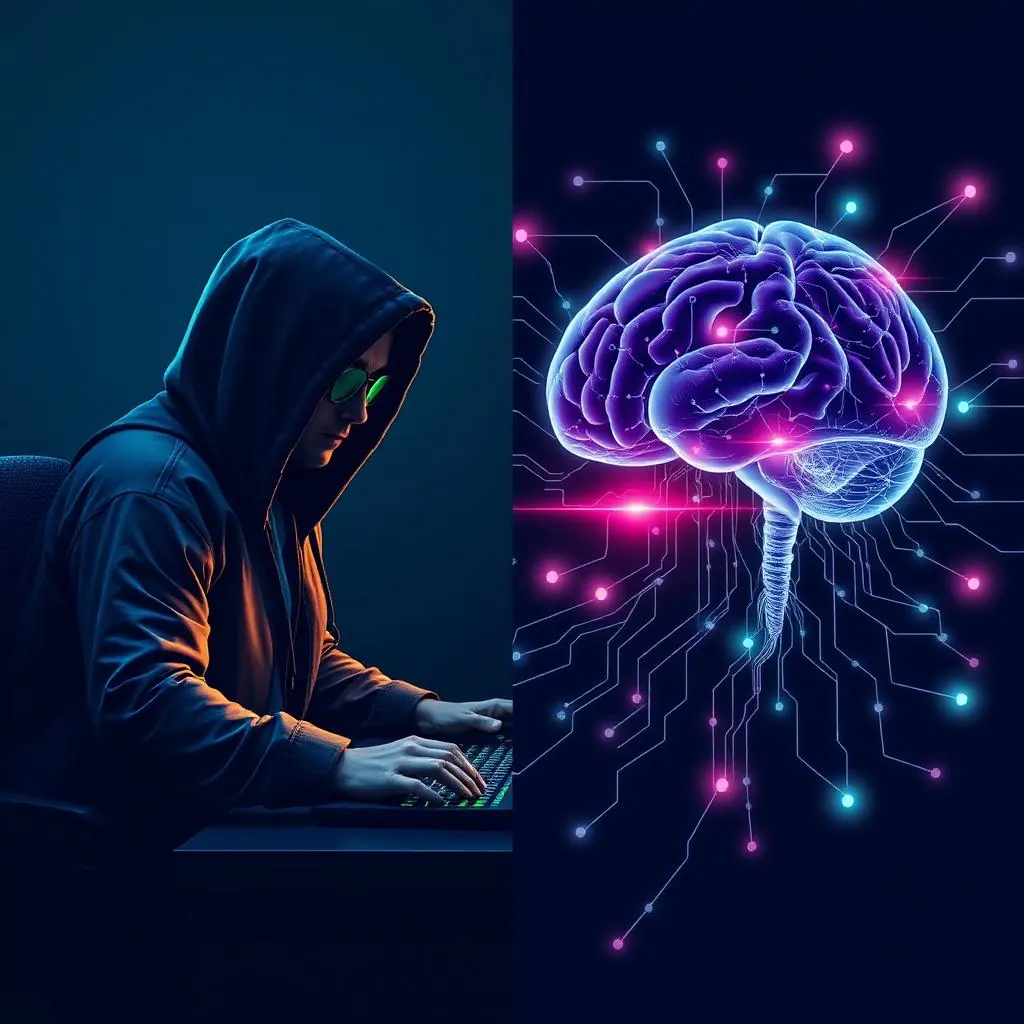
Social engineering, deepfakes and the cost of accessibility
Social engineering and deepfake risk. Perhaps the most unsettling evolution is in social engineering. Human attackers built trust through scripted phone calls and emails. AI now enables voice cloning and deepfake video convincing enough to impersonate executives in real time — a tactic increasingly used in business email compromise and wire-fraud schemes targeting CFOs and finance teams at mid-market companies in San Diego, Carlsbad, Irvine and Newport Beach. This blurs the line between 'phishing' and 'impersonation' in ways traditional security awareness training wasn't originally designed to address.
Cost and accessibility. Hiring a skilled human hacker, or building an in-house criminal operation, takes time, trust and money. AI-driven attack frameworks are increasingly available as off-the-shelf criminal tooling, lowering the technical bar for entry. This democratization of capability is one of the most significant cybersecurity trends shaping risk assessments for small and mid-sized businesses across Southern California — not just the Fortune 500.
How AI is also strengthening cyber defense in Southern California SOCs
It would be incomplete to frame AI purely as a threat. The same capabilities fueling AI-powered attacks are being mirrored in defense across managed security service providers (MSSPs) and security operations centers in San Diego and Irvine:
• Machine learning threat detection systems flag anomalous network behavior far faster than manual log review.
• AI-driven Security Information and Event Management (SIEM) platforms — Microsoft Sentinel, Splunk, CrowdStrike Falcon — correlate millions of events to surface the handful that matter.
• Automated incident response (SOAR) can isolate compromised endpoints within seconds of detection, rather than waiting on a human analyst to notice and act.
The practical takeaway: AI vs AI is becoming as relevant as AI vs human in modern security operations. The organizations adapting fastest are pairing automated detection with human judgment for final decision-making, rather than choosing one over the other entirely.
What this means for San Diego and Irvine businesses and security teams
Organizations evaluating their cybersecurity posture in 2026 should treat this evolution as a planning input, not a buzzword. A few practical implications worth weighing — especially for healthcare, life sciences, financial services, fintech, SaaS and manufacturing leaders across San Diego County and Orange County:
• Security awareness training needs to account for deepfake and voice-cloning scenarios, not just text-based phishing.
• Endpoint and network defenses should prioritize behavior-based detection over purely signature-based tools, since polymorphic and AI-generated malware is built specifically to slip past static rules.
• Incident response plans benefit from automation for speed, but should retain human review for high-stakes decisions, since AI systems can also be manipulated or produce false positives.
• Vendor and managed cybersecurity services risk assessments should now include questions about how a security tool handles AI-generated threats specifically, not just traditional malware signatures.
• Compliance frameworks — HIPAA for La Jolla and Irvine healthcare providers, PCI-DSS for retailers, CPRA for any California business handling consumer data, SOC 2 for SaaS — should be re-mapped to AI-era threat models.
Frequently asked questions about AI vs human cyberattacks
Is AI making cyberattacks more dangerous than human hackers? AI doesn't replace the human attacker; it amplifies what one person or small group can accomplish. The danger isn't that AI is 'smarter' than a skilled hacker in every sense, but that it removes the time and scale limitations that used to constrain attacks.
Can AI-based security tools fully replace human security analysts? Not currently. AI is highly effective at detection and pattern recognition at scale, but context, judgment calls and handling novel or ambiguous incidents still benefit significantly from human expertise — which is why San Diego and Irvine SOC teams still pair AI tooling with experienced analysts.
What industries in San Diego and Irvine are most affected by AI-driven cybersecurity threats? Financial services, healthcare and life sciences, biotech, defense contractors, fintech and any business handling sensitive customer data face elevated risk, largely because these sectors are high-value targets for both automated credential theft and AI-generated phishing campaigns.
Does my small business in San Diego or Irvine really need AI-aware cybersecurity? Yes. Off-the-shelf AI attack tooling means a 25-employee firm in Carlsbad or Irvine faces the same class of automated phishing and credential-stuffing campaigns as a Fortune 500 enterprise — without the same in-house security team. Managed detection and response (MDR) is often the most cost-effective answer.
Final thoughts — and your next step with Insyto in San Diego and Irvine
The story of cybersecurity evolution isn't really 'humans versus AI.' It's a shift in tempo and scale, where human creativity in social engineering now operates alongside machine-speed automation on both the attacking and defending sides. Businesses across San Diego, La Jolla, Carlsbad, Sorrento Valley, Irvine, Newport Beach and the wider Southern California region that understand this distinction — and adjust their training, tools and incident response plans accordingly — will be far better positioned than those still defending against yesterday's threat model.
Insyto is a Valley Center-based cybersecurity and Microsoft 365 consulting firm helping SMBs and enterprises deploy Zero Trust architecture, AI-aware threat detection, Microsoft Defender XDR, Sentinel SIEM and managed detection and response (MDR).
Related services and resources:
• Zero Trust Cyber Security — /services/consulting-services/cybersecurity-zero-trust-assessment
• AI Security & Governance — /services/consulting-services/ai-governance-security-consulting
• Cloud & Endpoint Security — /services/professional-services/defender-sentinel-implementation
• Managed M365 Services — /services/managed-services/microsoft-365-managed-services
• Managed Security Services — /services/managed-services/managed-security-services
• IT Services Packages in San Diego — /managed-it-services-san-diego
Have questions about strengthening your organization's defenses against AI-driven threats? Reach out to discuss a tailored cybersecurity assessment for your business in San Diego, Irvine or anywhere in Southern California.
Want to discuss this topic with our team?
Book a confidential executive briefing to explore how these insights apply to your organisation.
Book Executive Briefing